

/images/ppid_a911dc6a-image-177071104548613514.webp)

Anti-pollution restrictions under Stage 3 of the Graded Response Action Plan (GRAP-3) were invoked in Delhi on Saturday after the city’s air quality deteriorated to the “severe” category, officials said.
In the early hours of Saturday, Delhi recorded an overall Air Quality Index (AQI) of 390, which comes under the ‘very poor’ quality.
The GRAP-3 curbs include a ban on non-essential construction and demolition work, as well as stone-crushing and mining activities. Older diesel goods vehicles are barred from entering Delhi, schools up to Class 5 shift to a hybrid mode, and offices in the Delhi-NCR may operate with only 50 per cent staff.
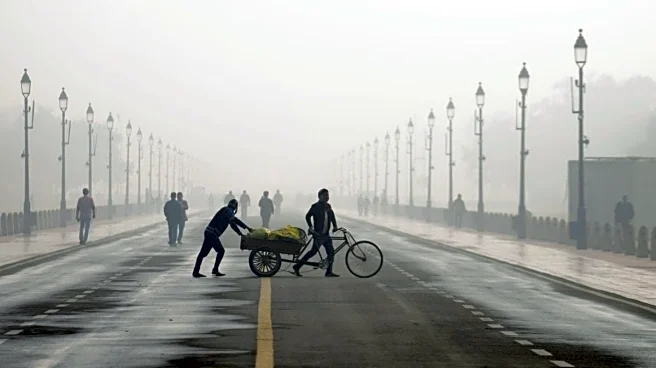
Several parts of the national capital remained enveloped in a dense layer of toxic smog, severely affecting visibility
and causing discomfort to residents.
According to the Central Pollution Control Board, the AQI in areas like Anand Vihar, ITO, and Akshardham has crossed the 400 mark. The AQI around the ITO area is recorded at 417; near the Akshardham area, it is 419.
According to the Air Quality Early Warning System, the pollution will remain in the ‘severe’ category today.
Amid low visibility due to fog, the Delhi airport issued an advisory on X and stated, “Low Visibility Procedures are in progress at Delhi Airport. All flight operations are presently normal. Passengers are requested to contact the airline concerned for updated flight information.”
The CPCB classifies an AQI between 0 and 50 as ‘good’; 51 and 100, ‘satisfactory’; 101 and 200, ‘moderate’; 201 and 300, ‘poor’; 301 and 400, ‘very poor’; and 401 and 500, ‘severe’.


/images/ppid_59c68470-image-177071258499638831.webp)

/images/ppid_59c68470-image-177071261217943838.webp)
/images/ppid_59c68470-image-177071254659065233.webp)





/images/ppid_a911dc6a-image-177071187085537069.webp)


/images/ppid_a911dc6a-image-177071163812861919.webp)