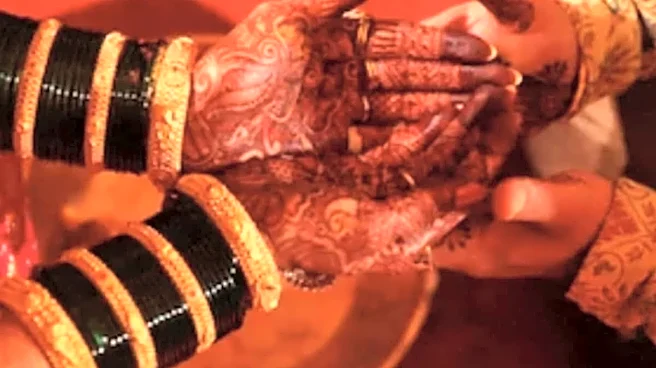

Even as Bengaluru sells itself as a global city, a 16-year-old girl was married off in the heart of the state capital earlier this week, exposing how deeply child marriage continues to persist across Karnataka.
On December 10, the KR Puram police booked the owner of a wedding hall, the parents of a minor girl, her 20-year-old groom and his parents for facilitating the child marriage. The incident took place at Crown Palace Wedding Hall, well within city limits.
The case came to light after officials received an alert through Childline, the national helpline run by the Ministry of Women and Child Development. Acting on the information, Shivaprasad Yadav of the District Child Protection Unit procured the girl’s birth certificate from her school and approached the police.
According to the FIR, the girl was 16 years and seven months old at the time of marriage, making it a clear violation of the Prohibition of Child Marriage Act. Police have named the wedding hall owner as Accused No.1, the groom and his parents as Accused No.2, and the minor girl’s parents as Accused No.3.
An official, who also works as an informant when it comes to detecting and exposing such child marriages, told News18 that there has been a steady rise in complaints, reflecting growing awareness.
However, several activists warn that official figures understate the problem, as many child marriages never reach police or helplines due to fear, stigma and family pressure. Poverty, caste considerations, lack of access to education and rigid gender roles continue to drive the practice.
“The thing is that even as more people come forward with information, detection has been higher, but mindset of people has not changed. They claim that they are doing it under social pressure. Where is the education that they received going then? While it becomes easier for officials to intervene and stop child marriages, the fact it has not seen a major downtrend is upsetting,” the official said.
During the investigation in the KR Puram case, police found that the girl’s elder sister had allegedly forced the marriage, believing it would ward off “ghosts” said to be troubling the girl—highlighting the role of superstition and social pressure in such cases.
The Bengaluru case mirrors a wider pattern across the state. Data from the Women and Child Development department shows that Karnataka recorded 8,355 attempted child marriages over the past three years, of which 2,198 were actually solemnised.
Even Bengaluru is not immune. The city has recorded 28 child marriages this year, while Bengaluru Rural district receives around 40 complaints annually. Districts such as Kolar, Mandya, Tumakuru and Chitradurga continue to report frequent cases, indicating that urbanisation has not weakened entrenched social practices.
Presenting data in the Assembly, Women and Child Development minister Laxmi Hebbalkar said that 564 child marriages had taken place in Karnataka in 2025 alone, up to the end of October. During this period, 2,623 complaints were received and 2,059 marriages were prevented through intervention.
In 2024, the state received 3,127 complaints, prevented 2,323 marriages, but still recorded 804 child marriages. Between 2023 and October 2025, officials said 6,157 minors were rescued, and FIRs were filed in 2,170 cases.
The government has appointed nearly one lakh Child Marriage Prohibition Officers across the state and directed panchayat development officers to monitor weddings. It has also announced an annual Rs 25,000 incentive for gram panchayats that report zero child marriages.
District-wise data shows mixed results. Mysuru reported 142 complaints between January and October 2025, of which 123 marriages were prevented, with only 19 cases going through. Mandya recorded a sharp decline, with cases dropping to 25 this year, compared to over 80 in the previous two years.
/images/ppid_a911dc6a-image-177104210287325129.webp)

/images/ppid_a911dc6a-image-177104202793221357.webp)
/images/ppid_a911dc6a-image-177104206710214315.webp)
/images/ppid_a911dc6a-image-177104202907093694.webp)
/images/ppid_59c68470-image-177104014803952296.webp)

/images/ppid_59c68470-image-177104006389961167.webp)
/images/ppid_a911dc6a-image-177103853218557950.webp)



/images/ppid_a911dc6a-image-17710364781122582.webp)