
/images/ppid_59c68470-image-177071258499638831.webp)
For almost 20 years, India and the European Union have negotiated in fits and starts, but the talks have never reached the level of urgency seen now.
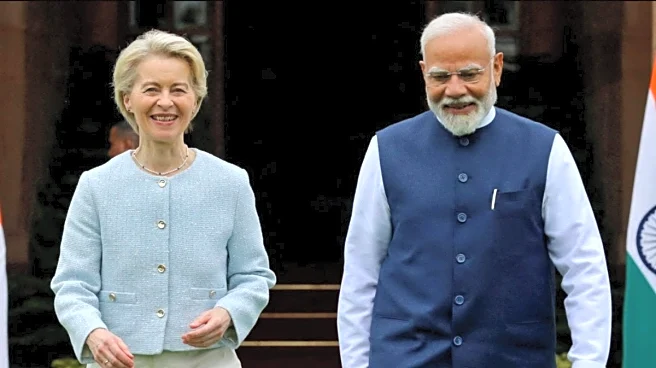
Speaking at the World Economic Forum in Davos, European Commission President Ursula von der Leyen said both sides were nearing the endgame. “There is still work to do. But we are on the cusp of a historic trade agreement. Some call it the mother of all deals,” she said. Her remarks captured both the scale of the envisioned partnership and the geopolitical context in which the negotiations have accelerated.
The EU is already India’s largest trading partner for goods, and the proposed free trade agreement stretches well beyond tariff cuts. It aims to create a more predictable environment for goods, services,
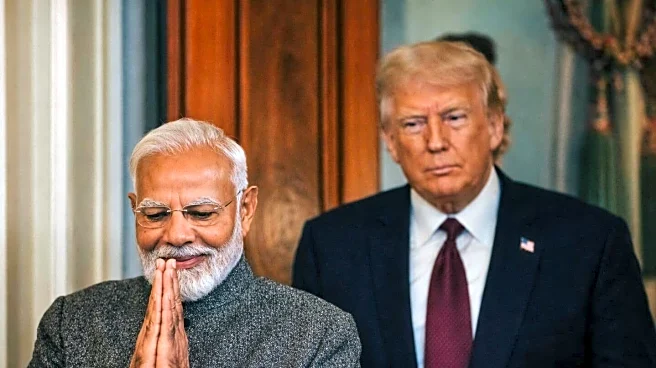
investment, standards, and emerging-technology cooperation. India, meanwhile, is contending with rising trade friction with the United States, particularly under President Donald Trump’s tariff-heavy approach.
With the India–EU Summit scheduled for 27 January, negotiators have been attempting to close the remaining chapters at a pace that would have seemed improbable a decade ago.
Why Is The Proposed Pact Being Called The ‘Mother Of All Deals’?
The India–EU free trade agreement is unmatched in scale. Von der Leyen’s characterisation reflects the size of the combined market — nearly two billion people — and an economic footprint close to one-quarter of global GDP.
Commerce Minister Piyush Goyal has repeatedly stressed the magnitude of what is being negotiated. “We have done FTA deals with seven developed countries so far. This one will be the mother of all. It will cover two of the world’s most powerful economies,” he said.
What elevates the agreement further is its breadth. Beyond tariff reduction, the pact includes cooperation on services, technology flows, regulatory standards, digital rules and investment protections. As global supply chains continue to reorganise, a deal of this nature would position both sides at the centre of new trade and production linkages.
How Did Negotiations Reach This Point After Years Of Gridlock?
The first attempt began in 2007 under what was then called the Broad-based Trade and Investment Agreement. Multiple rounds were held between 2007 and 2013, but differences over tariffs, intellectual property, data security, labour and environmental standards, and market access eventually stalled the process.
After years of minimal movement, negotiations were relaunched in 2022 with renewed political commitment. The pandemic’s disruption of supply chains and rising global uncertainty created conditions for both sides to revisit earlier positions. The revived talks progressed more quickly, aided by parallel engagement under the India–EU Trade and Technology Council, which allowed negotiators to address digital standards and technology-policy issues that had previously slowed progress.
According to a Moneycontrol report, 20 of the 24 negotiating chapters have already been closed. Commerce Secretary Rajesh Agrawal has echoed this momentum, saying, “We expect to conclude the talks and have the deal ready,” and noting that the final stages would be decisive.
Why Does The Moment Matter For India?
India’s trade relationship with the United States has become increasingly strained. Disputes over agricultural access, particularly American pulses, have resurfaced as flashpoints. US lawmakers have pressed India to lower tariffs, but New Delhi has insisted that protecting farmers is a red line. India has also faced tariff threats linked to its energy ties with Iran, including a 25 per cent duty warning that has unsettled exporters of tea, basmati rice and other goods.
These tensions have slowed progress toward any meaningful India–US trade breakthrough. In this climate, the EU provides a more stable, rules-based partner at a moment when India is seeking diversification in its external economic relationships. Goods trade between India and the EU reached €120 billion in 2024, according to a report by The Economic Times, while India’s own statistics show exports of $75.85 billion and imports of $60.68 billion in 2024–25. Services trade is estimated at around €60 billion, driven largely by IT and digital services.
With global protectionism rising, the India–EU pact offers scale, market security and strategic balance — all factors that align with India’s long-term trade posture.
What Does India Stand To Gain From The Agreement?
India’s largest immediate gains would accrue to labour-intensive sectors. Exports such as textiles, garments, leather goods and marine products currently face EU tariffs of roughly 2 to 12 per cent. Reduced or eliminated duties would significantly improve competitiveness against exporters from countries with preferential EU access.
Higher-value sectors could also see notable advantages. Pharmaceuticals and chemical products — two of India’s major export pillars — would benefit from clearer regulatory pathways and recognition of standards, helping generics and specialty chemicals move more efficiently into the European market. India’s exports of machinery, petroleum products and electrical equipment already have a strong foothold in Europe, and tariff reductions would deepen that presence. The agreement also promises wider opportunities for advanced manufacturing, particularly as European firms seek resilient supply chains beyond China.
Crucially, India has maintained its firm stance on agriculture and dairy. According to a Moneycontrol report, the emerging contours of the agreement show that India has not been required to open sensitive agricultural segments, consistent with its long-standing approach to protect domestic farmers.
The question of the EU’s Carbon Border Adjustment Mechanism remains unresolved. CBAM, introduced on 1 October 2023, imposes a levy translating into a 20–35 per cent cost increase for certain imports, potentially affecting Indian shipments of steel, aluminium and cement. India is negotiating transitional arrangements or exemptions, but clarity has not yet been reached.
Mobility for skilled professionals is another key priority for New Delhi. Although politically sensitive within several EU member states, an improved mobility framework would deliver substantial gains for India’s IT, engineering and professional-services sectors.
What Does The EU Gain From The Deal?
The EU sees the agreement as central to its strategy of diversifying away from over-dependence on China while deepening ties with a large, high-growth market. India’s tariffs on wines, spirits and automobiles have long been among the highest in the world, and European industry has pushed for greater access.
European wines and spirits, which often face import duties of 150–200 per cent, would see lower tariffs and simplified certification. This could significantly expand the EU’s footprint in India’s alcoholic beverages market. Luxury carmakers would also benefit if India reduces duties that currently sit between 100 and 125 per cent.
European exporters of machinery, chemicals, medical devices, industrial equipment and electronics — already major contributors to EU–India trade — would gain from smoother regulatory conditions and tariff reductions. Services sectors such as engineering, consulting, telecom and IP-driven industries would also benefit from clearer investment and operating rules.
Beyond trade, the EU is expected to increase investment in India across green hydrogen, renewable energy, digital infrastructure and advanced manufacturing. European companies have invested more than $117 billion in India since 2000, and the agreement is likely to accelerate that trend.
Why Could This Agreement Be A Game Changer For India?
If concluded, the India–EU free trade agreement would reshape India’s external economic landscape in ways few recent trade agreements have. It would link India to the world’s largest trading bloc, secure market access at a time of rising tariff pressures elsewhere, and embed Indian firms more deeply into global supply chains.
The deal would also signal India’s ability to conclude large, complex trade agreements with major economies, a critical marker for future negotiations. In a global environment characterised by fragmentation and protectionism, this agreement offers not only economic opportunities but also strategic stability.
Commerce Secretary Rajesh Agrawal has said India is “very close” to the finishing line. Whether the pact is announced at the upcoming summit or finalised soon after, it would mark a significant step in India–EU economic ties and could reshape how both sides structure trade and investment in the years ahead.




/images/ppid_a911dc6a-image-177071311265874579.webp)

/images/ppid_a911dc6a-image-177071314953421767.webp)
/images/ppid_a911dc6a-image-177071307920887358.webp)
/images/ppid_a911dc6a-image-177071303076331213.webp)