
/images/ppid_59c68470-image-177072253000836336.webp)
/images/ppid_59c68470-image-177071003473193707.webp)
After nearly two decades of drift, hesitation and missed deadlines, India and the European Union finally appear serious about concluding a free trade agreement (FTA). The renewed urgency is not accidental.
It is the product of a rapidly changing global order, aggressive US protectionism under President Donald Trump, and Europe’s growing realisation that overdependence on Washington is no longer sustainable. For India, the moment offers a chance to secure markets, assert strategic autonomy and position itself as a central pillar of a multipolar world.
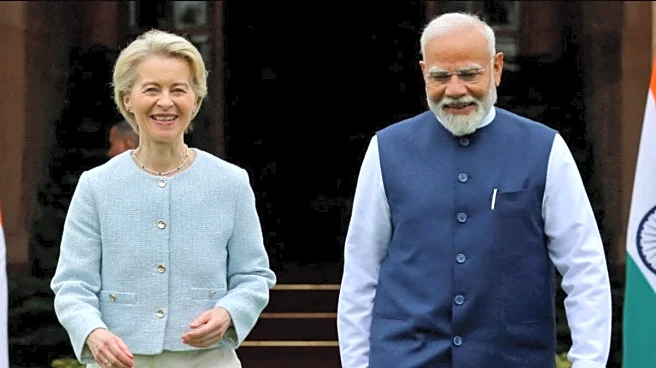
The political signalling could not be clearer. European Commission President Ursula von der Leyen’s description of the proposed deal as “the mother of all deals” at the World Economic Forum, followed
by her decision—along with European Council President Antonio Costa—to attend India’s Republic Day celebrations, is loaded with symbolism.
Republic Day is not just ceremonial pageantry; it is India’s assertion of sovereignty, constitutionalism and strategic independence. For EU leaders to anchor a summit around 26 January is a deliberate acknowledgement of India’s rising geopolitical weight.
This is a far cry from the era when Brussels treated New Delhi largely as a difficult but dispensable negotiating partner. Since talks began in 2007, EU–India trade negotiations have repeatedly stalled over market access, labour mobility, agriculture, automobiles and regulatory standards. For years, Europe lectured India on openness while sheltering its own farmers and industries behind generous subsidies and complex non-tariff barriers.
India, for its part, refused to sacrifice domestic producers at the altar of globalisation, especially after witnessing how free trade devastated manufacturing in parts of the developing world.
What has changed is the context. Trump’s return to aggressive tariff diplomacy, including 50 per cent import duties on Indian goods, has jolted New Delhi into accelerating diversification of trade partnerships. At the same time, Europe faces its own strategic anxieties. From Washington’s transactional worldview to Trump’s provocative rhetoric on Greenland, the transatlantic alliance no longer feels like an unshakeable foundation.
European leaders at Davos spoke openly about “economic independence” and reducing reliance on the United States—language that would have been unthinkable a decade ago.
In this environment, an India–EU FTA is not merely a trade agreement; it is a geopolitical hedge. Analysts are right to frame it as emblematic of an emerging multipolar order, where middle and rising powers seek to band together rather than submit to coercion by superpowers.
As Canadian Prime Minister Mark Carney bluntly put it at Davos, “If you are not at the table, you are on the menu.” India understands this instinctively.
Economically, the upside for India is substantial, though not without caveats. Sectors such as textiles, footwear and pharmaceuticals stand to gain enormously from the elimination of EU tariffs that currently range between 12 and 16 per cent. These industries employ millions of Indians and face stiff competition from countries like Bangladesh and Vietnam, which already enjoy preferential access to European markets. An FTA would level the playing field and provide Indian exporters with a vital alternative as US markets become less predictable.
For Europe, India represents scale, growth and resilience. As EU companies look to de-risk supply chains away from China, India’s vast domestic market, skilled workforce and improving infrastructure make it an attractive partner. Brussels’ recent trade deals with Mexico and Indonesia, and its intensified engagement with New Delhi, signal a broader strategy of hedging against both US unpredictability and Chinese dominance.
Yet the road to a deal remains fraught. The EU’s demand for steep reductions in India’s automobile tariffs—sometimes exceeding 100 per cent for fully built cars—touches a political nerve. India’s domestic auto industry, including its electric-vehicle ambitions under “Make in India”, could be severely disrupted by a flood of European luxury imports. New Delhi’s caution here is justified. Free trade should not become free rein for deindustrialisation.
Similarly, Europe’s Carbon Border Adjustment Mechanism (CBAM) is viewed in India as disguised protectionism cloaked in green rhetoric. By imposing levies on carbon-intensive imports such as steel and cement, the EU risks penalising developing economies that are still balancing growth with environmental transition. For India, which has repeatedly argued for climate equity and differentiated responsibilities, CBAM is a red line that will require careful negotiation.
Agriculture and dairy, predictably, remain non-negotiable for India—and for good reason. With millions of small farmers and producers dependent on these sectors, opening them up to heavily subsidised European competition would be politically and socially reckless. Ironically, the EU’s own farm politics are equally sensitive, exposing the hypocrisy of European demands for openness abroad while protecting vested interests at home.
Where the deal is most likely to succeed is in industrial goods, services and trade facilitation. These areas align with India’s strengths in IT, pharmaceuticals, manufacturing and skilled services, while offering Europe access to a growing market and talent pool. If done right, this economic core could anchor a broader strategic partnership encompassing technology, critical supply chains and selective defence cooperation.
However, expectations must be tempered. Despite lofty rhetoric, the EU remains a fragmented security actor. Defence collaborations will continue primarily at the bilateral level—France with Rafale jets, Germany with submarines—rather than through Brussels. Europe’s discomfort with India’s continued energy and defence ties with Russia further complicates trust on sensitive technologies. An EU–India partnership can complement groupings like the Quad in the Indo-Pacific, but it cannot replace them.
Still, the 27 January summit creates a powerful “deadline effect”. Even an agreement in principle or a strong headline deliverable would signal momentum and intent. In diplomacy, perception matters. By projecting unity and urgency, both sides are telling the world that they are adapting to a harsher, less predictable global reality.
For India, the lesson is clear: strategic autonomy today requires economic leverage. An India–EU free trade agreement, if negotiated on equitable terms, would not be a concession to globalisation but a confident assertion of India’s place in a multipolar order. The world is changing fast. This time, New Delhi seems determined not to be left waiting.
The writer is a technocrat, political analyst, and author. He pens national, geopolitical, and social issues. His social media handle is @prosenjitnth. Views expressed in the above piece are personal and solely those of the author. They do not necessarily reflect News18’s views.
/images/ppid_59c68470-image-177087756975063071.webp)



/images/ppid_59c68470-image-177074753723033180.webp)
/images/ppid_a911dc6a-image-177078725708786992.webp)

/images/ppid_59c68470-image-177074263586952695.webp)