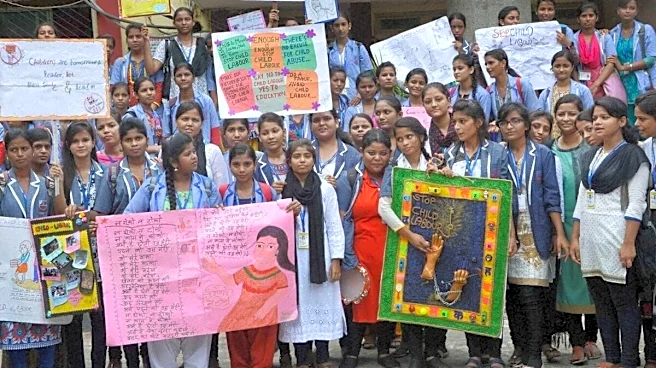




Karnataka’s massive crackdown on child labour, launched after Chief Minister DK Shivakumar’s recent surprise visit to the APMC yard in Yeshwanthpur, where several children were found working, has resulted in hundreds of children being rescued across the state. But child rights experts say the real test begins after the raids — ensuring the rescued children do not return to the same workplaces, addressing the trauma they may have suffered and tackling the family and economic pressures that pushed them into work in the first place.
So far, 529 children have been rescued in Bengaluru and 105 cases registered against employers, while around 800 children have been rescued across Karnataka.
Former CWC Urban chairperson Meena Jain, who works extensively
with children, particularly those who may have been trafficked or forced into child labour, told CNN-News18 that rescue cannot be treated as the end of the process.
“Now that so many children have been rescued, we need to take care of them. We cannot simply leave them, because there is a danger that they will come back into the same situation. The rescued children need to be profiled and we have to ensure that they are not brought back into child labour after they are released.”
Jain said the scale of the operation also highlights the need for interstate coordination, particularly as the rescued children are from several states and Nepal. “First of all, there needs to be an immediate network for interstate coordination, involving the Labour Department and the authorities under the Juvenile Justice Act. Secondly, there has to be proper rehabilitation, and we must ensure that every rescued child is rehabilitated.”
She also urged authorities to examine whether trafficking is involved in at least some cases. “Thirdly, we need to look at the trafficking angle because it is similar to forced child labour. No child would willingly want to work under such circumstances unless their parents have been enticed with money or shown some glamorous picture of a better life.”
But Bengaluru Police Commissioner Seemant Kumar Singh told CNN-News18 that the police have not found a trafficking pattern in the recent raids. “As far as the origin of these children is concerned, it is mixed. They are from other states, but their parents were also there with them, and they seemed to have been involved as well. It is more a question of livelihood, where families are looking for an additional source of income and children are being used as cheap labour.”
Singh said many of the younger children were found working alongside their families. “Most of the children below the age of 14 were found to be with their parents. In many cases, the entire family works and the children also contribute to the family’s income.”
He said the children were mainly found working in hotels, petrol pumps and logistics establishments, with cases falling into two broad categories — those involving children below 14 and those aged 14 to 18. “The nature of the jobs they were doing was mostly in hotels, petrol pumps and logistics establishments. There are two categories — children below 14 and those between 14 and 18 — and the nature of the cases is different in both categories.”
In some cases involving older children, Singh said, their age was allegedly presented as being above 18. “The younger ones were kept away, usually made to do background work, so that they were not in the line of sight,” he explained.
For Jain, however, the economic explanation cannot obscure what happens to the children themselves.“We also need to work with the families, but at the same time, we need to focus on the child, because it is extremely traumatic for these children. Rescue is one thing, but we also need to look at what they have gone through until the point of rescue.”
She asks, “Where is the emotional first aid for these children? Where is the shelter and support they need? They cannot simply be brought to homes and then put through the routine procedures of the CWC. That is not the answer to the problem.”
Jain has appealed for a special panel of former CWC members to immediately examine the needs of the rescued children and submit a report on their rehabilitation to ensure such incidents do not recur.
Karnataka Labour Minister Santosh Lad told CNN-News18 that the crackdowns being conducted regularly are being mapped but cannot be sustained by the Labour Department alone. He also called for greater public participation. “Child labour is not just the responsibility of the Labour Department. The Labour Department works along with the Revenue Department, the Police Department and other departments. All these departments have a role to play in tackling this issue.”
Lad said public awareness is critical because child labour often happens in plain sight. “My appeal to the people is that when you see a child working, we often ignore it. This requires a major awareness campaign. Most of these children may be from outside the state, but that does not matter. This is an issue concerning every citizen, and each and every person should be conscious about it.”
He also appealed to citizens to report violations. “Ultimately, this is a responsibility that rests with every citizen. The moment someone notices a child being employed, they should alert the authorities and come forward to file a complaint.”
Lad said the department was conducting raids, registering cases and mapping locations where child labour is detected. “As a department, we conduct multiple raids and register cases. Wherever such cases are found, the necessary action is taken and the children are brought under the Labour Department’s process. Once the action is completed, the establishment is shut down.”
The figures come after the September 13 statewide operation, during which police and Labour Department officials inspected 16,951 premises across Karnataka and rescued over 800 children in two hours.
Bengaluru accounted for 503 of those rescues, the highest number in the state. Police teams inspected 5,897 premises across 188 police station limits in the city and registered cases under the Child and Adolescent Labour (Prohibition and Regulation) Act, 1986, and the Juvenile Justice Act, 2015.
The children were rescued from establishments including hotels, restaurants, eateries, petrol pumps, grocery stores and warehouses. They came from Karnataka as well as Bihar, Rajasthan, Uttar Pradesh, West Bengal, Assam, Jharkhand and Nepal.
“When we conducted the drive at the APMC, we rescued around 19 children. Once we found that such establishments could be spread across the city, we shortlisted around 67 locations where this kind of labour was likely to be found, particularly labour-intensive establishments, and began conducting checks across all station limits,” the Bengaluru Police Commissioner said.
The police say that with people having become alert, they may not immediately find the same number of cases.
“We will have to adopt a wait-and-watch approach and allow the concerned departments to come forward and take the necessary action,” Singh told News18.


/images/ppid_59c68470-image-178973253208218143.webp)