
/images/ppid_59c68470-image-177060015473030542.webp)
/images/ppid_59c68470-image-177060009386523620.webp)
/images/ppid_59c68470-image-177060003151556696.webp)
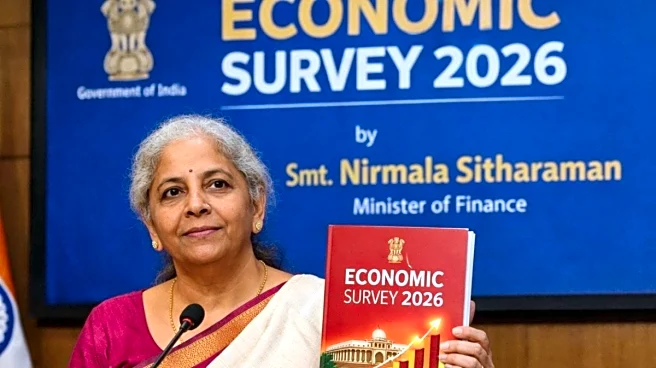
Economic Survey 2026 Key Takeaways: India’s economy is projected to grow 6.8%-7.2% in FY27, according to the Economic Survey 2025-26 tabled in Parliament on January 29, underscoring resilience even as global economic uncertainty persists. Presented by Finance Minister Nirmala Sitharaman, the Survey flagged easing inflation, improved banking-sector health, strong external buffers and a recovery in manufacturing as key supports for the outlook. Key takeaways from the Survey include:
First Advance Estimate Projects Real GDP Growth and GVA Growth for FY26 at 7.4% and 7.3% Respectively
The Economic Survey 2025-26 reaffirmed India’s position as the fastest-growing major economy, with the First Advance Estimates projecting real GDP growth at 7.4 per
cent and Gross Value Added (GVA) growth at 7.3 per cent in FY26. The Survey noted that India’s growth has remained resilient despite a fragile global environment marked by geopolitical tensions, trade fragmentation and financial vulnerabilities.
Growth for India Estimated at Around 7%; FY27 GDP Growth Seen at 6.8-7.2%
India’s medium-term growth potential has been assessed at around 7 per cent, reflecting improvements in productivity, investment and structural reforms. For FY27, the Survey projected real GDP growth in the range of 6.8-7.2 per cent, indicating sustained momentum even as global conditions remain uncertain.
Centre’s Revenue Receipts Rise to 9.2% of GDP in FY25
Fiscal consolidation continued alongside growth, with the Centre’s revenue receipts rising to 9.2 per cent of GDP in FY25 (provisional actuals). The improvement was driven by buoyant non-corporate tax collections and steady expansion of the direct tax base, reflecting better compliance and increased formalisation of the economy, according to the Survey.
GNPAs Reach Multi-Decadal Low of 2.2% in September 2025
India’s banking sector recorded a sharp improvement in asset quality, with the gross non-performing assets (GNPA) ratio falling to a multi-decadal low of 2.2 per cent in September 2025. The Survey highlighted this as evidence of stronger balance sheets, improved risk management and the effectiveness of financial sector reforms.
55.02 Crore Bank Accounts Opened Under PMJDY
Financial inclusion continued to deepen, with 55.02 crore bank accounts opened under the Pradhan Mantri Jan Dhan Yojana (PMJDY) as of March 2025. Of these, 36.63 crore accounts are in rural and semi-urban areas, providing a foundation for direct benefit transfers, savings and credit access.
Unique Investors Cross 12 Crore, Nearly 25% Women
Retail participation in financial markets expanded significantly, with the number of unique investors crossing the 12-crore mark in September 2025. Nearly a quarter of these investors are women, underscoring the widening reach of capital markets and growing financial awareness beyond traditional investor bases, it added.
Exports, Remittances and Services Strengthen External Sector
India’s share of global merchandise exports nearly doubled from 1 per cent in 2005 to 1.8 per cent in 2024. Services exports touched an all-time high of $387.6 billion in FY25, growing 13.6 per cent. India also remained the world’s largest recipient of remittances, with inflows reaching $135.4 billion, providing stability to the external account.
Forex Reserves Rise to $701.4 Billion
Foreign exchange reserves increased to $701.4 billion as of January 16, 2026. The reserves provide import cover of about 11 months and cover nearly 94 per cent of external debt, offering a strong buffer against external shocks.
Domestic Inflation Averages 1.7% During April-December 2025
Retail inflation moderated sharply, averaging 1.7 per cent during April-December 2025, the lowest since the beginning of the CPI series. The moderation was largely driven by disinflation in food and fuel prices, anchoring price stability and supporting consumption.
Foodgrain Output Rises to 3,577.3 LMT in AY 2024-25
Supported by a favourable monsoon, India’s foodgrain production is estimated at 3,577.3 lakh metric tonnes in the agriculture year 2024-25, an increase of 254.3 LMT over the previous year. Higher output of rice, wheat, maize and coarse cereals drove the rise.
Over Rs 4.09 Lakh Crore Released Under PM-KISAN
Since its inception, more than Rs 4.09 lakh crore has been released to eligible farmers under the PM-KISAN scheme, strengthening income support and enhancing rural demand alongside assured MSP mechanisms.
Vikshit Bharat-GramG to Reform MGNREGS
The Survey outlined Vikshit Bharat-GramG as a comprehensive statutory overhaul of MGNREGS, aligning rural employment with the long-term vision of Viksit Bharat 2047 and shifting the focus towards durable asset creation and productivity.
Manufacturing GVA Shows Structural Recovery
Manufacturing GVA grew 7.72 per cent in Q1 and 9.13 per cent in Q2 of FY26, reflecting a structural recovery despite global headwinds. Industrial growth remained broad-based across sectors.
PLI Schemes Drive Investment and Jobs
Production Linked Incentive schemes across 14 sectors attracted over Rs 2 lakh crore of actual investment, generating incremental production exceeding Rs 18.7 lakh crore and creating over 12.6 lakh jobs as of September 2025.
India Semiconductor Mission Gains Momentum
Domestic semiconductor capabilities advanced under the India Semiconductor Mission, with 10 projects involving investment of about ₹1.60 lakh crore approved across multiple states.
Infrastructure Expansion Accelerates
Operational high-speed corridors increased nearly ten-fold to 5,364 km by FY26, while 3,500 km of railway lines were added during the year. India also emerged as the world’s third-largest domestic aviation market, with airports rising to 164.
DISCOMs Post Historic Turnaround
Power distribution companies recorded a positive profit after tax of ₹2,701 crore in FY25 for the first time, marking a historic turnaround alongside reduced losses.
Renewables, Space, Education and Social Gains
India ranked third globally in renewable energy and solar capacity and became the fourth nation to achieve autonomous satellite docking. Education and health indicators improved, with high enrolment ratios, expanded premier institutions, sharp reductions in maternal and child mortality, declining multidimensional poverty, and over 31 crore unorganised workers registered on the e-Shram portal.
Disciplined Swadeshi for Strategic Resilience
The Survey proposed a calibrated three-tiered ‘disciplined Swadeshi’ strategy — building critical capabilities, reducing input costs and strengthening advanced manufacturing — to move India from self-reliance towards strategic indispensability in global value chains.
/images/ppid_a911dc6a-image-177060459050716255.webp)

/images/ppid_a911dc6a-image-177060455956770448.webp)
/images/ppid_a911dc6a-image-177060462277396524.webp)
/images/ppid_a911dc6a-image-177060452840148590.webp)
/images/ppid_59c68470-image-177060259326629403.webp)

/images/ppid_a911dc6a-image-177060263618562382.webp)
/images/ppid_59c68470-image-177060263036020993.webp)
/images/ppid_59c68470-image-177060256415162911.webp)
/images/ppid_59c68470-image-177060253296527544.webp)
/images/ppid_59c68470-image-177060253692789488.webp)