
/images/ppid_59c68470-image-177029253308451580.webp)
/images/ppid_59c68470-image-177031003782448539.webp)
The northern part of the world is currently enduring an intense cold wave. From America to Europe and Asia, people are struggling to cope with freezing temperatures. Russia is facing heavy snowfall and icy conditions, with Arctic winds turning cities into surreal frozen landscapes.
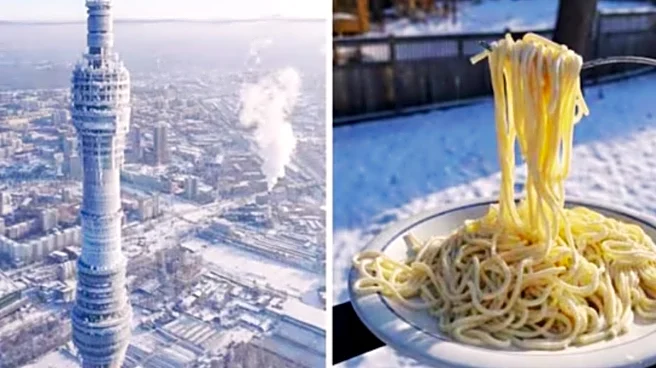
The Russian capital, Moscow, has become the epicentre of this extreme cold, with temperatures plunging to minus 28 degree Celsius this week. A skyscraper in the city has gone viral on social media, appearing completely encased in ice, resembling a giant frozen ice cream bar.
Unusual Cold In America
The United States is also grappling with extreme cold. In Minneapolis, temperatures dropped to minus 29.4 degree Celsius, with wind chill making it feel like minus 43 degrees. Social media users
have showcased the intensity of the cold through the so-called ‘pasta experiment’, where boiled noodles freeze mid-air, forming solid shapes.
Moscow’s Ostankino Tower, standing 540 metres tall, is covered in thick snow and frost. The extreme cold has transformed the skyscraper into a frozen spectacle, highlighting the unusual atmospheric forces at work.
Moscow’s extreme cold (up to -28°) has frozen the Ostankino Tower – the iconic 540-meter TV tower and one of the tallest structures in Europe. Sub-zero temperatures are no joke ❄️🥶 pic.twitter.com/fydhK6YOKr
— Russian Embassy in Kenya/Посольство России в Кении (@russembkenya) January 23, 2026
What’s Causing The Extreme Cold?
According to scientists, the primary cause is a disruption in the Polar Vortex. The Polar Vortex is a massive area of very cold air and low pressure near the Earth’s poles. Normally, a strong jet stream keeps this Arctic air contained.
However, when the jet stream weakens or becomes wavy, pockets of Arctic air escape southward, which is what is happening now.
Role Of The Arctic Oscillation
The World Meteorological Organisation (WMO) reports that the negative phase of the Arctic Oscillation is currently active. This climate pattern determines whether cold air remains trapped in the Arctic or spreads to mid-latitude regions such as America, Europe, and Asia.
Minneapolis reached a low of -21°F and a wind chill of -45°F this morning! Ouch! Obviously I had to do the pasta experiment 😝 pic.twitter.com/RuQkCb7ACY
— Jennifer McDermed (@McDermedFox9) January 23, 2026
During the negative phase, high pressure builds over the Arctic, while low pressure develops in mid-latitudes, causing the jet stream to slow and become wavy. This allows extremely cold Arctic air to spill into Europe, Asia, and America. The frozen skyscrapers in Moscow are a direct result of this phenomenon.
Risks Of Extreme Cold
Temperatures of minus 40 degrees Celsius pose serious health risks. Exposed skin can suffer frostbite in less than 10 minutes. The body responds with vasoconstriction, shrinking blood vessels to preserve core heat, leaving extremities like hands and feet highly vulnerable.
Extreme cold also strains infrastructure. Steel becomes brittle, and moisture inside buildings freezes and expands, putting immense stress on structures. Such conditions test the resilience of urban environments and highlight the dangers of sudden Arctic blasts.
These extreme cold events, closely monitored by global climate agencies, demonstrate the power and instability of Earth’s atmosphere. The Arctic blast of 2026 serves as a stark reminder of the potential for severe weather events in the future and the need for preparedness.

/images/ppid_59c68470-image-177046255390026736.webp)





/images/ppid_59c68470-image-177030753655445742.webp)
/images/ppid_59c68470-image-177029257050620635.webp)