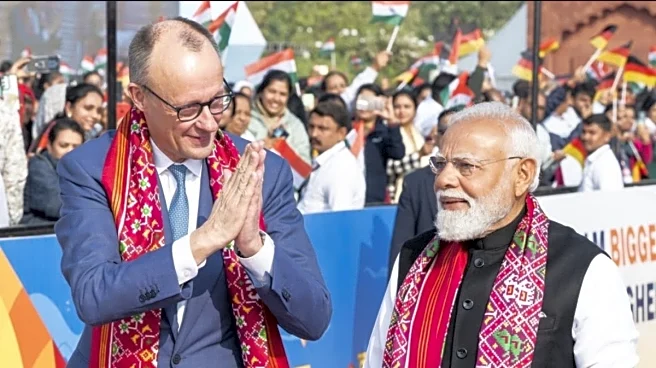

When Friedrich Merz arrived in India, he did so at a moment when old affinities are acquiring new relevance. German and Sanskrit, two of the oldest recorded Indo-European languages, share more than academic
kinship. The Sanskrit root yuj—to yoke or bind—reappears in German as Joch, the yoke itself. Words diverged; the idea of joining endured. Indo-German relations, long courteous and correct, are now being yoked by economic necessity and strategic calculation rather than sentiment.
That necessity is visible in the numbers. Bilateral trade crossed $50 billion in 2024, a psychological and economic threshold that underscores Germany’s place as India’s principal economic gateway to Europe. More than a quarter of India’s total trade with the EU flows through Germany, making Berlin a central node. India’s exports are led by engineering goods, chemicals and pharmaceuticals, and textiles and apparel—a mix that reflects its gradual move up the value chain. Germany’s exports to India are dominated by machinery and industrial equipment, automobiles and auto components, and electrical and electronic systems. The trade balance still favours Germany, with a $6 billion surplus, but that gap has narrowed.
Merz was accompanied by 23 leading German CEOs, an unusually heavy corporate phalanx. Their presence betrayed urgency. Germany’s economic model, once the envy of Europe, is under strain. Growth has slowed to a crawl. Its famed engineering and automotive champions face relentless US and Chinese competition. The shock of cutting off Russian energy has compounded the problem. German industry is now paying roughly 50 per cent more for energy than before the war in Ukraine—an enduring handicap in energy-intensive sectors from chemicals to steel.
This is why the relationship feels less asymmetrical than it once did. Germany needs India’s scale, growth and market almost as much as India values German technology, capital, process and engineering prowess.
In a reordered world, Berlin can no longer rely comfortably on the US alone—strategically or economically. India, meanwhile, finds itself squeezed by an America that is at once indispensable and increasingly transactional. Strategic autonomy, much invoked in Delhi and Berlin alike, now has common practical content.
Defence cooperation gives this convergence its sharpest edge. India and Germany are in advanced negotiations to jointly build diesel-electric submarines in India, centred on Thyssenkrupp Marine Systems’ Type-214 class, with Indian shipyards as full industrial partners. New Delhi is willing to pay top dollar for the technology. The proposal envisages six submarines initially, with an option for three more.
The Type-214 is among the most capable conventional submarines in service. With a submerged displacement of around 1,700 tonnes, it uses fuel-cell-based air-independent propulsion, allowing it to remain underwater for weeks with a minimal acoustic signature. It carries advanced sonar suites, heavyweight torpedoes and anti-ship missiles, and is optimised for operations in contested littorals as well as blue-water patrols. If the project proceeds as genuine co-production—with meaningful transfer of know-how rather than assembly work—it could become a strategically transformative industrial-military partnership, embedding German naval engineering into India’s defence manufacturing ecosystem.
Mind the gap
Differences remain, and were not concealed during the visit. On Russia, India reiterated its support for a peaceful settlement in Ukraine but stressed that its relationship with Moscow is structural, deep and far-reaching, rooted in decades of defence cooperation, energy ties and diplomatic alignment. Germany, by contrast, is looking to grind Russia down and would favour continuing the war. Berlin’s diplomacy is constrained by old memories of a surge towards the east; New Delhi’s by interests. Neither is inclined to yield.
The longer-term promise lies in trade policy. A completed India-EU Free Trade Agreement would materially change the relationship. India would gain improved access for pharmaceuticals, textiles, engineering goods and IT services; Europe would benefit from deeper penetration for capital goods, automobiles, green tech and high-end manufacturing. The obstacles are familiar: EU demands on labour and environmental standards, carbon border taxes, data rules and sustainability clauses; India’s resistance to steep tariff cuts in sensitive sectors and its insistence on easier movement for skilled professionals. Progress will require compromise rather than grandstanding.
Still, the direction is clear. As the old certainties of globalisation fray, Germany and India are rediscovering each other not out of nostalgia but necessity. Like yuj and Joch, forged from the same ancient root yet shaped by different histories, the two countries now find themselves bound together by the logic of a harsher world—where cooperation is less a choice than a requirement, and where being yoked to the right partner may determine who moves forward, and who is left standing. The trade agreement with the EU, India’s possible submarine deal, and greater engineering investment by Germany could be the key takeaways from this important visit.
The writer is a senior journalist with expertise in defence. Views expressed are personal and do not necessarily reflect those of News18.
/images/ppid_a911dc6a-image-17707550296985796.webp)



/images/ppid_a911dc6a-image-177075157301840277.webp)
/images/ppid_59c68470-image-177075003745079834.webp)

/images/ppid_59c68470-image-177075003659953644.webp)