


More than five decades after the Narmada Water Disputes Tribunal laid down the framework for sharing the waters and benefits of the Narmada River, the Centre has brokered a settlement to resolve one of India’s longest-running interstate financial disputes linked to the project.
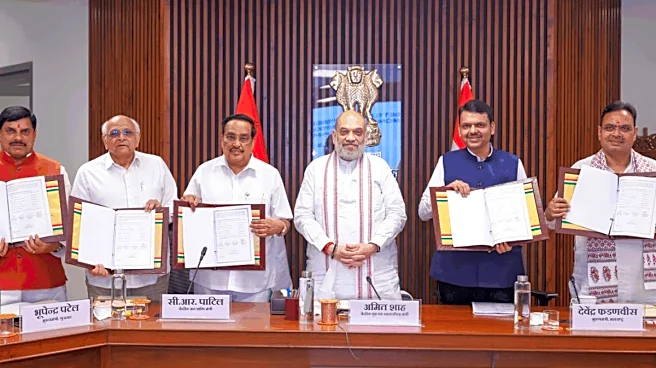
On July 7, Union Home Minister Amit Shah witnessed the signing of a tripartite agreement by the chief ministers of Gujarat, Madhya Pradesh, Maharashtra and Rajasthan, bringing to a close decades of disagreements over outstanding payments under the Sardar Sarovar Project (SSP) – India’s largest multipurpose river valley project on the Narmada. The agreement settles pending financial claims related to project costs, land acquisition, rehabilitation of displaced people and other
dues through a one-time settlement.
While the settlement ends the financial dispute, it does not change the allocation of water, electricity or irrigation benefits among the four states. Those continue to be governed by the award of the Narmada Water Disputes Tribunal (NWDT), which was constituted in 1969 and delivered its final award in 1979.
What Was The Narmada Payments Dispute?
The Sardar Sarovar Dam is located in Gujarat, but its reservoir extends into Madhya Pradesh and Maharashtra, submerging villages, agricultural land and forests. As a result, these upstream states bore much of the burden of land acquisition, rehabilitation and compensation for families displaced by the project.
The NWDT Award required the beneficiary states to share not only the river’s waters and electricity but also the costs of constructing the project and compensating those affected by it.
Over the years, disputes arose over reimbursement of land acquisition costs, compensation for submerged land, rehabilitation and resettlement expenses, maintenance costs and other outstanding financial liabilities. The disagreements continued for decades despite repeated negotiations, leaving several payment issues unresolved until the latest agreement.
The Narmada Formula: Who Gets What?
The latest agreement does not alter the tribunal’s allocation of water or power. Those allocations remain as follows:
Water Allocation
Madhya Pradesh receives the largest share because most of the river basin lies within the state. Gujarat receives the second-largest allocation, while Rajasthan and Maharashtra receive comparatively smaller shares.
Maharashtra Chief Minister Devendra Fadnavis mentioned that Maharashtra would receive its previously undelivered 10 TMC water entitlement via two alternative arrangements (5 TMC diverted, 5 TMC from the Ukai Dam), which Gujarat agreed to in principle.
#WATCH | Delhi: Maharashtra CM Devendra Fadnavis says, “There were several ongoing disputes regarding this Narmada project—specifically involving Maharashtra, Gujarat, Madhya Pradesh, and Rajasthan. Discussions were held to resolve these disputes collectively, and today, we have… https://t.co/Oy6b5sTvdc pic.twitter.com/GnSUoeelDk
— ANI (@ANI) July 7, 2026
Hydropower
Hydropower generated from the Sardar Sarovar Project is shared according to the tribunal award:
- Madhya Pradesh – 57 per cent
- Maharashtra – 27 per cent
- Gujarat – 16 per cent
- Rajasthan – No share in hydropower
Although Rajasthan does not receive electricity from the project, it benefits through irrigation water supplied via the Narmada Canal system.
Irrigation
The project’s irrigation benefits are heavily skewed towards Gujarat.
- Gujarat receives irrigation for around 18 lakh hectares, besides drinking water supply to thousands of villages and several towns and cities.
- Rajasthan receives irrigation water for around 2.46 lakh hectares, mainly in its arid western districts.
- Madhya Pradesh and Maharashtra derive comparatively fewer irrigation benefits from the Sardar Sarovar Project itself, benefiting more through their share of hydropower and other upstream Narmada projects.
Who Pays Whom?
The settlement concerns payments, not water allocation. Under the original tribunal award, Gujarat, as the principal beneficiary of irrigation and drinking water, was required to bear a significant portion of the expenditure on land acquisition and rehabilitation incurred in Madhya Pradesh and Maharashtra. However, over decades, disputes emerged over revised compensation, rehabilitation costs, reimbursement claims and pending dues.
The agreement signed on Tuesday settles all such pending liabilities through a one-time financial settlement. While the government has not officially announced the amounts, Maharashtra Chief Minister Devendra Fadnavis stated, “Maharashtra is now required to pay only Rs 27 crore, whereas earlier, claims amounting to Rs 2,000–Rs 3,000 crore had been raised against us.”
Meanwhile, some reports say Madhya Pradesh’s demand for compensation for the Sardar Sarovar Dam was Rs 7,669 crore. In the current agreement, the government of Madhya Pradesh will have to pay Rs 550 crore to the government of Gujarat.
The End Of A Long Dispute
The Sardar Sarovar Project has been among India’s most complex infrastructure projects, involving multiple states, evolving land acquisition laws, revised compensation norms, rehabilitation obligations and prolonged litigation.
Although the dam became operational years ago, financial liabilities continued to accumulate as compensation and rehabilitation costs were revised over time. The four states repeatedly differed over who should bear these additional costs and how outstanding dues should be calculated.
The latest agreement finally closes those pending financial issues without reopening the tribunal’s water-sharing formula.
The agreement marks the end of one of India’s oldest interstate financial disputes linked to a river project. It provides closure to outstanding payment issues that had persisted since the implementation of the NWDT Award, while leaving intact the existing framework governing water sharing, hydropower distribution and irrigation benefits.

/images/ppid_a911dc6a-image-178341592115526965.webp)