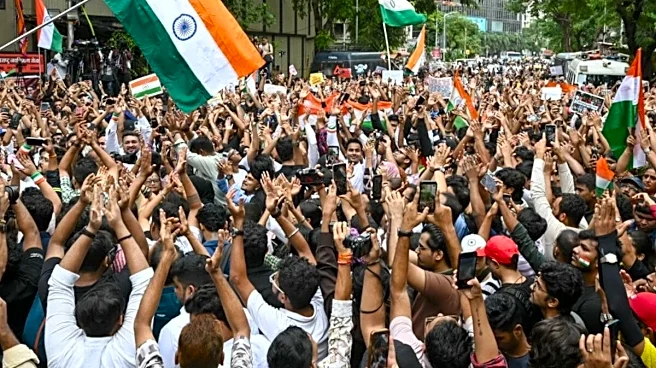


The recent Cockroach Janta Party (CJP) protests at Delhi’s Jantar Mantar reignited familiar debates around Gen Z, online activism and youth politics. But beneath the slogans and memes lies a bigger story. The way mass movements spread is changing, and recommendation algorithms are becoming an increasingly important part of that story.
For decades, protests depended on organisers knocking on doors, student unions mobilising campuses, trade unions rallying workers or television channels bringing an issue into the national spotlight. Today, another force is increasingly shaping whether a movement reaches millions or fades into obscurity: the recommendation algorithms powering Instagram, YouTube, X and other social platforms.
Every time someone opens
Instagram Reels, YouTube Shorts or X, they are shown content chosen not by editors or political organisers but by software designed to predict what will keep them watching. These systems have become the invisible infrastructure through which ideas, emotions and movements spread.
The Real Story Lies Beneath The Protest
CJP has roughly 26.8 million followers on Instagram. According to the analysis done by KlugKlug, 82.38% of the engagement with the content originating from this account came from netizens who did not even follow the CJP account.
The physical street protest led by CJP officially started on June 6. Once the protest began gaining momentum, thousands of videos, memes, reaction clips and short explainers started circulating. Some crossed millions of views despite being posted by relatively unknown creators. Others disappeared almost immediately. What determined the difference?
Increasingly, it is not simply the size of a creator’s following but how recommendation systems judge the content. Platforms constantly analyse how quickly people stop scrolling, whether they watch a video till the end, whether they share it, comment on it or send it privately to friends. Every interaction becomes a signal.
The algorithm does not know whether a protest is politically important. It only knows whether people are paying attention. That shift represents one of the biggest changes in public mobilisation since the arrival of the internet.
“Recommendation algorithms determine which content appears in your feed by using machine learning models trained on billions of user interactions. They combine collaborative filtering (‘people with similar interests engaged with this’) and content-based filtering, which analyses features such as text, hashtags, watch time, and other content characteristics to match individual preferences. Modern recommendation systems also rely on deep learning, where both users and content are represented as high-dimensional vectors, or embeddings. These models estimate the likelihood that a user will click, watch, share, comment, or otherwise engage with a post, and rank content accordingly. Continuous feedback from user behaviour allows the models to retrain frequently, enabling feeds to adapt in near real time,” says Jaspreet Bindra, co-founder of AI&Beyond.
From Social Networks To Recommendation Networks
The internet people used a decade ago functioned very differently. On Facebook or Twitter in their early years, users mostly saw posts from accounts they deliberately chose to follow. Information travelled through personal networks. If someone did not follow a political leader, activist or journalist, they were unlikely to encounter their content.
Today’s platforms work differently. Instagram Reels, YouTube Shorts and even X increasingly recommend content from people users have never heard of. Discovery is driven less by social connections and more by prediction.
Instead of asking, “Who do you follow?”, platforms ask, “What are you most likely to engage with next?” That shift has enormous consequences.
It means an unknown student, comedian or creator can sometimes reach millions overnight if the algorithm predicts their content will hold attention. For protest movements, this dramatically lowers the barriers to visibility.
“Today’s internet is largely algorithm-driven, with personalised recommendations replacing chronological feeds and search as the primary way people discover content. Modern platforms first generate a large pool of potential posts before sophisticated neural ranking models evaluate and prioritize them based on predicted engagement. Recommendation engines have become significantly more powerful because of three key advances: the enormous volume of user interaction data generated every day, increasingly sophisticated model architectures such as transformers and two-tower networks that better understand user preferences and content relationships, and real-time feedback that continuously updates a user’s profile based on signals like watch time, skips, replays, and clicks. Combined with multi-modal AI capable of analysing text, images, audio, and video, these systems can predict and personalize content with remarkable precision,” explains Bindra.
Why Protest Content Fits The Algorithm
Recommendation systems are often described as neutral technologies, and in many ways, they are. Algorithms do not support governments or opposition parties. They are not programmed to favour one ideology over another. Their primary objective is to maximise engagement.
Ironically, many characteristics of protest content naturally align with what these systems reward.
Strong emotions encourage comments. Humour makes videos shareable. Anger increases discussion. Memes simplify complicated issues into instantly recognisable formats. Powerful visuals keep viewers watching longer.
Modern protest movements increasingly communicate through exactly these formats. A clever meme can sometimes travel farther than a detailed policy document. A 30-second Reel can generate more public conversation than a two-hour speech.
This does not mean algorithms intentionally promote protests. It means protests often produce the kind of content algorithms are built to distribute.
“Recommendation algorithms are designed to prioritize content that generates strong user engagement, and protest-related posts often produce exactly those signals. Such content typically evokes novelty, emotion, urgency, and collective action, leading to higher click-through rates, longer watch times, more comments, and increased sharing.
“During major events, rapid surges in related keywords, hashtags, and location-based activity create concentrated patterns that recommendation models quickly recognise. Collaborative filtering further expands the reach by recommending similar content to users with comparable engagement histories. As more people interact with these posts, network effects reinforce their visibility. While recommendation algorithms do not intentionally promote protest content, their optimisation for engagement often results in this type of content spreading more rapidly and reaching wider audiences than less emotionally engaging posts,” said Bindra.
How The Cost Of Mobilising Millions Has Collapsed
The freedom movement relied on political networks that took decades to build. Jayaprakash Narayan’s movement (1974-1975) against the Emergency drew strength from student organisations, political parties and trade unions. The anti-corruption movement led by Anna Hazare in 2011-2013 required months of coordination, volunteers, media coverage and physical mobilisation across cities.
The brutal gang rape and murder of a 23-year-old physiotherapy student in Delhi in December 2012 triggered one of the largest public protests India had witnessed in decades. Anger over sexual violence, women’s safety, victim-blaming and the perceived failure of the criminal justice system brought thousands of students, women’s groups and ordinary citizens onto the streets. From India Gate to Raisina Hill, protesters demanded tougher laws, faster justice and greater accountability from the government. As demonstrations grew, Delhi Police responded with barricades, water cannons, tear gas and baton charges, turning parts of the national capital into the epicentre of a nationwide movement.
More recently, the anti-CAA protests (2019-2020), the farmers’ protests (2020-2021) and demonstrations following the NEET paper leak showed how digital platforms had become integral to mobilisation. Protest sites were still physical, but information travelled at digital speed. Livestreams, hashtags, short videos and creator-led explainers helped sustain public attention far beyond the protest locations.
What has changed most dramatically is the cost of reaching people. A movement that once required newspapers, television cameras, funding and organisational networks can now achieve national visibility through a handful of viral videos.
Creators with smartphones increasingly play a role once occupied by local organisers. This does not eliminate the need for leadership or planning. Large protests still require coordination on the ground. But digital visibility now arrives much faster, and sometimes before formal leadership even emerges.
The Rise Of The Creator-Activist
Another noticeable shift is the growing influence of creators. Unlike traditional political leaders, creators often speak the language of internet culture. They communicate through memes, humour, reaction videos and personal storytelling rather than speeches or press conferences.
For younger audiences, these formats feel more authentic and relatable than conventional political messaging. Some creators deliberately engage in activism. Others simply explain events or react to developments. Yet their content can significantly influence how millions understand a protest.
The line between journalism, commentary, entertainment and activism has become increasingly blurred.
Of the 30 notable engagers identified by KlugKlug, 80% had fewer than 40,000 followers, while 82.38% of all engagement came from non-followers.
Influencers also made up 8.6% of active engagers, compared with 5.58% of the overall follower base, suggesting that the conversation was being amplified by a wider network of micro-creators and ordinary users, rather than being driven only by a few large names.
According to Kalyan Kumar, Co-founder and CEO, KlugKlug, as quoted to Buzz in Content, “There are very few creators who actually have managers discussing how to approach this. Many influencers genuinely feel vocal about this issue. There appears to be a democratised voice emerging that goes beyond the concerns of a handful of larger creators.”
Kumar added, “From my understanding, this is not a political protest. The sheer number of influencers speaking out is significant, and it makes clear that this is not a coordinated campaign driven by a small group.”
In many cases, creators are not organising demonstrations themselves. They are shaping the narratives that determine whether people feel compelled to participate.
Is This The Future Of Mass Movements?
India’s digital landscape is expanding at an unprecedented pace. The country now has 958 million active internet users, growing at around 8% year on year. Artificial intelligence has also entered the mainstream, with nearly 44% of users engaging with AI-powered features such as voice search, image search, chatbots and AI filters. Adoption is highest among younger users, with 57% of those aged 15-24 and 52% in the 25-44 age group using AI-enabled features over the past year, according to the Internet in India report based on the ICUBE study.
Short-form video has emerged as one of the biggest drivers of this digital growth. In 2025, around 588 million Indians, about 61% of all internet users, consumed short-video content, with rural users slightly outnumbering their urban counterparts.
These numbers point to a much bigger question that goes beyond the CJP protests. If previous generations relied on political organisers, student unions and traditional networks to mobilise people, could the next generation increasingly rely on the architecture of digital platforms instead?
Algorithms are unlikely to replace leaders, organisations or ideology. People will continue to decide whether to protest, participate or remain silent. But the digital pathways through which those decisions are shaped, and the speed at which ideas spread, are becoming increasingly difficult to ignore.
/images/ppid_59c68470-image-17853451781431742.webp)






/images/ppid_a911dc6a-image-17852226321122392.webp)

/images/ppid_a911dc6a-image-178521727364993469.webp)
/images/ppid_a911dc6a-image-178521682630856480.webp)