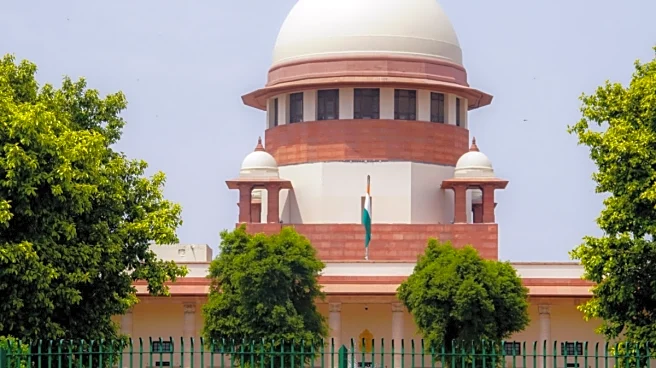

In a landmark decision, the Supreme Court has directed that a minor girl from Puducherry be issued a Scheduled Caste certificate based on the caste of her mother instead of her father. The decision is expected
to have far-reaching consequences, especially when similar petitions are pending in the apex court, challenging the traditional rule that a child’s caste is decided by the father’s caste.
According to a Times of India report, the girl’s mother belongs to the ‘Adi Dravida’ caste while her father is not from the Scheduled Castes. As per the report, the bench of Chief Justice of India Surya Kant and Justice Joymalya Bagchi refused to reverse a Madras High Court order that directed the issuance of an SC certificate to the child to continue her education.
“With changing times, why can’t a caste certificate be issued based on the mother’s caste?” the bench asked. It, however, clarified that the larger “question of law” remains open.
The decision, in effect, could mean that children born to Scheduled Caste women and Upper Caste men would be eligible for an SC certificate even if they are brought up with privileges of Upper Caste families.
In this particular case, the SC woman from Puducherry had applied for SC certificates for her two daughters and son based on her own caste, contending that her parents and grandparents all belong to the Adi Dravidar community. Her application mentioned that, after marriage, her husband lived with her at her parents’ home.
The case also referred to old government notifications. According to presidential notifications from March 5, 1964, and February 17, 2002, and Home Ministry guidelines, a person’s caste is mainly decided by the father’s caste and place of residence.
The Supreme Court has earlier accepted in several cases that a child’s caste is usually decided by the father’s caste. In the 2003 ‘Punit Rai vs Dinesh Chaudhary’ case, the Supreme Court said that for reservation matters, the deciding factor is the father’s caste, and under traditional Hindu law, a child gets their caste from the father, not the mother.
However, in the 2012 ‘Rameshbhai Dabhai Naika vs State of Gujarat’ case, the Supreme Court made this rule a bit flexible. The court said that in cases of inter-caste marriages or in cases where a tribal person marries a non-tribal, a child’s caste cannot be decided only by the father’s caste. The court also said that while it can be assumed that the child belongs to the father’s caste, this is not a final or unchangeable rule.
The Supreme Court also clarified that if a child can prove that they were raised in the social environment of an SC/ST mother and faced the same discrimination and hardships as others in that community, then the child can be considered part of that community.
In this latest decision, the Supreme Court has put the child’s interests first and allowed the SC certificate to be issued based on the mother’s caste, but also made it clear that the final decision on the bigger legal questions will be made later.
/images/ppid_a911dc6a-image-177092652580356823.webp)







/images/ppid_a911dc6a-image-177092306157991736.webp)