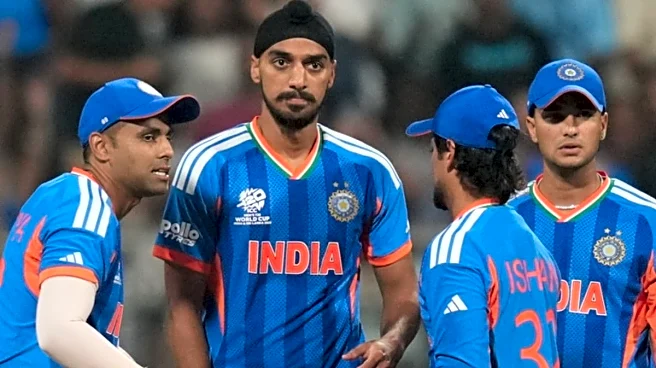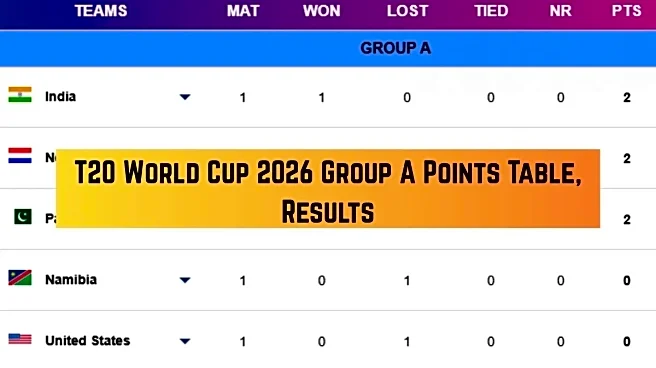


The start to the T20 World Cup has been chaotic, and in many ways, tournaments quietly hope for. The Netherlands nearly sent Pakistan back to the burrows on opening night. Nepal pushed England into discomfort. The USA stretched India longer than expected. For the first three days, imbalance was the point.
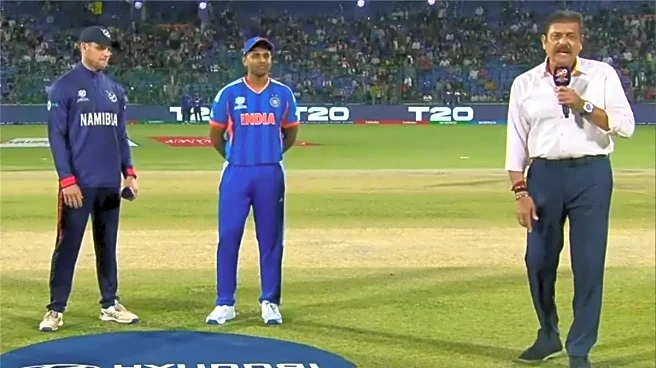
As the tournament moves into its fourth day, the chatter around associate nations ‘punching above their weight’ will give way; as on Tuesday morning at the Arun Jaitley Stadium, two associate sides meet. Namibia vs the Netherlands is the first match of this World Cup at the venue, and one that could already decide which way their campaigns bend in a group containing India, Pakistan and the USA.
For Namibia, it is a beginning. For the Netherlands,
it is a response.
Namibia arrived early in Delhi and had the luxury to get acclimatised to the conditions. Batters spent extended spells working on range-hitting, conscious of short boundaries. Local spinners were used in long net sessions, bowling into the surface.
Skipper Gerhard Erasmus, in his fourth T20 World Cup, kept circling back to one idea that keeps Associate nations afloat – exposure.
“Purely exposure is what physically gets you on this level,” Erasmus told the media ahead of the tie. “Going into our fourth World Cup, we’ve had lots of guys from the previous World Cups getting that feeling, that pressure, that sort of exposure that you have from crowd to media to big stadiums to lights, something we don’t have in Namibia.”
That experience is something Erasmus is banking on against the Dutch.
“In terms of skill set, yes, your skill set also goes up,” Erasmus said. “But I do think we have a nice young group now that also is competing for the other spots in the team, and that’s always quite healthy. We are not the biggest player pool in Namibia, so we need to create competition in our own circle.”
Delhi, at least, no longer feels unfamiliar. “We’ve been here two or three days now, and pitches were open so we had a good look and a feel,” he said. “We saw the groundsmen, how they prepared even for many hours in this morning session and in the afternoon session… so I think we’re well accustomed and got a good feel of most of the day.”
That comfort matters because Namibia’s hopes are closely tied to a small group of multi-skilled players who have carried them through qualifiers and into this World Cup. Erasmus himself remains their axis – Namibia’s leading T20I run-scorer with 1833 runs in 77 innings at an average of 32.15, often batting through the volatile middle overs. Alongside him, JJ Smit provides balance that few associate sides possess: at the Africa qualifiers, he scored 197 runs in four innings at a strike rate of 187.61 while also picking up six wickets, and in 2025, bowled at an economy of 6.19.
With the ball, Namibia will lean heavily on old hand Bernard Scholtz, who is expected to play given the condition. He arrives as Namibia’s leading T20I wicket-taker with 79 wickets at an average of 19.79 and an economy of 6.18. On a surface that grips early before flattening out, Namibia’s ability to manage the middle overs could determine whether their campaign finds early traction.
Despite India waiting three days later, Erasmus shut down any suggestion of a forward glance. “All our energy is on the Netherlands game now,” he said. “It’s such a different game that we’re going to face as opposed to the India game. We haven’t even thought about the 12th. We’re only thinking about the next 24 hours.”
Erasmus was equally firm in rejecting the framing that followed the opening days of the tournament. “I don’t see anyone as less or as an associate nation,” Erasmus said. “Those first four games showed that it wasn’t any flukes… It’s been real proper just bat against ball cricket between teams – not associate teams, just the cricket teams.”
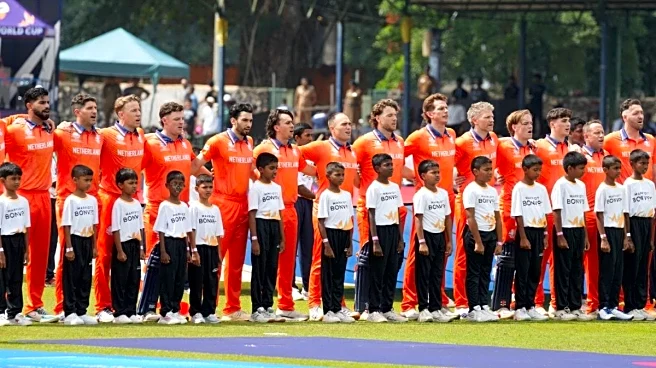
If Namibia draw confidence from discipline, the Netherlands arrive carrying frustration.
Against Pakistan in Colombo, they were close enough to touch a result that ultimately slipped away. The performance, however, reinforced the depth of a side built around all-rounders and late-order resilience.
Much of that responsibility rests with Max O’Dowd, Colin Ackermann, and Logan van Beek – players capable of shifting momentum quickly in either direction. Against Pakistan, it was Paul van Meekeren who nearly turned the game, finishing with 2 for 20 and triggering a collapse with a double-wicket over. With Delhi expected to reward both seamers who hit the deck and spinners who attack the stumps, the Netherlands’ bowling depth remains their primary weapon.
Ackermann acknowledged the emotional weight of that defeat ahead, speaking at the pre-match press conference. “It was naturally a very disappointing result for us,” he said. “But the nature of this tournament is that the games come thick and fast. So we’ve parked that.”
The reset, however, has to be immediate. “When we got off the bus in Delhi, coach Ryan Cook said the past is the past, there’s nothing we can do about it, and we must look forward to the next game against Namibia.”
For the Dutch, it came down to the missed catch of Faheem Ashraf, but Ackermann was quick to admit that he could have had Pakistan on the mat on various other occasions.
“There were obviously many other moments in the game where we could have done better,” he said. “If we look at the last five overs of our batting, if we had added another 15–20 runs, that could have been the difference. There are around 240 moments in a T20 game, so we need to be better in those other moments as well.”
Delhi, though, will differ from Colombo with its short boundaries and heavy runs expected. “From the games played here, it looks like a slightly higher-scoring ground than the one in Colombo,” Ackermann said. “We knew coming into this tournament that we’d be playing four games in four different venues, so communication is key once the game starts tomorrow.”
Despite the opening loss, the Netherlands’ semi-final ambitions remain unchanged. “In the immediate future, our goal in this World Cup is to reach the semi-finals,” Ackermann said. “I believe we have the team and the skills to achieve that. It hasn’t started in the best way, but we still have three big games ahead.”
On a ground where mistakes travel quickly and recovery time is scarce, this match, for the Netherlands, is about ensuring Colombo becomes a lesson rather than a regret; as for Namibia, it is about converting preparation into points before the tournament tightens further.
Possible Playing XIs
Namibia: Louren Steenkamp, Jan Frylinck, Jan Nicol Loftie-Eaton, Gerhard Erasmus (c), JJ Smit, Malan Kruger, Zane Green (wk), Ruben Trumpelmann, Bernard Scholtz, Ben Shikongo, Jack Brassell.
Netherlands: Michael Levitt, Max O’Dowd, Bas de Leede, Colin Ackermann, Scott Edwards (c & wk), Zach Lion-Cachet, Logan van Beek, Roelof van der Merwe, Aryan Dutt, Kyle Klein, Paul van Meekeren.