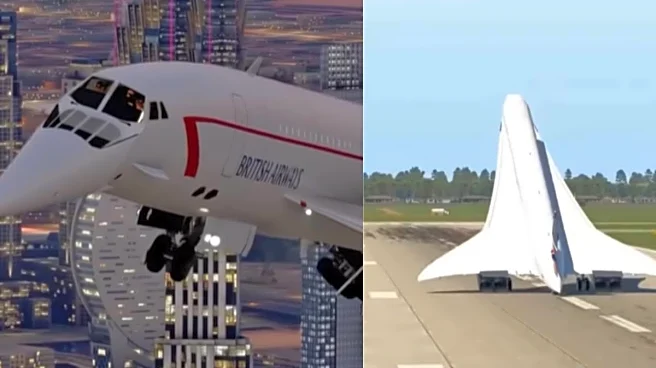

In 2003, an aircraft that changed air travel forever made its final landing. The Concorde was not just another plane, it was built to fly faster than sound. It was able to cross the Atlantic in less than three
and a half hours, something no other passenger aircraft could do at the time. The plane flew at 1350 miles per hour and climbed as high as 60,000 feet, far above normal commercial flights.
Its sharp nose, slim body and triangle shaped wings helped it cut through the air with ease. Four strong engines pushed it to speeds that felt unreal for passengers. But this speed came with problems. The loud sonic boom limited where it could fly and it also used huge amounts of fuel every hour. High costs and strict noise rules slowly grounded it. Even years later, the Concorde is still remembered as a bold and unforgettable machine.
How Concorde Changed Long-Distance Travel
In a video shared on Instagram, the content creator said, “Have you ever seen a plane that can nod. That’s the Concorde and no, it’s not showing off, it lowers its nose so pilots can actually see the runway ahead during take off and landing. But that long pointed nose isn’t just for looks, it’s what helped the Concorde become the fastest passenger jet in history. It cruised at around 1350 miles per hour, more than twice the speed of sound, its sleek body and unique delta shaped wings let air flow smoothly over the surface with minimal drag.”
“Combined with four powerful turbojet engines, the Concorde could soar up to 60,000 feet, far higher than regular airliners, but its flaws were just as extreme as its speed. Breaking the sound barrier created a sonic boom so loud it could shatter windows on the ground. Because of that, it was only allowed to go supersonic over the ocean and it burned fuel like crazy, several tons every hour. In the end, the Concorde’s high operating costs and deafening noise led to its retirement in 2003,” the page added.
The video posted on Instagram came with the caption, “The Concorde, The Legend That Broke the Sound Barrier. The Concorde wasn’t just a plane — it was a revolution. Flying at Mach 2 (2,180 km/h) and cruising at 60,000 ft, passengers could see the curvature of the Earth while sipping champagne. It could cross the Atlantic in under 3.5 hours, but its era ended in 2003 due to high costs and noise restrictions. Still, it remains one of the most iconic aircraft ever built.”
View this post on Instagram
Reacting to the post, a user wrote, “Actually, the Concorde retired because of a crash in Paris, France that killed everyone onboard and in a hotel/ motel.”
Another shared, “Where do I sign up? I would love a flight on the most iconic bird ever.”
“My mum and dad got the privilege to fly from London to Paris and back on Concorde, which my mum actually won as a prize playing bingo, would you believe still have the Concorde pens and pad that they got,” a comment read.
An individual stated, “They should have never taken it out of service and with all the technology plus artificial intelligence in place now, they would still never be able to create a great aircraft like that again. British engineering at its best, the story of our lives back then.”
Another mentioned, “Bring back Concorde, it was Worth every penny.”
One more added, “It’s fast, but it’s not the fastest passenger plane in history. The fastest passenger plane in history is the not-so-famous Tupolev Tu-144, an aircraft developed by the USSR. The Tupolev Tu-144 reaches a top speed of 2,430 km/h (1,518 mph), about 251 km/h faster than the Concorde.”
How The Concorde Journey First Began
According to Interesting Engineering, the story of the Concorde began in 1962, when France and the United Kingdom agreed to build a fast passenger plane together. After several years of design and testing, the British model flew for the first time in 1969 and it successfully crossed the speed of sound.
The aircraft entered regular service in January 1976. British Airways started flights from London to Bahrain, while Air France began flying from Paris to Rio de Janeiro. In 2000, a tragic accident in Paris took many lives and raised serious safety concerns. Flights were stopped for years and only restarted in 2001. Even after returning, the plane did not fly for long. In 2003, both airlines decided to end Concorde operations for good.



/images/ppid_a911dc6a-image-177053502313565963.webp)







/images/ppid_59c68470-image-177036253738543013.webp)
