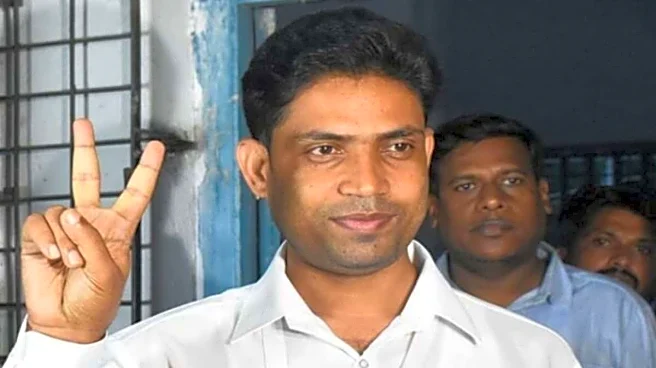


It took 26 days for ‘Bhaipo’ Abhishek Banerjee to muster the courage to visit the families of post-poll violence victims in Bengal.
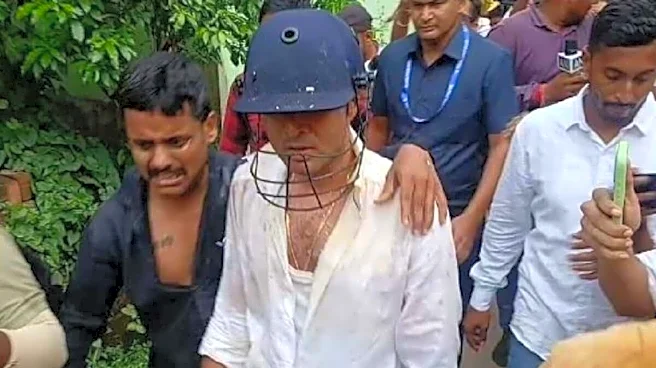
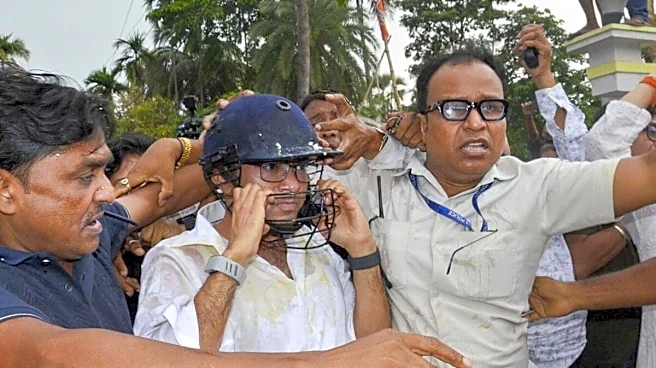
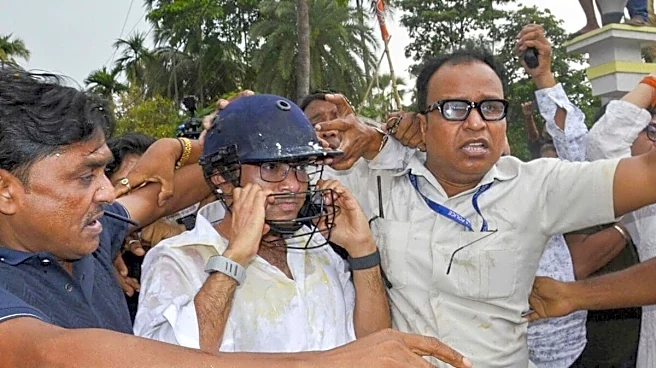
Not 26 hours. Not 26 minutes. Twenty-six days of comfortable silence while the people he claims to represent bled, mourned, and waited. And when he finally arrived in Sonarpur on May 30, the streets gave him the only reception a 26-day delay deserves: stones, eggs, shoes. Chants of “chor, chor” echoed loudly, overpowering any security cordon.
He wore a cricket helmet to survive his constituency. Let that image settle.
This is not the story of a leader under siege. This is the story of a dynasty confronting its own ledger. Abhishek Banerjee did not earn Diamond Harbour. He inherited it, the way one inherits a family
business, with the keys already cut and the staff already in place. He is not Suvendu Adhikari, who walked away from the comfort of Trinamool Congress (TMC) patronage, faced the full fury of the Mamata machine, and still won. He is not Mamata Banerjee herself, who has the bruises, the broken leg, and the street-fighter’s instinct to show for her political survival. Abhishek is something else entirely. He is a manager. A franchise operator. A nepo kid in a kurta who mistook access for authority. The Diamond Harbour model was sold to us as a governance blueprint. Abhishek’s constituency, we were told, was different. Cleaner. More efficient. A proof of concept for what Bengal could look like under a younger, more polished TMC. Political journalists took the tour. Profiles were written. The narrative was diligently handled, because managing narratives and indulging in theatrics is precisely what TMC leaders under the stewardship of ‘Pischi’ Mamata Banerjee have been indulging in for long. What these chaps are not good at is governing. And now, with TMC out of power and the scaffolding removed, the model stands exposed for what it always was: a faux pas dressed as a flagship. Old videos are returning to haunt him with the precision of a metronome. Statements made from a position of unearned certainty. Threats delivered with the confidence of a man who never imagined accountability. In Bengal’s political culture, where loyalty was enforced through fear and dissent was swiftly punished, Abhishek operated as the enforcer-in-chief. He was never the movement. He was always the machinery. And machinery, when the power supply is cut, simply stops. There is something almost Shakespearean in his predicament. The very political legacy that handed him his Lok Sabha seat—in the cradle—that made him a national face, that gave him platforms and press conferences, is the same legacy now turning the streets against him. He is the victim of the ecosystem he goaded and nurtured. The violence visited upon TMC workers’ opponents for years has produced a public memory that no PR exercise can erase. Sonarpur did not happen to Abhishek Banerjee. Sonarpur happened because of what Abhishek Banerjee represented. Bengal is not finished. In fact, far from it. That is the thing that neither TMC’s laments nor the Marxist academicians’ and political pundits’ hand-wringing will acknowledge. Ours is a civilisation older than the parties that fought over it. The soil that produced Swami Vivekananda, Rabindranath Tagore, Shyama Prasad Mookerjee, and Bankim Chandra Chattopadhyay has not forgotten what it is. The BJP’s rise in Bengal is not an imposition. It is a reclamation. Slowly, stubbornly, and now with the mandate to govern, Bengal is finding its way back to its civilisational self. Expecting Gujarat 2.0 is not an exaggeration. It is a roadmap towards prosperity and not subjugation, as is being touted by the TMC leaders and ecosystem. What Gujarat achieved over two decades, anchoring itself as the locomotive of India’s growth story, Bengal has every condition to replicate: the intellectual capital, the industrial geography, the cultural pride. What it lacked was political will uncorrupted by dynastic entitlement. That is changing. Abhishek Banerjee left Sonarpur in a helmet, escorted by security, through a crowd that had stopped fearing him. That is not a moment of sympathy — though it should be unequivocally condemned considering the democratic setup of our country — that is a verdict. An egg on his face is quite literal, more than metaphorical. Violence and democracy are antithetical terms. You can’t speak them in one sentence. You just can’t.
Yuvraj Pokharna is an independent journalist and columnist. He tweets with @iyuvrajpokharna. Views expressed in the above piece are personal and solely those of the author. They do not necessarily reflect News18’s views.

/images/ppid_a911dc6a-image-17802148210775767.webp)

/images/ppid_59c68470-image-178020752264456683.webp)