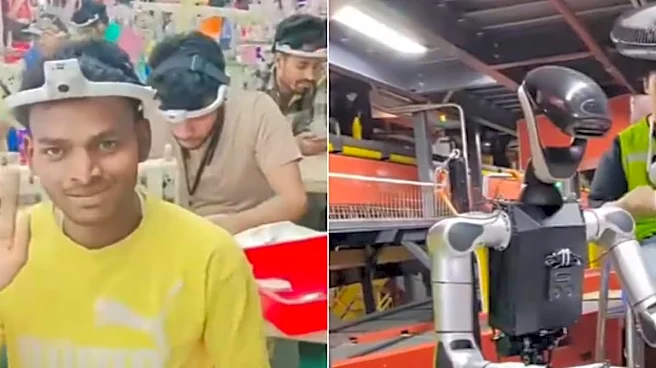




A set of viral videos featuring factory workers in India equipped with head-mounted cameras has sparked intense discussion online. Filmed inside what appear to be large garment manufacturing units, the clips show workers stitching, cutting, and handling fabric while recording their movements, raising both curiosity and concern among viewers.
In the widely circulated footage, rows of workers can be seen focusing on their tasks while the cameras capture their actions from a first-person perspective. The unusual setup quickly drew attention online, with many questioning the purpose of such devices in traditional, manual workflows.
As the videos gained momentum, speculation around their intent intensified. A commonly shared theory suggests that the cameras
are being used to record ‘egocentric’ or first-person data of skilled labour.
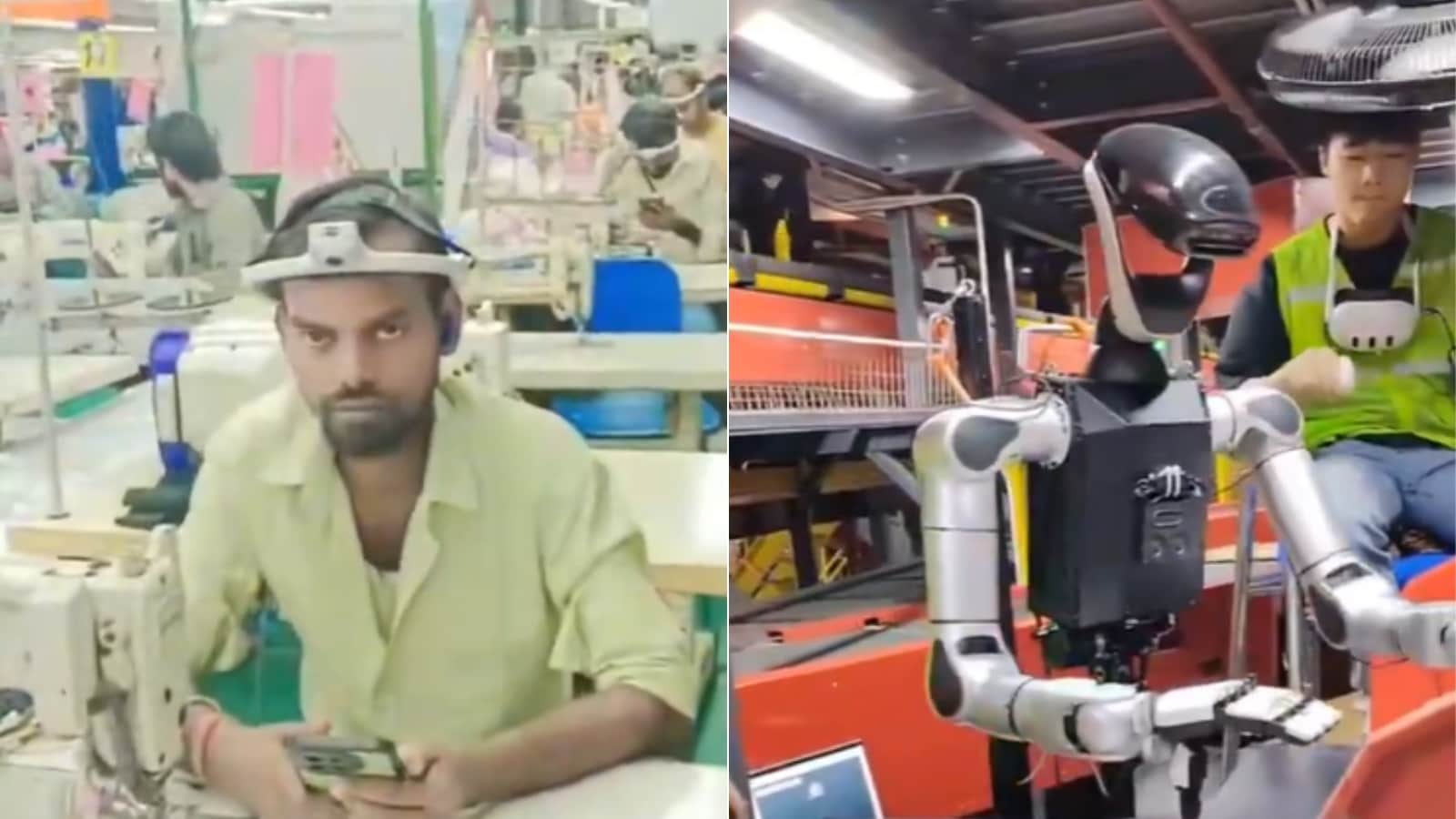
This footage, some users claim, could potentially be used to train artificial intelligence systems or robotics through imitation learning, allowing machines to replicate intricate hand movements involved in garment production without relying on costly motion-capture setups.
Several social media users expressed concern that workers may unknowingly be contributing to technologies that could eventually replace them. Alongside concerns about automation, the videos have also raised ethical and labour-related questions.
Some commentators have called for greater transparency, asking whether workers are fully informed about how the recorded data will be used and whether they are being fairly compensated.
The discussion has also expanded beyond India, with some reactions touching on global supply chains, outsourcing, and the growing role of automation worldwide. Among the reactions, one user remarked, “But in China the operator has to wear a whirling room scanner on their head… 😄” while another joked, “Will they be collecting their data during bathroom breaks too?”
“This data value chain dynamic confirms my experience. The UAE offers logistics professionals the regulatory stability that Cairo and Beirut lack, making Dubai the hub for deploying these robotics systems,” said another user.
Two spacetimes, one data value chain
>India: Workers’ headcams record garment sewing egocentric data flows to AI/robotics companies.
>China: Operators teleoperate humanoid robots in warehouses, sorting packages …validating the system ,collecting real-world training data. pic.twitter.com/uPrTb6nYRR
— CyberRobo (@CyberRobooo) April 12, 2026
“The scale at which #humanoid bots is scaling, is staggering, I genuinely believe in the next 24 months we’re going to be seen #humanoid bots walking amongst humans in the public, like the movie I-Robot. How do people see this playing out? Are you optimistic about this?” a fourth user remarked.
At the same time, a few users highlighted how different regions are positioning themselves within the evolving automation ecosystem, pointing to cities like Dubai as emerging hubs for robotics deployment.



/images/ppid_a911dc6a-image-177625706193378954.webp)

/images/ppid_a911dc6a-image-177625709833097260.webp)
/images/ppid_a911dc6a-image-177625706440993179.webp)
/images/ppid_a911dc6a-image-177625703047325043.webp)