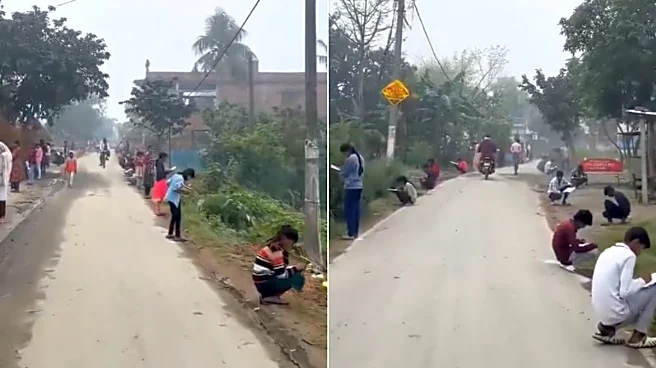




Rows of children sitting and standing by the side of a village road, heads bent over test papers, while bikes and people pass by. That is the scene from a video shared on X. The caption says, “Children from some coaching institute in the Siwan district of Bihar are taking test papers by the roadside. Perhaps that’s why Bihar has the lowest literacy rate in India.”
No classrooms, no desks in the usual sense, just a stretch of roadside being used as a makeshift exam hall. Around them, everyday life carries on, vehicles move, people walk past, but the students stay focused on their papers. For many watching, the image is hard to ignore.
Some reactions have pointed to the contrast. In a country that talks about smart classrooms and digital education,
this is what learning looks like for many. “Where open air is the classroom,” one comment said, while another called it a reminder that “the darkness of the lantern still persists.”
Others have been more direct, placing the responsibility on the system. A number of users said this reflects gaps in public education infrastructure, arguing that overcrowded private coaching centres have grown because government schools are not able to meet demand.
There’s also frustration in some responses.
A few pointed out that Bihar continues to have one of the lowest literacy rates in the country, and scenes like this help explain why basic facilities remain out of reach for many students. But alongside that criticism, there’s also a different tone.
Several users focused on the students themselves. Despite limited resources, they’re still showing up, still writing exams, still putting in the effort. “Look at the spirit of the children,” one comment read, noting that students from Bihar continue to make it into top institutions across the country.
बिहार के सिवान जिले के किसी कोचिंग संस्थान के बच्चे सड़क के किनारे टेस्ट पेपर दे रहे हैं।
शायद इसीलिए बिहार की साक्षरता दर भारत में सबसे कम है।
pic.twitter.com/vqICgzb9JE— Jaiky Yadav (@JaikyYadav16) April 10, 2026
Another reaction summed it up more simply: the problem isn’t the children, it’s the system around them. On one hand, the video is a stark reminder of the gaps in infrastructure. On the other hand, it’s a glimpse of the kind of determination that keeps going despite those gaps.





/images/ppid_a911dc6a-image-177585207263091406.webp)

/images/ppid_a911dc6a-image-177577402932055557.webp)
/images/ppid_a911dc6a-image-177584692680232159.webp)
/images/ppid_a911dc6a-image-177583647256661822.webp)