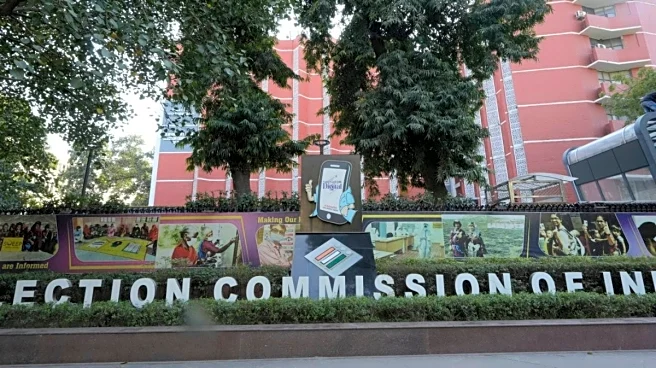

In a move that the senior officers of the state describe as “unprecedented”, the Election Commission of India (ECI) has appointed the West Bengal home secretary and two police commissioners, two range
IGs, as election observers for the forthcoming assembly elections, while simultaneously summoning a large batch of IAS and IPS officers to Delhi for an intensive briefing.
Official communication issued by the ECI on January 27 stated that briefing meetings of central observers for the upcoming assembly elections in Assam, Kerala, Tamil Nadu, West Bengal, and Puducherry will be held at the India International Institute of Democracy and Election Management (IIIDEM), Dwarka, in early February. The meetings are scheduled in three batches across February 5 and 6.
Alongside senior constitutional and administrative authorities, the commission has also called dozens of IAS and IPS officers from West Bengal to Delhi, with batch-wise instructions issued for mandatory attendance. The communication makes it clear that any form of an “unauthorised absence” will be viewed seriously and may invite disciplinary proceedings.
While the ECI routinely appoints senior bureaucrats as observers, the inclusion of the state’s home secretary and the police commissioners has drawn attention within administrative circles. Senior officers familiar with past election cycles said such a configuration has not been seen in earlier assembly elections in West Bengal or other states.
“This level of institutional oversight, particularly the drafting of the home secretary and police commissioners, is without precedent,” a senior officer said, requesting anonymity. “In previous elections, observers were largely drawn from the state’s list of available officers or from specific services, not from the core state election machinery itself.”
Senior officers noted that the move comes alongside heightened preparatory steps by the commission, including detailed, minute-to-minute briefing schedules and direct reporting mechanisms. The ECI has asked the Chief Electoral Officer of West Bengal to ensure that all concerned officers are informed within 24 hours and that written confirmations, along with acknowledgements, are sent back to the commission.
Notably, officers said that such an approach was not adopted during recent assembly elections in other states, where observer appointments followed more conventional patterns.
With the 2026 assembly election in West Bengal expected to be politically high-stakes, the ECI’s latest steps reflect an unusually expansive mobilisation of the state’s senior administrative leadership well ahead of polling.
/images/ppid_a911dc6a-image-177077322976413782.webp)

/images/ppid_59c68470-image-177077258165510745.webp)

/images/ppid_59c68470-image-177077272281824806.webp)
/images/ppid_59c68470-image-177077276056749159.webp)
/images/ppid_59c68470-image-177077261155977594.webp)
/images/ppid_59c68470-image-177077268877789072.webp)
/images/ppid_59c68470-image-17707726531682045.webp)
/images/ppid_59c68470-image-177077254224536754.webp)
/images/ppid_a911dc6a-image-177077043838376354.webp)