



Uttar Pradesh is battling a widening flood crisis, with 23 of the state’s 35 districts affected, more than 16,000 people evacuated and three deaths reported in rain-related incidents. As floodwaters rise in Varanasi, and Prayagrajmany are left wondering if this is another downstream fallout of the catastrophic floods that devastated Nepal last week.
Nepal’s August 26 disaster did trigger a real flood alert in parts of eastern Uttar Pradesh. But that immediate threat subsided. The rivers now causing the most serious flooding in the state, particularly the Ganga, Yamuna and Mandakini, are responding primarily to heavy rainfall and rising upstream inflows within the wider Indian river system, rather than a fresh flood wave from Nepal.
Read More:
Flood Fury In UP: Over 16,000 Evacuated, 3 Killed In Rain-Related Incidents
Why UP Was Put On Alert After Nepal Flash Flood
The scale of the Nepal disaster was extraordinary. A flash flood triggered by a massive ice-and-rock collapse near the Nepal-Tibet border sent torrents of water, mud and debris through downstream river valleys on August 26.
Nepal’s latest figures put the death toll at 1,204, with 4,216 people still missing. Nearly 12,000 people have been rescued so far. The disaster destroyed homes, bridges and power infrastructure and left a trail of devastation across northern Nepal.
The geographical proximity immediately raised concerns in Uttar Pradesh. Maharajganj and Kushinagar were put on high alert, with authorities closely monitoring the Gandak, a river that enters India from Nepal. Officials prepared vulnerable villages for possible evacuation and kept rescue teams ready as the possibility of a downstream surge was assessed.
The Gandak did carry a grim reminder of the Nepal disaster into UP: bodies believed to be victims of the flash floods were recovered from the river in Maharajganj and Kushinagar. At least 10 bodies had been recovered by August 30, with the number subsequently rising. Five Nepali nationals’ remains recovered in Kushinagar were handed over to Nepal Police on September 2.
But crucially, the immediate flood threat from the Nepal surge eased. Reports from the border districts said the Gandak water level fluctuated but the flood danger had subsided.
Which Rivers From Nepal Flow Into UP?
UP does have several important hydrological links with Nepal. The Gandak, known as the Narayani in Nepal, is the most obvious one in the current context. The Ghaghara, known upstream as the Karnali, originates in the Himalayas and flows through Nepal before entering India and eventually becoming one of the major tributaries of the Ganga in Uttar Pradesh.
The Rapti also rises in Nepal before flowing into eastern UP. Its basin covers areas including Shravasti, Balrampur, Gonda, Basti and Gorakhpur.
The Sharda, or Mahakali, forms part of the India-Nepal boundary before entering Uttar Pradesh and flowing through the state’s Terai region.
However, the recent floods in UP are not linked to Nepal in any way.
What Is The Cause Of Flooding UP Now?
The current crisis has a very different geographical footprint.
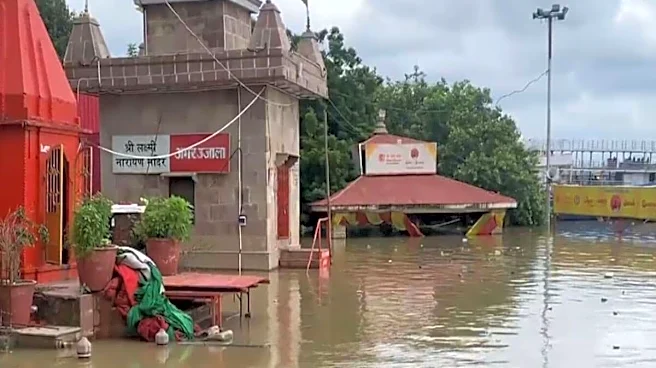
In Varanasi, the story is the Ganga. The river has risen amid continuing heavy rain, submerging the city’s famous ghats and pushing water into low-lying neighbourhoods. On September 3, the Ganga at Rajghat reached 70.54 metres, above its warning level of 70.262 metres, although still below the danger mark of 71.262 metres. The river was rising at around 2 cm an hour at the time of the reading.
The flooding has disrupted life along the riverfront, with water entering lanes and affecting areas around the ghats.
In Prayagraj, meanwhile, the focus is on the Ganga and Yamuna. Water levels have risen rapidly, while releases from dams in Madhya Pradesh into the Yamuna have added to concerns. At monitoring points in Prayagraj, both rivers were being closely watched, although they remained around two metres below the danger mark in the latest readings cited by officials.
In Madhya Pradesh’s Chitrakoot, the biggest immediate culprit is the Mandakini, not a river flowing down from Nepal. A sudden surge pushed the river to 129.2 metres, inundating 36 villages and affecting around 14,000 people. Nineteen villages in Karwi tehsil, 10 in Manikpur and seven in Rajapur were affected, with water entering homes and shops and boats being used for evacuation.
The Mandakini is a local river of the Bundelkhand region. Its flooding therefore cannot be explained by the August 26 Nepal flash flood travelling downstream.
Rainfall Is The Common Thread
What connects the present UP crisis is not necessarily Nepal’s floodwater, but the broader monsoon system. The India Meteorological Department has warned of heavy rain, thunderstorms and flash-flood conditions across parts of UP, while a strengthening monsoon and a low-pressure system have increased rainfall over southern UP and Bundelkhand.
The result is a state dealing with several river systems rising simultaneously. In Pilibhit, for instance, the Sharda, Deoha and Khakra rivers have been rising. More than 2 lakh cusecs of water was released from Banbasa into the Sharda, while more than 30,000 cusecs was released from Nanak Sagar into the Deoha. The Khakra bridge was submerged, cutting off around 18 villages.
The state government has deployed 1,499 boats and motorboats and 1,067 medical teams, while 1,311 flood shelters have been established, 201 of which were operational. More than 36,000 livestock have also been affected.
Nepal And UP: Connected, But Not One Giant Flood
Nepal sits upstream of several rivers that eventually flow through Uttar Pradesh. And the Gandak did carry the human toll of the Nepal disaster downstream into UP.
But the present flood crisis is a more complicated story. The Nepal disaster did prompt a genuine alert in UP, particularly along the Gandak in Maharajganj and Kushinagar. That immediate danger subsequently eased. What Uttar Pradesh is dealing with now is a broader monsoon flood emergency involving the Ganga, Yamuna, Mandakini, Sharda, Saryu and other rivers, driven by heavy rainfall, upstream inflows and, in some places, releases from dams and barrages.
While Nepal and UP are undeniably connected by rivers, the floodwaters currently threatening Varanasi, Prayagraj and other areas should not be described simply as Nepal’s flood moving downstream into Uttar Pradesh.