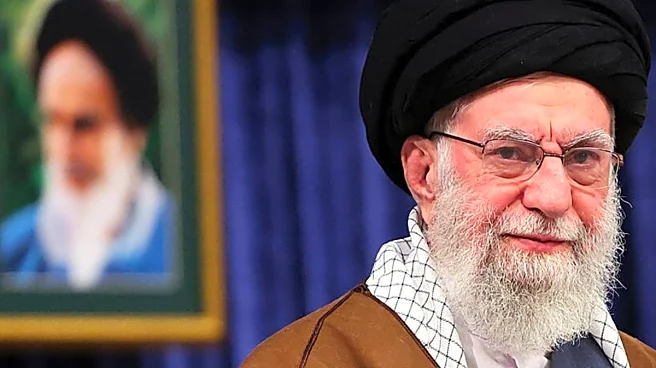

Iran’s Consul General To India, Saeid Reza Mosayeb Motlagh, said that Supreme Leader Ali Hosseini Khamenei is being provided security; however, he is not hiding in a bunker.
Motlagh, while speaking exclusively
to NDTV, said that foreign intelligence agencies have incited political unrest in his country. He added that India and Iran are making efforts to keep their co-operation intact amid the threat of sanctions.
“As you are aware, there have been efforts to depict that Iran is facing an internal crisis. I must say that security forces showed flexibility and self-control towards the demonstrators until a turning point date, which I believe was Thursday (January 8), or Friday,” said Iran’s Consul General, while speaking to NDTV.
“From Thursday and Friday onwards, when terrorist elements received commands from their masters and bosses who were outside Iran, they started machinations and plots and conducted sabotage in several places, in big and small cities. This issue led to fear among some of our citizens and damage to their properties, as well as damage to government properties. Unfortunately, a total of 3,117 people were killed, of which 2,427 martyrs were civilians and security forces, and 690 terrorists were also killed,” he added.
The diplomat said that a very small number of foreign nationals were involved in the protests. He further claimed that the Iranian government has received intel that various protesters had been “trained by foreign intelligence services, instructed by their trainers, or influenced by news that was spread across the world”.
He further stated that Iran is fully prepared in the wake of measures being taken by the US in the region.
“Our country has shown that it has the power to fend off any kind of aggression that it has witnessed so far. A case in point would be the operations that were carried out in the 12-day war (with Israel in June last year), or the resistance that was shown against this terrorist operation,” Motlagh said.
“This unrest was brought under control with the assistance of the police and the public in a matter of two days. Likewise, if any forces want to act offensively against Iran, we are completely prepared to defend ourselves, and we will do so with full power,” he added.
Internet Blackout, Khamenei’s Disappearance
Speaking about the internet blackout in Iran in the wake of the protests, the consul general defended the move and said it was necessary because “foreign factors were fanning the unrest” with the help of the internet, and the country also faced some cyber attacks.
“However, we are seeing that the internet situation is improving, and officials have pledged that the internet will be fully re-established within a few days,” the diplomat said.
He further quashed the reports of Khamenei avoiding public appearance and hiding in a bunker and said that all the required meetings with officials are being held by the Supreme Leader through video conferencing.
“We are not afraid of any foreign powers. Some people are spreading rumours. It is natural that His Eminence must have security personnel protecting him, as in any other country. However, one should not think that he is hidden in a bunker or a shelter,” Motlagh said.
No Foreign Nationals Harmed, Indians Are Safe: Iranian Diplomat
Iran’s Consul General said that various foreign sanctions have been imposed on Iran for many years, and the country has shown its ability to resist them.
“In this regard, it will also be collaborating with India. Although these sanctions have affected our economic relationships with countries around the world, including India, ultimately, there are solutions, and we have taken some measures. In the same way, Indians have also taken some measures so that they can maintain some form of relations with us,” Motlagh said.
He further assured that no foreign nationals have been harmed in Iran and Indians living in his country are safe.
“I have also seen some interviews of Indian nationals returning from Iran, and it was interesting to me that some of them said that they did not even realise that there was any unrest. Obviously, they were living in some remote places where there was no unrest. I would like to assure all family members of Indians currently residing in Iran that they are all safe and sound,” he stated.
The cycle of tension commenced in late December last year, when widespread anger over soaring inflation, a collapsing currency, and deteriorating living conditions sparked protests across Iran. Initially centred on economic hardship, the demonstrations swiftly evolved into broad anti-government calls demanding political change.
Within days, Iranian authorities responded by implementing a near-total shutdown of internet and phone services. The blackout, imposed on 8 January, aimed to cut communication among protesters, obscure the scale of the unrest, and restrict the flow of information out of the country.
As the protests intensified, the human toll escalated sharply. Activist organisations estimate that more than 5,000 people have been killed so far, though they believe this figure is incomplete due to the communications restrictions.
/images/ppid_a911dc6a-image-177101053501199609.webp)

/images/ppid_59c68470-image-177101003680064644.webp)





/images/ppid_59c68470-image-177100753350744656.webp)
/images/ppid_a911dc6a-image-17710070301901476.webp)
/images/ppid_a911dc6a-image-177100572282276854.webp)