
/images/ppid_59c68470-image-177072755109797092.webp)
The Balochistan Liberation Army (BLA) launched what analysts describe as its most expansive operation in decades on January 30, with its fighters attacking military and government installations at nearly 48 locations across 14 cities, including the provincial capital, Quetta. For almost a week, the Pakistan Army struggled to regain control, even as it declared its “clearance operations” had concluded on February 5, while local media reports stated that BLA fighters continued to maintain control over several arterial roads.
While the scale and intensity of the attack red-faced Pakistan’s intelligence and security grid, the most consequential shift was not tactical but social, with women visible on the front lines, carrying rifles, addressing cameras
and, in several cases, conducting suicide attacks. Their presence signals a transformation of the Baloch insurgency from a predominantly male guerrilla movement into a broader societal revolt.
The BLA has identified three of the four suicide attackers as women. They include 24-year-old Asifa Mengal, who struck the Counter Terrorism Department (which functions as ISI’s field offices) headquarters in Noshki; 21-year-old Hawa Baloch alias Dorshum, who targeted security forces in Gwadar; and 60-year-old Hatam Naz Sumalani alias Gul Bibi. In video footage released by the group’s media wing, Hakkal, Ghazi Dur Jan Baloch, described as a commando of its Fateh Squad, is shown speaking calmly from a battlefield before being extracted after three days of fighting on the frontline. In another widely circulating video clip, 29-year-old Yasma Baloch alias Zarina is seen sitting beside her husband, a combatant in Pasni, shortly before both were killed, as per another media release by the group.
While Baloch women have participated in nationalist politics before, it was never so openly in insurgency combat roles, even though a few suicide attacks have been carried out by women in recent years. For many observers, this marks the “mainstreaming” of the insurgency, evidencing that the conflict has penetrated the intimate core of Baloch society, where mothers, daughters and grandmothers are no longer only mourners of the disappeared but are becoming fighters themselves.
It is true that armed movements across the world have often relied on women, from the Tamil Tigers in Sri Lanka to Kurdish militias in Syria. Scholars have noted that when women cross the threshold from support roles to direct violence, it usually indicates two things. Firstly, it shows the widening base of legitimacy of armed insurgency for a political cause and, secondly, and more importantly, it highlights the closure of non-violent avenues to voice grievances.
In the case of Balochistan, both of these conditions are present. Pakistan’s decades of militarised governance in the region have eroded traditional spaces of dissent, with much of its popular leadership humiliated by the country’s elite class, as was done with Akhter Mengal in 2024. The province, which was annexed by Pakistan in 1948 after a brief period of contested independence, has experienced repeated waves of insurgency in the 1950s, 1960s and 1970s, and again since the early 2000s, with the Pakistani state using heavy-handed counterinsurgency. Moreover, even as political institutions exist in Balochistan, they function largely as extensions of the security establishment, with the Quetta cantonment commander seen as more powerful than the elected chief minister of the province.
Balochistan is Pakistan’s largest province, yet its poorest. It sits atop vast reserves of gas, copper and gold, but local communities see little benefit, as most of these resources are used by the Punjab-centric politico-military elite to fuel the development of Punjab and Punjabis. Pakistan has further allowed China to undertake mega resource-extraction projects under the China-Pakistan Economic Corridor (CPEC), thereby deepening resentment and bringing further militarisation without any dividend for locals. Pakistan’s government has also auctioned provincial resources to US President Donald Trump to seek military incentives as it hedges between Washington and Beijing.
While the state narrative frames the insurgency as the work of a few extremists, the ground reality presents a far more complicated picture. The current wave of rebellion, which is the longest phase of the Baloch insurgency, began in the early 2000s after the killing of nationalist leader Nawab Akbar Bugti by the Pakistan Army. Since then, groups such as the BLA have steadily expanded recruitment, drawing not only from tribal fighters but also from urban youth and educated professionals, thereby helping it sustain and grow despite multiple campaigns by the Pakistan Army.
The latest attack by the BLA, described as Operation Hurof 2, reflects this evolution. In its earlier iteration, BLA fighters demonstrated sophisticated coordination by hijacking a train carrying off-duty soldiers in the remote Bolan region last year, an operation that lasted more than two days, during which the Pakistan Army suffered dozens of casualties. The January 30 attack went further and revealed an organisation capable of simultaneous urban warfare across half the province.
Women’s participation fits this trajectory, with their entry into the battlefield carrying more than symbolic weight. In conservative Baloch culture, where women are often viewed as custodians of honour and continuity, their willingness to leave their homes to take up arms, and their readiness to kill and die, communicates that the conflict has moved beyond factional militancy into a collective grievance. Families that once discouraged sons from joining now watch daughters volunteer. For Islamabad, this signifies that the very social contract of Pakistan has collapsed in Balochistan.
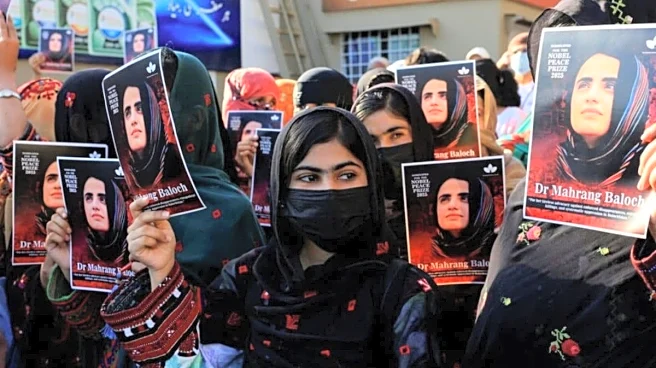
A state usually claims moral agency to present itself as the protector of its people, but in Balochistan that bond appears to have long frayed. Here, leaders are widely viewed as appointees of the security apparatus, and elections as an engineered spectacle. The closure of civic space for voicing grievances in the region is central to understanding why women now pick up guns. When the Baloch Yakjehti Committee (BYC) organised long marches seeking accountability for the Pakistan Army’s conduct and the whereabouts of over 8,000 forcibly disappeared people in the province, it was banned, with many of its prominent leaders, including Dr Mahrang Baloch, imprisoned. Therefore, the mothers and daughters who once sat outside press clubs holding photographs of their sons have concluded that the state listens only to force. In that sense, the rise of female fighters is not merely a military development but a moral indictment.
The 60-year-old Gul Bibi, before her transformation into a suicide attacker as Hatam Naz, was injured during her disappearance by the Pakistan Army for four months a decade ago, in 2016. When the state treats an entire population as suspect, insurgents find fertile ground. The presence of women in combat is thus a mirror held up to Islamabad: it reflects the failure of politics and the triumph of coercion.
The Pakistan Army insists it will defeat the insurgents through force, as the latest DG-ISPR statement declares the conclusion of clearance operations against BLA fighters, but history suggests otherwise. It seems deliberately oblivious to how each of its previous counterinsurgency campaigns has produced only a temporary lull before insurgents emerged far stronger. The current phase, with its visible female participation, may prove the most difficult to contain.
For now, the images from January linger: young women in camouflage speaking into cameras; another standing shoulder to shoulder with her combatant husband; a grandmother’s photograph holding a gun; and roads echoing with gunfire. The emergence of women fighters does not romanticise the insurgency; rather, it underlines a tragedy, revealing how deeply the conflict has entered the social fabric, how despair has crossed gender and generational lines, and, above all, how Pakistan’s battle in Balochistan is no longer only about territory or security but about moral authority, which seems to be slipping away each time another daughter decides that the only language left is the language of war.
The writer is an author and columnist. His X handle is @ArunAnandLive. Views expressed are personal and solely those of the author. They do not necessarily reflect News18’s views.