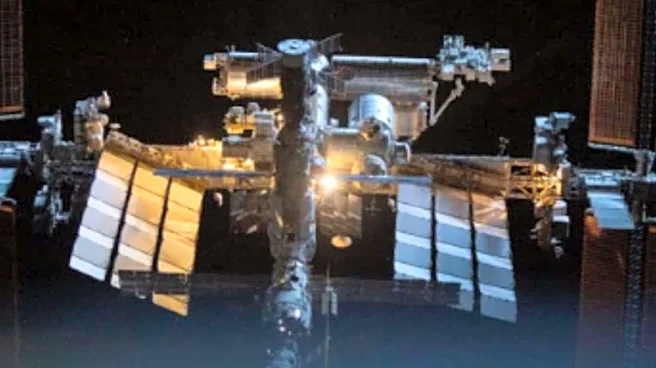




As different parts of the world usher in the New Year at different time zones, a small group of people will ring in 2026 16 times.
At the International Space Station (ISS), the Expedition 64 includes 10 astronauts – Nasa astronauts Mike Fincke (commander), Zena Cardman, Anne McClain, Nichole Ayers, and Chris Williams; JAXA astronaut Kimiya Yui from Japan; and Roscosmos cosmonauts Oleg Platonov, Kirill Peskov, Sergey Kud-Sverchkov, and Sergei Mikaev.
According to New York Post, ISS hurtles around Earth in a speedy 90-minute orbit around the Earth and it travels about 17,500 miles per hour.
This means in 24-hours, the ISS circles around 16 times which means the astronauts see 16 sunrises and 16 sunsets every day. As midnight sets in towards westward
across the globe, from the Pacific islands towards the Americas, the ISS moves overhead multiple times. Unlike on Earth, where a day usually consists of 12 hours of light and 12 hours of darkness, in space astronauts get 45 minutes of daylight and then 45 minutes of darkness.
This will leads to the ISS crew witness the New Year celebrations again and again. However, the astronauts do not party 16 times in real. Their official schedule runs on Coordinated Universal Time (UTC).
UTC is the worldwide scientific standard of timekeeping. According to NASA, it is based upon carefully maintained atomic clocks and is highly stable. The addition or subtraction of leap seconds, as necessary, at two opportunities every year adjusts UTC for irregularities in Earth’s rotation.


/images/ppid_a911dc6a-image-17710654257455666.webp)









/images/ppid_a911dc6a-image-177106302538573741.webp)