

/images/ppid_a911dc6a-image-177077043838376354.webp)


As one passes by a mustard field in Jugrawar village in Rajasthan’s Alwar, there stands a small open temple with cemented walls. Adjacent to the temple is a tiny 8×10 room that has walls made of huge pieces of locally sourced rocks, a slab used as a bench along the wall, a cot, an earthen pot for water and a transistor.
This transistor is Vijay Singh Meena’s only window to the outer world. As he takes off the stole wrapped around his eyes, one can see his distorted face and empty eye sockets—remnants of what he lost almost eight years ago.
On a pleasant winter morning in 2017, Meena and his neighbour had taken his herd of sheep for grazing over one of the hills very close to his house on the Aravallis, when a sudden explosion buried them under
heavy debris.
Meena and his friend, both unaware that illegal mining was recklessly rampant in the region, were pulled out of the rubble by locals as help arrived. While Meena survived, his friend wasn’t as lucky.
But for Meena, the survival doesn’t mean much.
“This survival is worse than what happened to my friend. I’m dependent, my son is still studying, we married my daughter off recently and I couldn’t see her wedding. What is this life? Our economic status is fragile, and I have been reduced to nothing but a useless dependent living being,” Meena tells a CNN-News18 team that reached Jugrawar village to check the ground reality of illegal mining and the effect it has had on residents and the vegetation around.
Meena says he now spends most of his time in the temple that he got made and is mostly found fiddling with his transistor resting on the cot.
The village situated 10 kilometres away from sub-district headquarter Ramgarh has such stories emanating from almost every household that uncover the dark implications of the Aravallis being eaten up by illegal mining.
Just like Meena, Gafoor Khan’s family also has a tragic tale to narrate that exposes the deadly and brutal side of the ongoing illegal mining.
Khan was just 45 when he was diagnosed with tuberculosis. His house, a green-painted single-storey half-pukka-kutcha structure, has cracks on almost every wall. The house lies right at the beginning of a hill that has been heavily mined.
Gafoor’s son Abbas, who lives there with his two brothers and their seven children—including many toddlers—says the dust that rises from multiple crusher machines that have been installed is claiming their lives.
“My father died inhaling this dust. He did not even work in the mines; we just live in the proximity. Now many of our children have breathing issues, they often fall sick. If we leave our house, where do we go? These crushers are running day and night and mining is rampant since months and years,” Abbas, 25, said.
He also shows the walls of his house that are damaged as miners use illegally procured explosives that are damaging houses in its vicinity beyond repairs.
Just meters ahead of Khan’s house lives Mordhwaj with his family.
Mordhwaj got his house built just five years ago, and now all the walls in his rooms have cracks.
“Regardless of time, there will be explosions. Our house rattles like an earthquake has just hit it. Will the government compensate us? Who allowed these illegal miners here to damage our houses we’ve built with our savings and hard-earned money?” he asks.
As Mordhwaj speaks, a group of women carries buckets full of water on their head. The group has a six-year-old girl trying to not spill a single drop of the water that has become a rare resource for the villagers over the years.
While the well and the ponds have dried up, tankers are called in as villagers contribute and pay to avail water for their cattle and other requirements.
“The village has no handpumps, all have gone obsolete. We cannot even get borewell and dwellings. The ground water level has depleted to such a depth that fetching water is a challenge now. This is why women and children travel far to get water. Life, with every passing day, is becoming hard for us here. Many villagers have also relocated from here as problems only increase,” said Vishvendra, a local resident.
Jugrawar is one of the worst-hit villages by illegal mining in the Aravallis.
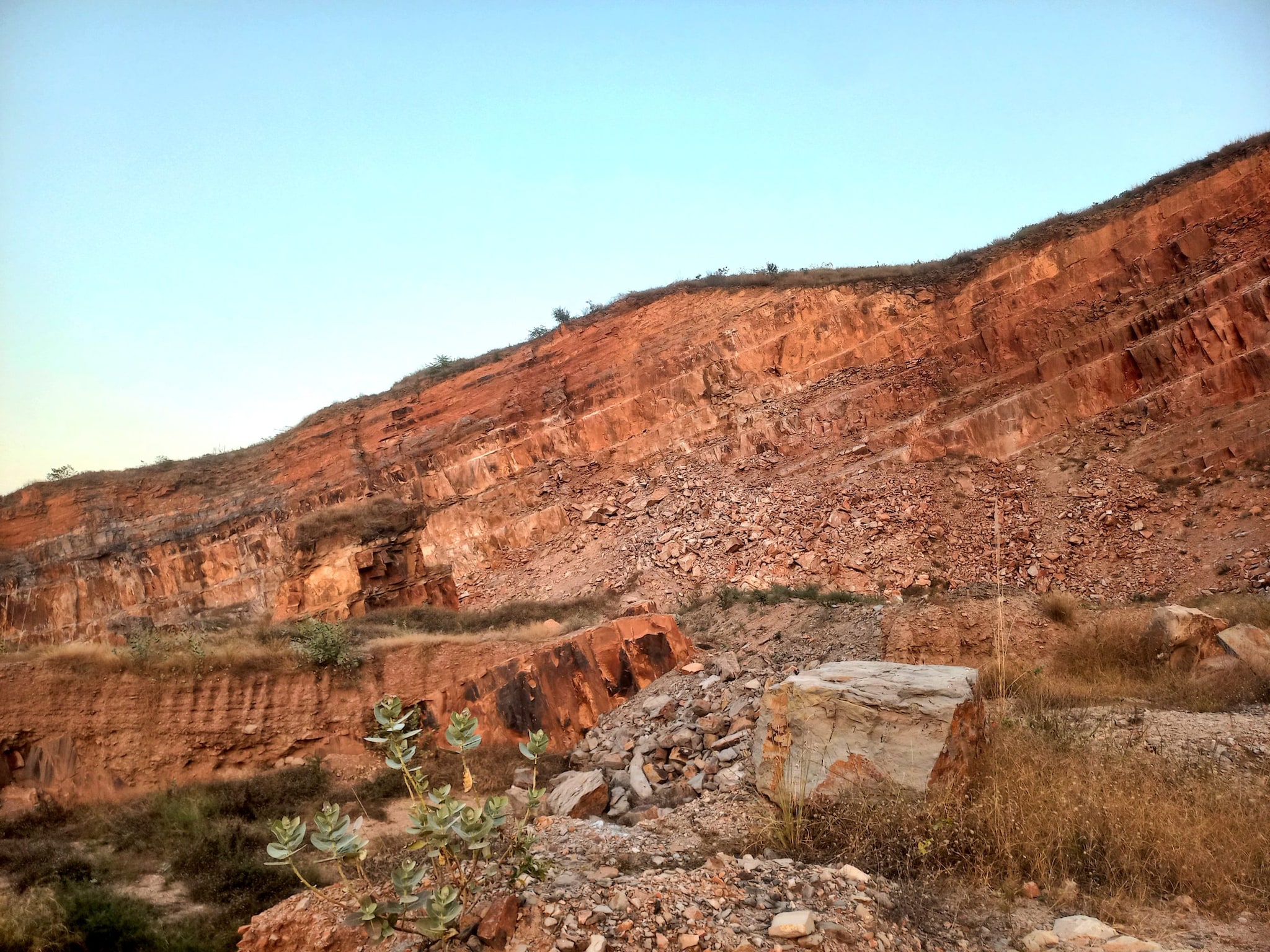
As the CNN-News18 team walked ahead, it came across multiple hills that locals claim were once lush green forests but have been reduced to rubble. Entire hills razed to debris and meters of ranges cut into half—blasted and shrunk to mere pieces of rocks.
Even as the government claims that no new mining leases have been granted in the Aravallis, the CNN-News18 team visited multiple sites where the hills were dug up, revealing the extent of damage to the ecology and the environment.
Fresh marks of movement of heavy machinery, tractors, and trucks evident all around such sites also suggest that vehicles carrying loads of scarce resources out of the Aravallis were a recent phenomenon.
Experts say the Aravalli hills are rich in critical and strategic minerals such as copper, zinc, lead, iron ore, limestone, marble, and rare earth-bearing minerals that are vital for infrastructure, renewable energy, and defence-related industries.
But rampant illegal mining continuing across the Aravalli range, especially in Rajasthan and Haryana, which has caused severe ecological degradation in recent years.
The unregulated extraction has not only led to deforestation, groundwater depletion, air pollution, and the destruction of fragile hill ecosystems that act as a natural barrier against desertification, they say, but has also weakened geological stability, increased human–wildlife conflict, and undermined regulatory institutions, turning the Aravallis into one of India’s most environmentally threatened mineral belts.
/images/ppid_a911dc6a-image-177077603394625504.webp)

/images/ppid_59c68470-image-177077512106794299.webp)

/images/ppid_59c68470-image-177077504615982639.webp)
/images/ppid_59c68470-image-177077515851590090.webp)
/images/ppid_59c68470-image-177077508321758455.webp)
/images/ppid_a911dc6a-image-177077322976413782.webp)
/images/ppid_59c68470-image-177077258165510745.webp)
/images/ppid_59c68470-image-177077272281824806.webp)
/images/ppid_59c68470-image-177077276056749159.webp)
/images/ppid_59c68470-image-177077261155977594.webp)