
Rajat Kapoor seems to have quietly carved a niche for himself as Hindi cinema’s most reliable authority figure — the kind who walks in with files, listens patiently, and delivers the final word. In 2025
alone, the actor has repeatedly stepped into the shoes of senior government officials, playing men who sit just above the chaos while others do the dirty work.
Earlier this year, he appeared as a senior Income Tax officer in Raj Kumar Gupta’s Raid 2, positioned as the superior to Ajay Devgn’s relentless enforcer. More recently, he turned up as a Director General of Police in Netflix India’s Raat Akeli Hai: The Bansal Murders, directed by Honey Trehan, once again occupying the role of the calm, observant senior — this time overseeing Nawazuddin Siddiqui’s troubled ACP Jatil Yadav.
The Cop, the Bureaucrat, and the Problem With Authority Roles
Rajat is fully aware of how frequently he’s being cast in these thinking-man’s authority roles — and he isn’t blind to their limitations either. Speaking to SCREEN, he acknowledged the pattern with a mix of humour and honesty.
“Oh man, income tax, CBI, that’s where I’m stuck at,” Rajat said. “It’s not just a cop role. You’re playing a character in the script. So, you’re just reacting to the situation. But the problem with playing a generic cop of this kind, and not like Nawaz’s because he’s got a role, is that you’ve got nothing to do. He just comes in the end and says, ‘Chalo sab andar!’ That would be boring.”
For Rajat, the distinction is clear — authority figures work only when the script gives them emotional or moral weight. Otherwise, they risk becoming functional furniture.
The ‘Cop Husband’ Returns In Drishyam 3
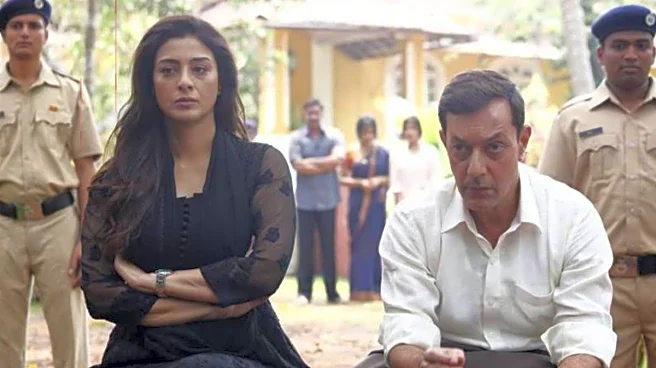
Next year, Rajat will reprise one of his most understated roles — that of the civilian husband to Tabu’s Inspector General Meera Deshmukh — in Abhishek Pathak’s upcoming Drishyam 3. His character exists on the margins of her moral conflict, torn between love, legality, and the quiet horror of what she’s capable of.
Yet Rajat describes the role with characteristic self-awareness. “There’s nothing to crack. I was standing behind Tabu, that’s it,” he said casually. Asked whether the third film might finally give his character an arc, he laughed it off. “There’s no arc. I’m still standing behind Tabu.”
Finding Space To Improvise
Despite the seeming simplicity of his roles, Rajat doesn’t treat scripts as rigid commandments. He believes in allowing space for organic evolution on set.
“You can’t close yourself to that because then you’ve already made your film. The organic process of making a film is to improvise in whatever ways,” he explained. “In all the films I’ve acted in, there’s probably only one film in which the director was so obsessed with what he’d written that he didn’t want one word here to there.”
When pressed to name the filmmaker, Rajat simply shrugged. “I’ve forgotten!”
Working With Smita Sharma Again
Raat Akeli Hai: The Bansal Murders marks Rajat’s second collaboration this year with writer Smita Sharma, following his memorable turn as Hakim in Prime Video’s horror series Khauf. The actor was already sold on the new project because of her writing.
“I’m a huge fan of her writing in Khauf. She did a great job at making everything into horror and creating characters that will be remembered for a long time,” Rajat said. “It’s a really difficult job to write a good series, and she did it excellently. So, I was already excited for this one.”
He also noted a thematic overlap between the two scripts. “The common ground would be her larger social concern, that’s there in Khauf and is also reflected in this one.”
Rajat Kapoor, the Director — Waiting in the Wings
While acting keeps him busy, direction remains a more complicated pursuit. Rajat, who has won multiple National Awards for Tarana, Hypothesis, and Raghu Romeo, hasn’t released a directorial since RK/RKay over three years ago — not for lack of ideas, but funding.
“It’s the same old thing. You never have money. I’m not able to release a film I made two years ago,” he admitted. “But one can be bitter about it or one can say okay, this is what it is. This is the marketspace we live in.”
He’s realistic about the state of independent cinema today. “Forget crowdfunding, the potential audience wouldn’t even pay to watch indie films in theatres today,” he said. Still, he clings to hope.
“There are filmmakers like Payal Kapadia, Rima Das, and Prateek Vats, who will find a way to do it. They may even sell their houses if they have to. They’ll loot a bank if they have to. That’s all a part of the hope.”
/images/ppid_59c68470-image-177065754276587834.webp)

/images/ppid_59c68470-image-17706575780372121.webp)
/images/ppid_59c68470-image-177065753930384882.webp)

/images/ppid_a911dc6a-image-177065567868913302.webp)

/images/ppid_a911dc6a-image-177065562738227437.webp)
/images/ppid_59c68470-image-177065507049415544.webp)
/images/ppid_59c68470-image-177065505265365483.webp)
/images/ppid_a911dc6a-image-177065466501151392.webp)
/images/ppid_a911dc6a-image-17706547039401557.webp)