

India’s approach to humanitarian assistance has expanded steadily over the past decade, shaped by a foreign-policy emphasis on responsibility and timely support during crises. The Modi government has described this outlook through the idea of ‘Vishwamitra’ (a friend of the world), reflecting India’s intention to offer practical help where it can, especially during natural disasters.
This approach has increasingly taken the form of structured Humanitarian Assistance and Disaster Relief (HADR) missions, many of which extend beyond the immediate neighbourhood.
India’s participation in earthquake, cyclone and flood-related relief efforts in recent years, from Nepal and Indonesia to Türkiye, Myanmar and Sri Lanka, illustrates this shift. These deployments
have not been about scale or prestige but about providing targeted capabilities at critical moments: medical support, engineering assistance, temporary connectivity solutions and on-ground stabilisation.
Over time, this has built a reputation for reliability, particularly in the Indo-Pacific and surrounding regions.
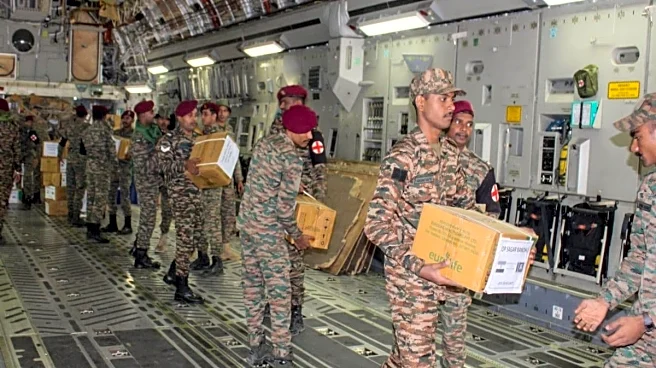
At the centre of this effort is the Indian Army. Its medical, engineering and aviation units have repeatedly operated in difficult terrain and time-sensitive environments, supporting local authorities when civilian systems are overstretched. Whether establishing field hospitals, reopening access routes or assisting displaced communities, the Army’s contributions have become a defining element of India’s HADR profile.
The following case studies present this evolution in detail, tracing how the Army has responded to some of the biggest humanitarian crises of the last decade.
Operation Maitri (2015, Nepal)
The 7.8-magnitude earthquake that struck Nepal on 25 April 2015 flattened entire districts, killed thousands and left Kathmandu Valley in a state of near paralysis. India launched Operation Maitri within hours, and the Indian Army became the backbone of the response.
According to official data, the Indian armed forces flew 2,223 sorties, evacuated about 11,200 people and transported nearly 1,700 tonnes of relief material into Nepal during the operation.
The Army’s Rapid Action Medical Teams provided medical assistance to 4,762 injured people, performed 300 surgeries, admitted 216 patients and handled more than 4,100 outpatient cases in some of the worst-hit locations.
The Engineer Task Force helped reconstruct 55 shelters for displaced families. Army Aviation inducted 567 Nepalese Army personnel into inaccessible areas and ferried relief material into villages such as Lukla, Dhading, Chautara, Barpak and Lamabagar, which had been isolated by landslides. The Army also supplied 10,000 blankets, 1,000 tents and 1,000 tarpaulins to families who had lost their homes.
Former NDRF Director General O.P. Singh said, “We were the first international rescue team in Nepal. Within hours, we had equipment, rescue teams, and canines on the ground. For the first time, we received global recognition.”
This cemented India’s position as the region’s fastest-moving disaster responder.
Operation Samudra Maitri (2018, Indonesia)
When an earthquake and tsunami struck Central Sulawesi in September 2018, Indonesia faced mass casualties, collapsed hospitals and displacement on a large scale. India responded with Operation Samudra Maitri.
Indian Army medical teams set up mobile clinics in Palu and Sigi, treating crush injuries, septic wounds, dehydration and respiratory distress among survivors. Army engineers assisted local authorities in clearing debris and reopening fractured road networks, enabling relief movement into districts where infrastructure had collapsed.
While relief material was transported through air and sea routes, the Indian Army’s medical and engineering teams ensured that assistance was rapidly translated into on-ground care and support for affected communities.
Operation Dost (2023, Türkiye–Syria)
The twin earthquakes that struck Türkiye and Syria in February 2023 caused catastrophic destruction across multiple Turkish provinces. Under Operation Dost, the Indian Army established a 30-bedded field hospital in Hatay, staffed by 99 Army personnel, including surgeons, orthopaedic specialists, anaesthetists and paramedics. The facility became operational within hours of landing.
During the mission, the Army treated 3,604 patients, performing surgeries, stabilising crush injuries and providing critical paediatric and geriatric care. Patients included those pulled from rubble after prolonged entrapment and others injured during severe aftershocks.
India also supplied hundreds of tonnes of relief material, including medicines and diagnostic kits, reinforcing the Army’s operations. Turkish authorities publicly acknowledged India as one of the earliest and most effective responders.
India also sent more than six tonnes of relief material to Syria. On questions about aid to a country facing US sanctions, MEA secretary Sanjay Verma said India followed the G20 mantra of “One Earth, One Family, One Future”, adding that “Sanctions don’t cover such humanitarian assistance.”
Operation Brahma (2025, Myanmar)
A powerful 7.7-magnitude earthquake struck Myanmar on 28 March 2025, killing over 2,000 people. India launched Operation Brahma to provide necessary support, including Search and Rescue (SAR), humanitarian aid, disaster relief and medical assistance. Prime Minister Narendra Modi told Myanmar’s military chief Min Aung Hlaing that “India stands in solidarity with the people of Myanmar in this difficult hour.”
Under the operation, India provided relief supplies of approx 750 MT, including essential medicines, foodgrain, ready-to-eat meals, tents, blankets, gensets, rapidly deployable surgical and medical shelters, water, sanitation and hygiene services, drinking water, essential clothing, 20 prefabricated office/residential structures, etc.
Operation Brahma: Indian Army’s Humanitarian Mission to Myanmar 🇲🇲
In a swift response to the 28 March 2025 earthquake in Myanmar, the #IndianArmy, as part of Operation Brahma, is deploying a specialised medical task force to provide urgent humanitarian aid.
A 118-member team… pic.twitter.com/ESkMGqQ2Bn
— ADG PI – INDIAN ARMY (@adgpi) March 29, 2025
It deployed a 127-member Indian Army field hospital team. The hospital offered a wide spectrum of services: emergency surgeries, orthopaedic intervention, maternal care and treatment for crush injuries and fractures.
MEA spokesperson Randhir Jaiswal had said that when India says “Vasudhaiva Kutumbakam”, “we also want to mean it. We want to prove that by action, and therefore, you know, we are very humbled when we have this opportunity to respond to a crisis such as what has happened in Myanmar and extend our support to people.”
Operation Sagar Bandhu (2025, Sri Lanka)
India launched Operation Sagar Bandhu on 28 November 2025 as the first responder to Cyclone Ditwah, which devastated large parts of Sri Lanka’s east and central districts.
Guided by the Neighbourhood First policy, India moved quickly to deliver life-saving assistance across regions that had been badly hit and, in several cases, rendered inaccessible. Within the first few days, more than 50 tonnes of emergency relief material — including dry rations, tents, tarpaulins, blankets, medical supplies and trauma-care systems — reached Sri Lanka, followed by heavier consignments moved by air and sea. By the end of the first week, India had sent well over 1,000 tonnes of relief material through a combination of airlifts and naval sealifts.
The Indian Army’s role became central as the mission shifted from immediate relief to stabilisation. A modular Indian Army field hospital, airlifted to Sri Lanka in the early phase of the operation, treated thousands of cyclone-affected persons within days, performing surgeries, delivering trauma care and supporting local health services that had been damaged or overwhelmed.
Indian Army medical teams also worked alongside the Aarogya Maitri initiative, deploying BHISHM trauma-care cubes and training Sri Lankan medical personnel in their use.
Army engineers played a crucial part in restoring connectivity. They deployed modular Bailey bridge systems to replace washed-out links in landslide-affected districts, enabling relief material to reach communities cut off since the cyclone’s landfall. The combination of medical support, engineering capability and sustained logistical presence made the Army a core pillar of India’s on-ground humanitarian effort.
Domestic Humanitarian Operations
India’s overseas HADR missions operate alongside an equally demanding responsibility at home. While the Army has long been central to disaster relief within India — whether during floods, landslides or cloudbursts — the past decade has seen these roles acquire greater urgency and frequency.
Extreme weather events now affect multiple states each year, often overwhelming civilian infrastructure. In such situations, the Army’s ability to mobilise quickly, navigate difficult terrain and provide medical and engineering support remains indispensable. The following examples outline how the Army’s humanitarian role continues within India’s borders.
Kerala Floods (2018)
The floods that hit Kerala in August 2018 were the worst in nearly a century, displacing more than a million people and submerging entire districts. The Indian Army deployed over 100 columns across Alappuzha, Pathanamthitta, Ernakulam, Thrissur and Idukki. Soldiers carried out rooftop rescues, navigated dangerously swift currents to reach stranded families and evacuated those trapped without food or medical support.
Army engineers rebuilt washed-out stretches, constructed improvised bridges over broken roadways and cleared landslides that had cut off access to multiple towns. Medical teams operated clinics in relief camps, treating flood-related injuries, infections and dehydration. The Army’s sustained presence allowed civil authorities to stabilise communities and plan recovery in one of the most complex disaster responses India has managed in recent decades.
North India Floods (2025)
Persistent monsoon rainfall in July 2025 triggered severe flooding across Himachal Pradesh, Punjab and Jammu & Kashmir. The Army’s Western Command mounted continuous HADR operations, deploying multiple columns across different states. Soldiers rescued stranded residents, restored road links damaged by landslides and reinforced slopes vulnerable to further collapse.
Army medical teams treated thousands in makeshift relief centres, often working through relentless rainfall that made mobility unpredictable.
Manipur Landslides (2025)
Torrential rain in mid-2025 caused extensive landslides across Manipur’s hill districts, isolating several villages. The Indian Army and Assam Rifles delivered essential supplies, including food, medicines and water, to communities that had lost all road connectivity.
Soldiers worked with state authorities to identify alternative evacuation routes, move vulnerable residents to safety and provide immediate medical care in remote clusters where health access had been cut off.
Arunachal Pradesh Flood Relief (2025)
Flash floods and slope failures in Arunachal Pradesh’s Dibang Valley destroyed bridges and blocked all approach roads, leaving settlements isolated. The Indian Army deployed drones to deliver essential supplies — an innovation tailored to the region’s terrain. Engineering units created improvised access systems, stabilised damaged slopes and maintained a supply chain until weather conditions improved. The operation demonstrated how technology-driven adaptations are increasingly becoming part of the Army’s HADR toolkit.
Conclusion
The Modi era has placed clearer emphasis on India’s humanitarian commitments, and the Indian Army has been central to translating that vision into effective action. Whether assisting neighbouring countries in moments of crisis or supporting state administrations during severe floods and landslides at home, the Army’s contribution has been defined by reliability, speed and practical capability.
As climate-related emergencies increase across the region, the Army’s experience in HADR operations will remain essential to India’s response framework.
/images/ppid_a911dc6a-image-177072008391720047.webp)

/images/ppid_a911dc6a-image-177072003668215260.webp)
/images/ppid_a911dc6a-image-177072016638512152.webp)
/images/ppid_a911dc6a-image-177072012220392505.webp)
/images/ppid_59c68470-image-177072004423273525.webp)

/images/ppid_59c68470-image-177072008151875294.webp)