



The Kerala government on Thursday announced a 583-km Regional Rapid Transit System (RRTS) project connecting Thiruvananthapuram and Kasaragod. The state cabinet has given in-principle approval to the plan.
The new proposal comes after the earlier K-Rail (SilverLine) project was dropped due to technical objections raised by Indian Railways and public opposition in some areas.
A formal letter will be sent to the Central Government expressing the state’s interest in the project. The Cabinet has also tasked the Transport Department to initiate necessary consultations for the same.
After discussions with the Central Government, a Memorandum of Understanding (MoU) will be signed as soon as the in-principle approval of the Centre is received, and the Transport
Department will submit the final approval regarding the technical and financial aspects of the project and sources of credit for the consideration of the Cabinet.
Rapid transport system is an important element in the development vision of the government. Considering the geographical structure and population density of Kerala, a timely and environment-friendly high-speed rail system is essential for the economic and social growth of the state. The central point of this vision is to reduce travel time significantly, connect the regions, and expand employment and education opportunities.
The K-Rall (Silverline) project, which aims to provide high-speed rail connectivity from Thiruvananthapuram to Kasaragod, has not been able to go ahead due to technical objections from the Indian Railways. In addition, there were public objections in some areas.
Till date, the DPR submitted by the state has not been approved by the Railways. The proposals put forward by the Railways for DPR approval are not in line with the rapid development goals of the state. The project cannot be implemented without the approval of the Railways.
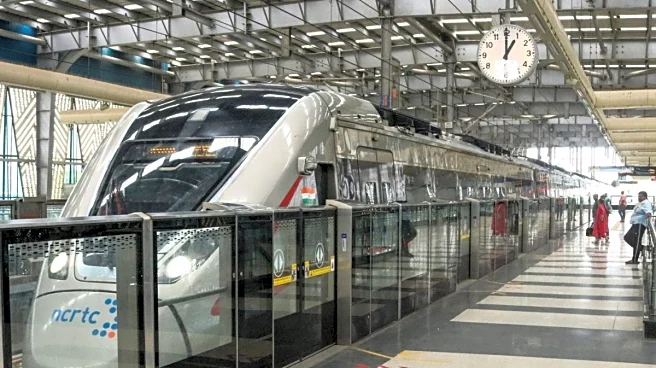
RRTS (Regional Rapid Transit System) is a practical and socially acceptable high-speed rail system. The Delhi-Meerut RRTS corridor has been successfully implemented. Through this, the feasibility of this technology has been proven in India.
The speed of 160-180 kmph, short station intervals and high passenger capacity make RRTS suitable for Kerala as well. In addition, the Meerut Metro is operated in conjunction with RRTS. This system can be implemented completely grade-separated (with pillars).
The Union Ministry of Housing and Urban Affairs has taken a positive stand that the RRTS project being implemented in the Delhi-NCR region through the NCRTC (National Capital Region Transport Corporation) can be considered outside the Delhi-NCR limits. The Union Minister has informed during his visit to Kerala that if the DPR is submitted, the RRTS project in Kerala can also be seriously considered.
It is in this context that the RRTS, a high-speed railway system, is planned to be implemented for Kerala.
Considering the population density of the state and the geography that requires environmental protection, the elevated viaduct model is being adopted instead of the embankment model. This will significantly reduce land acquisition, avoid obstruction of natural water flow, and reduce the differences of opinion that have arisen in some areas. Most of the project will be on pillars, with embankments and tunnels only where necessary.
The RRTS is intended to be integrated with urban metro projects. It will be possible to integrate the existing Kochi Metro and the future metro systems of Thiruvananthapuram and Kozhikode with RRTS stations. Last mile connectivity will improve and reliance on private vehicles will decrease. This will create a unified multi-modal transport network in the state.



/images/ppid_59c68470-image-177084004043125742.webp)




/images/ppid_a911dc6a-image-17708908284999862.webp)