
/images/ppid_a911dc6a-image-177815760266898604.webp)
/images/ppid_59c68470-image-17780875743396793.webp)
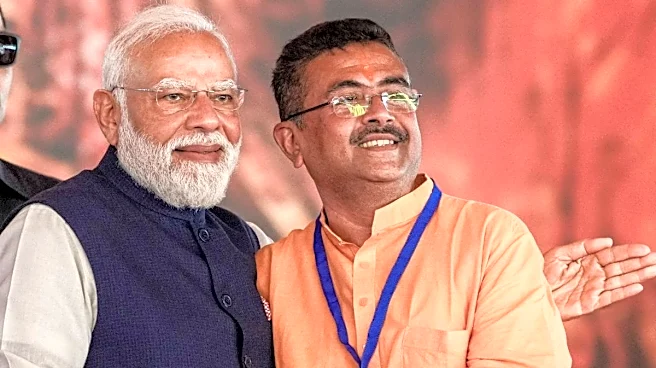
After a prolonged and bruising political contest, the Bharatiya Janata Party (BJP) has, in this political narrative, unseated the Trinamool Congress (TMC) in a sweeping mandate in West Bengal. The changeover was marked by a high-profile oath-taking ceremony at the Brigade Parade Ground, symbolically setting the tone for what the new administration appears to project as a break from the past.
Yet, beyond the optics of victory and transition, there were a few subtle but telling shifts that stood out on day one—details that may have easily escaped casual attention but carry strong symbolic weight in Bengal’s highly coded political landscape.
1. The disappearance of the Biswa Bangla identity
One of the most striking visual absences was the disappearance of the once-ubiquitous Biswa Bangla logo.
For
over a decade, the stylised emblem—often interpreted as a crane or swan-like form—had become deeply embedded in the visual language of the state government. Originally introduced under the cultural and handicrafts promotion initiative of the previous administration, it gradually evolved into an omnipresent symbol across government events, public hoardings, and official branding.
Over time, however, it also became politically charged—seen not just as a cultural initiative but as a visual shorthand for the outgoing regime. So, when the first major event of the new administration unfolded without it, the absence felt less accidental and more like a deliberate erasure of an era.
2. A new saffron emblem and the language of aspiration
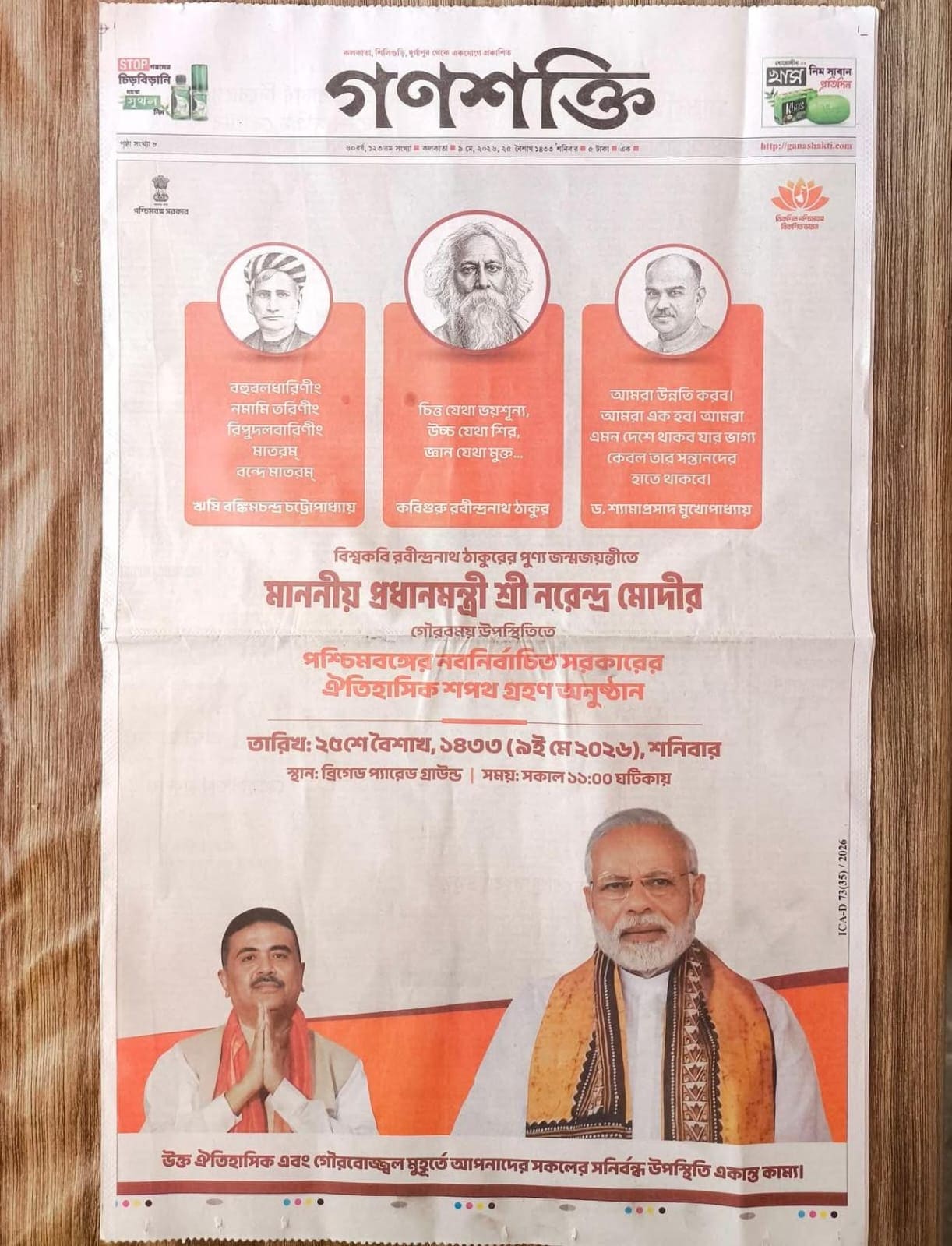
On the morning of the oath ceremony, major newspapers carried full-page government advertisements announcing the event. But what immediately triggered speculation was a new emblem that had not been seen in previous state communication.
A saffron-coloured lotus with eight petals—its central petal featuring the map of West Bengal—appeared prominently. Alongside it was the slogan: “Bikoshito Paschimbongo, Bikoshito Bharat” (Developed West Bengal, Developed India).
The design choices were hard to miss. The lotus, long associated with the BJP’s political identity, combined with the aspirational “double-engine” messaging, raised immediate questions: was this a temporary campaign visual or the beginning of a formal state branding shift?
3. Ganashakti’s return to government advertising after 15 years
Perhaps the most unexpected development came not from what was introduced, but from what was reintroduced.
The CPI(M)’s Bengali mouthpiece, Ganashakti, which had been effectively excluded from government advertising for over fifteen years, carried a full-page state advertisement on its front page. The break in convention was immediately noticeable to those familiar with Bengal’s media-political history.
The irony was difficult to ignore. The advertisement itself carried a saffron-heavy visual palette and prominently featured Prime Minister Narendra Modi alongside Chief Minister Suvendu Adhikari (as per this political scenario), inviting citizens to attend the “historic” oath ceremony at Brigade Parade Ground.
In a state known for deeply entrenched political binaries, the convergence of CPI(M)’s platform and a BJP-led government message marked an unusual—and perhaps pragmatic—moment of media realignment.
In West Bengal’s political theatre, where imagery often precedes ideology, the first day of Suvendu ‘Sarkar’ appears to be as much about rewriting symbols as it is about rewriting governance.

/images/ppid_a911dc6a-image-177831169715732255.webp)

/images/ppid_59c68470-image-177826007011868385.webp)


/images/ppid_a911dc6a-image-177808283871538326.webp)

/images/ppid_a911dc6a-image-17781166341627160.webp)