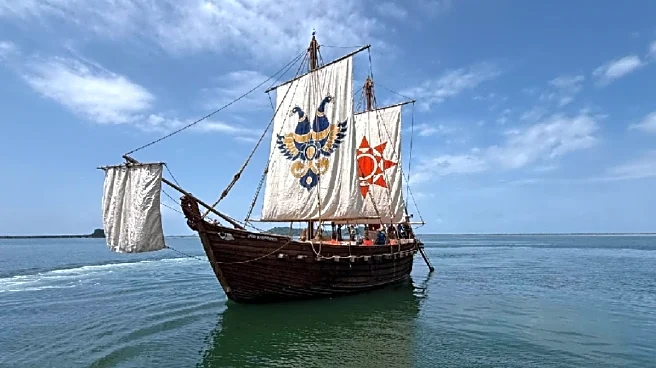




This week, the Indian Navy’s hand-stitched wooden sailing vessel INSV Kaundinya arrived in Oman after 17 days at sea. Named after Kaundinya — the Indian Brahmin who sailed to Southeast Asia, married a Naga princess, and founded the Funan kingdom in present-day Cambodia and Vietnam in the early centuries AD — the vessel was built using an ancient Indian stitching technique, inspired by a 5th-century depiction from the Ajanta Caves.
INSV Kaundinya stands as a reminder that India’s maritime past was neither peripheral nor borrowed. It also signals a reawakening of Indian history from the long slumber imposed by colonial historians, aided and abetted by their Marxist successors.
As India’s history takes tangible shape this week, I turn to Eminent
Distorians: Twists and Truths in Bharat’s History. Its author, Utpal Kumar — a seasoned journalist and rare bibliophile — advances his mission to offer an alternative lens through which India’s past can be analysed, understood and, more importantly, course-corrected.
In the process of doing so, Kumar unwaveringly shuns the ideological preoccupations of leftist historians who held sway in interpreting India’s past for long. His bid is to reflect and highlight those uncomfortable twists and turns that often prohibit viewing historical facts and events outside a predictable, methodical arrangement. Eminent Distorians, a 291-page book with nearly 50 pages devoted to research references, succeeds in striking a responsive chord and offers ample scope for further debate on viewing India’s past beyond a series of invasions.
Unflinchingly, the book uncovers many lesser-known facts, including the maritime exploits of Kaundinya in ancient Southeast Asia, and passionately adds a new word to the lexicon — ‘distorians’ — to exemplify acts of distortion in history writing.
With hindsight, many of the trials and errors of yesteryears can be regretted, and this book appears to undertake soul-searching without rejecting all the liberal virtues that dominated the intellectual scene for decades in independent India. While differing ideologically — and that too very strongly — it keeps room for free and fair debate, which is one of the book’s key achievements. It makes a serious inquiry into earlier interpretations of history carried through an uncontested stream of historiography, calling for a reinterpretation of India’s past to look ahead.
For vantage point, the book’s flap helps: “Bharat’s history is often written as a series of invasions starting with the Aryans knocking on the gates of the subcontinent, followed by Central Asian tribes, the Arabs, Afghans, Turks, and finally Europeans. Mainstream history depicts Bharat as a barren land where various races and cultures arrived at different times. This country, we are told, belonged to each one of these migrants and invaders — or to none of them.” Eminent Distorians challenges this historiography, presenting India’s story from its own perspective.
Among the unique characteristics of the book are:
i) It debunks the Aryan invasion theory, calling the Vedic and Harappan civilisations two sides of the same coin;
ii) it re-evaluates Ashoka’s legacy and the Nehruvian obsession with his ‘greatness’;
iii) it reinterprets Bharat’s ‘golden era’ during the Gupta period and sheds new light on the post-Gupta phase.
To give strong traction to the call for a fresh look beyond academic confines, the book argues that “Islamic conquest in Bharat faced stiff Hindu resistance until Akbar’s diplomatic and matrimonial overtures. When Aurangzeb reverted to confrontation, his empire declined.”
Departing from conventional understandings, Eminent Distorians ponders how the British conquered this country from the Marathas, not the Mughals. It also examines the roles of Mahatma Gandhi, Gandhians, and revolutionaries in ending colonialism, besides decoding the Delhi-centric view of history. Meticulously researched and argued, the book goes beyond the obvious and succeeds in covering significant but often neglected episodes from dynasties such as the Karkotas, Gurjara-Pratiharas, Pallavas, Cholas, and Ahoms, among others.
While the book comments on leftist historians, the most notable mention is that of the 94-year-old Romila Thapar, in the context of the Kluge Prize awarded to her in 2018 by the Library of Congress.
That said, “Her research has profoundly changed the way India’s past is understood both at home and across the world.” On the same page (xxi) of the book’s introduction, an important reference to Edward Luce’s review of Thapar’s Early India in May 2003 for London’s Financial Times is worth noting, as such a narrative still finds itself firmly rooted in certain quarters of mainstream academia: “Romila Thapar’s masterful recent book, Early India, ends before the Islamic era, but it makes it plain that the destruction of temples — a highly combustible issue in today’s India — was also the normal thing for incoming Hindu dynasties to do… Well before Islam appeared in India. Hindu dynasties had erased almost all the Buddhist and Jainist temples of early dynasties.”
Eminent Distorians aptly responds to these distortions and more.
Towards the fag end (pages 234–35), the book presents a proposition that may have many takers but is not free from contestation: “The free nation that was born in 1947 was unapologetically Hindu. This was also evident from the look of the original Constitution.” The book includes 22 illustrations, created under the guidance of Nandlal Bose, within its main body. While illustrations from the ancient era ranged from a Mohenjodaro seal to a scene of a Vedic ashram, from Rama’s victory over Ravan to Krishna propounding the Gita to Arjun, and Buddha delivering a sermon, those chosen to represent the medieval era were a Hindu sculpture from Odisha, the image of Nataraj, a Mahabalipuram scene depicting the penance of Bhagiratha, and the descent of the Ganga.
Among Muslim themes, only the portrait of Akbar found space.
The other two individuals included in the medieval list were Shivaji and Guru Gobind Singh.
In the modern era, Gandhi’s Dandi March and his visit to riot-hit Noakhali, along with Subhas Chandra Bose and his INA, found space, indicating that revolutionaries had not yet been pushed to the margins (Source: S Gurumurthy’s Eternal India and the Constitution, India First Foundation, 2005).”
The final words of the book put it bluntly, while acknowledging that this is a work in progress: “Bharat, thus, was born as a Hindu state in 1947. It was the Nehruvian conspiracy in the 1950s, which saw further ascendancy in the 1960s and 1970s, that pushed the country towards a socialist, secular order, much against the civilisational grain of this land. And in all this, our eminent distorians played a prominent role. How Bharat lost its Hindu-ness within a few years of regaining it, soon after independence, is another sordid saga — for another book.”
Between India and Bharat, between pride in what has been achieved since 1947 and lament for opportunities foregone, the world’s largest democracy and a great civilisational nation deserves a renewed sense of history — free from ‘isms’, free from holy and unholy biases. This week, with the successful journey of INSV Kaundinya, as India’s history comes out of theory to become a lived reality, it is time to relook at Indian history afresh with Utpal Kumar’s Eminent Distorians. It is time we unshackled the country’s history, hijacked by Marxist historians.
Atul K Thakur is a policy professional, columnist and author (most recently co-authored ‘Kathmandu Chronicle: Reclaiming India-Nepal Relations’; Penguin Random House India). Views expressed in the above piece are personal and solely those of the author. They do not necessarily reflect News18’s views.