

/images/ppid_a911dc6a-image-17700130559368310.webp)
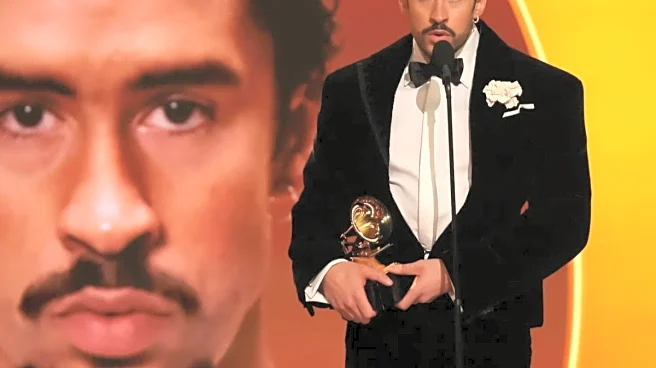
The Grammys hadn’t even fully warmed up when Bad Bunny made it clear the night wouldn’t be just about music. As soon as he stepped on stage to accept his first televised award at the 2026 ceremony, the global superstar turned the spotlight toward immigration, identity and compassion, delivering one of the evening’s most talked-about moments.
Even before his win, Bad Bunny had already broken new ground at the 68th Grammy Awards. The Puerto Rican artist became the first Spanish-language performer to be nominated in all three top categories — Album of the Year, Record of the Year and Song of the Year — and entered the night with five nominations overall. He had also been announced earlier as the winner of Best Global Music Performance.
His first
on-air Grammy of the evening came in the Best Música Urbana Album category. Taking the stage, Bad Bunny used his acceptance speech to directly criticise U.S. Immigration and Customs Enforcement (ICE) and the broader climate around immigration enforcement.
“Before I say thanks to God, I gotta say ICE out,” he said. “We’re not savage, we’re not animals, we’re not aliens. We are humans, and we are Americans. Also, I will say to people, I know it’s tough to know not to hate on these days and I was thinking sometimes, we get contaminados [contaminated], I don’t know how to say that in English. Hate gets more powerful with more hate. The only thing that is more powerful than hate is love. So please, we need to be different. If we fight we have to do it with love. We don’t hate them. We love our people. We love our family, and that’s the way to do it: With love. Don’t forget that, please. Thank you.”
The speech added to what is already shaping up to be a defining year for the artist, born Benito Antonio Martínez Ocasio. In addition to his strong showing at the Grammys, Bad Bunny is set to headline the Super Bowl halftime show in just a week — a choice that has sparked both excitement and controversy.
As Donald Trump’s administration intensifies immigration enforcement and ICE activity, the NFL’s decision to feature Bad Bunny has drawn criticism from conservative groups and MAGA supporters. The singer has previously spoken out against ICE and Trump, and has said he avoided including U.S. tour dates out of concern for fans’ safety amid immigration raids.
Trump has also weighed in, telling the New York Post that he would not attend the Super Bowl and criticising the halftime lineup. “I’m anti-them,” Trump said. “I think it’s a terrible choice. All it does is sow hatred. Terrible.”
Meanwhile, conservative organisation Turning Point USA has announced plans to stage a counterprogrammed “All-American Halftime Show,” though details remained limited in the days leading up to the game.
Beyond politics and awards, Bad Bunny also made waves on the fashion front at the Grammys. His corseted tuxedo, designed by Daniel Roseberry in his first menswear creation for Schiaparelli, landed the singer a spot on Vanity Fair’s Grammys 2026 best-dressed list.