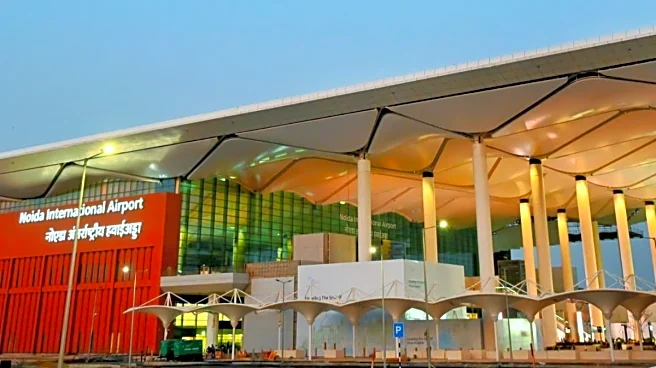




Prime Minister Narendra Modi arrived at Jewar by helicopter on 28 March 2026, landed at a gleaming new apron 72 kilometres south-east of Delhi, and walked into a terminal that did not exist four years ago. The inauguration of the Noida International Airport marked the end of a construction sprint that cost roughly Rs 10,050 crore.
Delhi now has two international airports. The question now is whether that arrangement produces a genuinely larger market or simply splits the existing one.
IGI handled 79.2 million passengers in the 2024–25 financial year, ranking it among the nine busiest airports in the world, and its operator was already drawing up expansion plans for 125 million by the time Jewar’s gates opened. Jewar starts smaller, with a single
3,900-metre runway and a Phase 1 terminal rated for 12 million passengers annually, projected to increase to 70 to even 100 million after completion of all phases.
If both airports reach numbers approaching those, the NCR would have more combined capacity than the London system. Whether the economics, the regulatory framework, and the surface infrastructure are in any shape to support that trajectory is considerably less certain.
The Demand Is Not In Dispute
IGI has been running close to its limits for several years. The revamped Terminal 2 returned to service in October 2025, carrying roughly 15 million passengers per year, bringing combined terminal capacity across the three buildings to around 105 million annually. Even at that level, the airport was handling 79 million actual passengers in FY25, and DIAL was simultaneously advancing plans to extend capacity to 125 million by 2029–30.
Delhi-NCR’s air traffic has grown, and the numbers follow a demand curve that has been running well ahead of India’s ability to accommodate it. Delhi-NCR’s air traffic has grown by 8 to 9 per cent annually. It has been sustained by rising incomes, corporate expansion along the Yamuna Expressway corridor, and a domestic airline market that added tens of millions of first-time flyers through the pandemic recovery.
Crisil Ratings estimated in early 2026 that alternate airports across NCR, Mumbai, and Goa would collectively bring roughly 40 million passengers of new annual capacity online by the end of the current fiscal year, rising to 50 million by FY2030. India’s aviation bottleneck, in other words, is not a question of whether enough people want to fly; it is a question of whether airports, runways, and surface connections can be built fast enough to accommodate them.
A Catchment That IGI Cannot Reach
Jewar’s most compelling case rests less on relieving IGI than on accessing a traveller base that IGI has never been able to serve efficiently. The airport’s catchment extends across western Uttar Pradesh, eastern Haryana, and parts of Rajasthan: a region that contains tens of millions of residents for whom a journey to Palam in south-west Delhi takes two to three hours.
The Yamuna Expressway, which runs directly past the airport’s entrance, connects Noida and Greater Noida in under an hour and reaches Agra in less than two. The Samsung and Microsoft facilities in Noida, the industrial estates along the expressway corridor, and the textile and manufacturing clusters of western UP represent an addressable market that no existing airport has served with any convenience.
The geography is amplified by the international route profile that the airport management has already been cultivating. The Gulf corridor is central to Jewar’s early international ambitions: Air India Express is expected to focus its initial international operations on short-haul routes to the UAE and the broader Middle East, targeting the large blue-collar and lower-middle-class migrant worker population in western UP and eastern Haryana, for whom direct access matters enormously.
This is a distinct market segment from the premium business and leisure travellers who anchor IGI’s international traffic. Done correctly, it is not substitution; it is an expansion of the addressable market.
The Airline Economics Problem
The demand case, however, runs into a market problem. India’s commercial aviation sector is, in practice, a near-duopoly: IndiGo and Air India together account for close to 90 per cent of domestic market share. Every slot assigned to Jewar must be filled by one of two dominant carriers, and those carriers are simultaneously anchored at IGI with established slot portfolios, loyal corporate accounts, and the network efficiencies that come from operating at a hub airport with deep connectivity.
The incentive to cannibalise their own IGI operations by shifting capacity to Jewar is limited, even if Jewar offers lower charges, which it does: the Uttar Pradesh government has reduced jet fuel VAT to 1 per cent for the airport, and the Airport Economic Regulatory Authority has proposed user development fees in the range of Rs 210 for domestic passengers, below the benchmarks at IGI.
The contrast with Navi Mumbai is instructive. The Adani Group controls both Mumbai’s Chhatrapati Shivaji Maharaj International Airport and the new Navi Mumbai greenfield facility. That gives a single operator the incentive and the leverage to migrate airlines between its two assets without creating competitive tension between them. Zurich Airport, as a concession operator at Jewar with no stake in IGI, does not have such an incentive. It must attract airlines on the merits of cost, catchment, and route economics alone, competing directly against a facility that has decades of slot history, a deeper route network, and far superior current connectivity.
The Connectivity Gap That Exists
The most immediate constraint on Jewar’s commercial trajectory is one that no amount of airline incentive can resolve in the short term: getting passengers there. On the day of inauguration, the airport’s surface connectivity consists of the Yamuna Expressway, feeder bus services from Noida and Greater Noida, and app-based taxi services. The metro connections that would make the airport genuinely accessible to Delhi’s mass-market travellers remain years from reality.
The Greater Noida to Jewar metro link has completed its DPR but has not begun construction. The Ghaziabad to Jewar Rapid Rail Transit System, which would offer journey times of 37 to 72 minutes from central NCR, is in the planning phase with a projected completion no earlier than 2031. The Ballabhgarh to Jewar metro corridor has not yet completed a DPR.
It matters for the traveller profile Jewar needs to attract in its first phase. The domestic leisure and lower-cost traveller from Noida and Greater Noida is precisely the segment most sensitive to last-mile access. A passenger choosing between Jewar and IGI who lives in Delhi will, for the foreseeable future, face a longer, more expensive, and less predictable surface journey to the newer airport.
The airport’s management has partially mitigated this by securing direct bus links from the Botanical Garden metro station and Pari Chowk, and by providing a direct connection to the expressway system. But until the metro arrives, Jewar’s accessible market will remain materially smaller.
There is a third constraint, less visible than connectivity but consequential for the kind of hub ambitions the master plan implies. Both IGI and Jewar sit within the Delhi Flight Information Region, managed by the Airports Authority of India.
When both airports are operating at scale, with IGI handling upward of 86 aircraft movements per hour under its expanded capacity and Jewar adding its own departure and arrival streams, airspace coordination becomes a non-trivial operational challenge. The two airports share terminal control airspace and approach paths. This again will require carefully managed separation standards, particularly as Jewar scales from its initial 50 daily flights to the hundreds of daily movements implied by Phase 2 and beyond.
A Credible Beginning, With Known Risks
The inauguration of Jewar is genuinely significant. It demonstrates that India can build complex greenfield infrastructure to international specification, on a compressed timeline under a private concessionaire, in a sector where the country’s record has been uneven.
The terminal, designed by a consortium including Grimshaw and Nordic Office of Architecture, has been widely praised for its quality and its cultural references to Uttar Pradesh’s riverine landscape. The cargo infrastructure, developed in partnership with Air India SATS, positions the airport as a multi-modal logistics node for the pharmaceutical and electronics clusters that line the expressway. Akasa Air’s decision to anchor an MRO facility at Jewar signals confidence that goes beyond the launch phase.
The test, however, is not the inauguration. It is whether, five years from now, Jewar has built a route network that draws on its own demand base rather than diverting it from IGI; whether the RRTS and metro links have arrived to make the airport genuinely accessible; and whether the airspace and regulatory framework has matured to manage two major airports in the same metro without the kind of slot congestion and coordination failures that have periodically disrupted Delhi’s aviation system.
Modi’s runway is open, and the foundation stone is laid. The rest of the work is structural, institutional, and unglamorous, which is precisely where India’s infrastructure story has most often stalled under previous governments. Whether Delhi NCR becomes a genuine dual-hub market or a city with two airports pulling against each other will be decided not by a day of fanfare, but by the decade of policy and investment discipline that follows it.