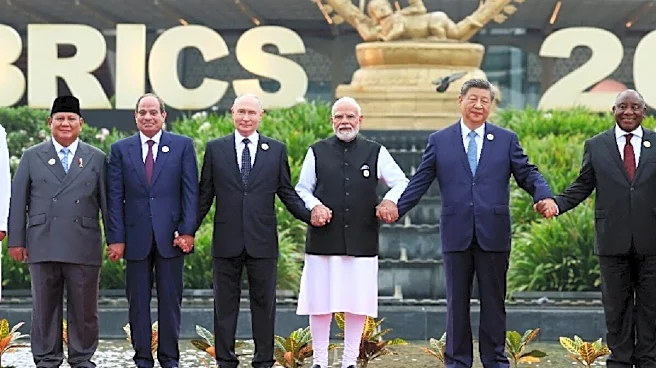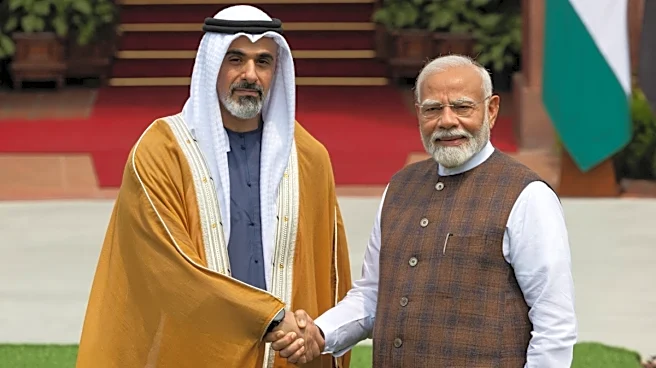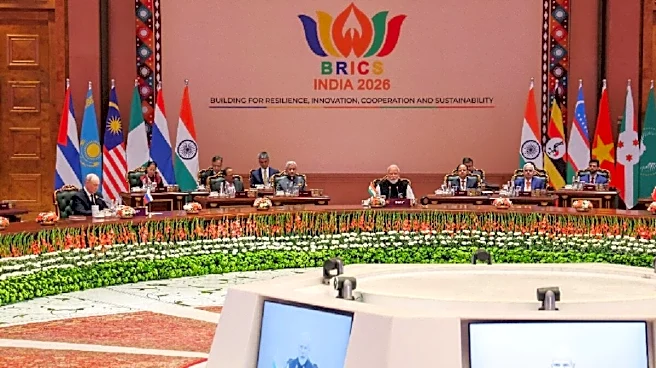




As leaders of the expanded BRICS grouping gather in New Delhi for the 18th BRICS Summit, the bloc has grown far beyond its original five-member structure. Under India’s 2026 chairship, BRICS is being presented as a grouping of 11 countries spanning four continents and representing nearly half of the world’s population and a substantial share of the global economy.
11 Countries, 4 Continents
According to the Indian government’s latest BRICS backgrounder, the grouping currently comprises 11 countries Brazil, China, Egypt, Ethiopia, India, Indonesia, Iran, Russia, Saudi Arabia, South Africa and the UAE.
Together, they account for 49.5% of the world’s population, 40% of global GDP and 26% of global trade. The bloc’s geographical reach now extends across
four continents Asia, Africa, the Middle East and Latin America.
A caveat applies to Saudi Arabia: while India’s official BRICS material lists it among the 11, Reuters reported on September 12 that Riyadh has not formally accepted the invitation to join.
Nearly 4 Billion People
An MP-IDSA analysis estimates the population of the 11-country grouping, including Saudi Arabia, at around 3.9 billion, or approximately 48% of the global population. The Indian government’s current BRICS figure is slightly different, putting the grouping’s share at 49.5%.
Within the bloc, India has the largest population, with the UN-based 2026 estimate putting its population at around 1.477 billion. China follows with around 1.413 billion.
$32 Trillion-Plus Economy
The combined nominal GDP of the 11 countries is estimated at more than $32 trillion in 2026, according to MP-IDSA. In purchasing-power-parity terms, the combined economy is estimated at around $78 trillion, accounting for more than 40% of global GDP.
China is the bloc’s biggest economy in nominal terms. The IMF’s 2026 projection puts China’s GDP at around $20.85 trillion, compared with around $4.15 trillion for India.
India: Population Powerhouse
India is not only the most populous country in BRICS but also the world’s most populous country in 2026, with about 1.477 billion people according to UN-based estimates. Its population is considerably larger than that of China, which stands at around 1.413 billion.
Ethiopia: Youngest Population
Among the BRICS countries, Ethiopia has the youngest population. UN World Population Prospects-based 2026 estimates put Ethiopia’s median age at 20.4 years. By comparison, India’s median age is around 30.2 years and China’s around 41.7 years.
Saudi Arabia: Biggest Oil Producer If Counted
Saudi Arabia is the largest oil producer among the countries counted in India’s current 11-member BRICS list. 2025 production data put Saudi Arabia at around 11.21 million barrels per day, ahead of Russia at around 10.53 million barrels per day when oil and petroleum liquids are counted.
However, because Saudi Arabia’s formal BRICS membership remains disputed, the safer wording is: “Saudi Arabia is the largest oil producer among countries included in India’s current BRICS list.”
Russia: The Bloc’s Largest Country By Area
Russia is by far the largest BRICS country geographically, covering about 17.2 million square kilometres. The BRICS Joint Statistical Publication records Russia’s territory at roughly 17.234 million sq km, far ahead of China and Brazil.
A Bloc With More Than Economic Weight
Beyond its headline numbers, the expanded BRICS grouping brings together major energy producers, the world’s two most populous countries, large emerging markets and some of the world’s fastest-growing economies.