

/images/ppid_a911dc6a-image-17825605286991095.webp)



Boney Kapoor made Hum Paanch in the 1980s, and the movie turned out to be a massive hit, which prompted Kapoor to take an even bigger risk. In 1983, he decided to make Woh Saat Din and launched his brother Anil Kapoor with it. The movie went on to become an even bigger success. Apart from Anil, the film also starred Padmini Kolhapure and Naseeruddin Shah in pivotal roles.
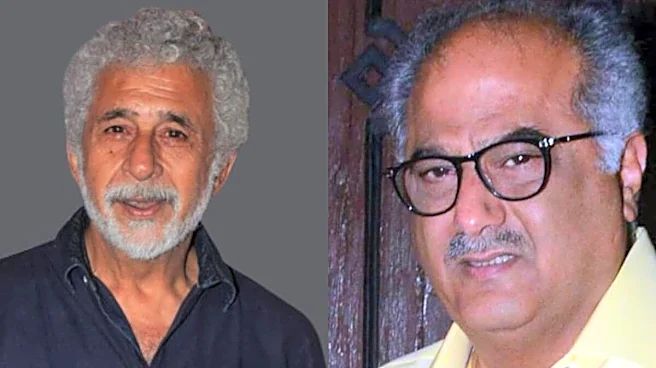
Now, as the film turns 43,Boney Kapoor, in a recent interview with Variety India, shared that Naseeruddin Shah was initially hesitant to do the movie as he didn’t wish to box himself into playing the “big brother” role, but Boney convinced him to do the film.
Sharing the anecdote, Kapoor said, “Initially, he didn’t want to do the film. It took a while for me to chase him and
pin him down. I asked him why he didn’t want to do it. He said, ‘I don’t want to get stuck in this bade bhai (big brother) stereotype.’ On the day he was supposed to let me know his decision, I landed up at his house. He was sitting at a writing desk, writing to me why he wouldn’t do the film. I said, ‘Nothing doing, Naseer, you can’t escape this.’ Also, in those days, buying a Fiat car was impossible, and he wanted to gift Ratna one. I helped him get that.”
Recalling how the film was made, Kapoor shared, “Bapu was then offered a Telugu production, the remake of the 1981 Tamil film ‘Andha 7 Naatkal’, directed by the late K. Bhagyaraj. He invited me to accompany him to see some of the reels. There was still some work left to be done. At the time, there was no intention to remake the film in Hindi. After watching the film, I told Bapu he had to make it in Telugu, so he started working on it. I couldn’t get over the film. I wanted to buy the rights for a Hindi version, but Bhagyaraj wasn’t keen on giving them up because his ‘Ek Hi Bhool’ with Jeetendra and Rekha had just become a big hit, and he was probably awaiting better prospects. In the end, though, I convinced him to let me remake ‘Andha 7 Naatkal’ in Hindi.”
Following K. Bhagyaraj’s demise, Anil Kapoor took to his X account to pen a tribute for him, where he wrote about Woh Saat Din and said, “Woh Saat Din, adapted from his work, became one of the most important films of my career. I will always remain grateful for what he contributed to my career and to Indian cinema as a whole.”
/images/ppid_a911dc6a-image-178258155628314056.webp)

/images/ppid_a911dc6a-image-178253955187977360.webp)
/images/ppid_a911dc6a-image-178257802980833087.webp)
/images/ppid_a911dc6a-image-178263057616630313.webp)
/images/ppid_a911dc6a-image-178258855756934173.webp)
/images/ppid_a911dc6a-image-178263755747458362.webp)