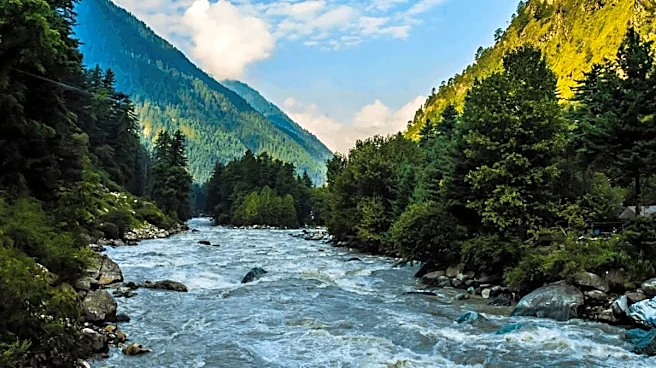

For years, Himachal Pradesh’s Parvati Valley has occupied a strange space in India’s tourism landscape. The villages of Kasol, Tosh, Chalal and Pulga are celebrated by backpackers for their Himalayan scenery, music festivals and psytrance culture. But the same region has also been repeatedly linked to allegations of drug abuse, illegal parties and weak enforcement. This uneasy balance between tourism and regulation has now turned into a major legal battle that has reached the Supreme Court.
The controversy began through a set of public interest litigations before the Himachal Pradesh High Court, including one filed by the Himalayan Environment Protection Society. The petition alleged that rave parties were being organised in the name of tourism
in Kasol, Jibhi, Manali and other parts of Kullu, where narcotic substances were openly consumed and sold under political patronage and administrative protection. The petition claimed that entry tickets for some such events ranged from Rs 5,000 to as high as Rs 7 lakh.
A fresh trigger came in June 2026, when reports highlighted a large music event near Kasol scheduled from June 7 to June 11. According to material placed before the court, ticket prices were reported to be between Rs 10,000 and Rs 16,000 per person, with visitors arriving from Delhi, Chandigarh, Bengaluru, Hyderabad, Goa and even Israel. The event was expected to attract several thousand participants.
Taking serious note, the High Court asked the Kullu District Legal Services Authority (DLSA) to inspect the venue and sought personal affidavits from the Deputy Commissioner (DC) and Superintendent of Police (SP). The DLSA report became central to the case. It stated that permission for sound and music had been granted on June 6 despite an adverse report submitted a day earlier by the Deputy Superintendent of Police, who had warned that the isolated venue was vulnerable to drug trafficking and unlawful activities and that the local police lacked sufficient manpower to monitor a crowd expected to exceed 3,000 people.
The inspection reportedly found infrastructure capable of accommodating about 4,000-5,000 people, temporary toilets, large quantities of empty liquor bottles, rolling papers commonly associated with cannabis use, refrigerators stocked with alcohol and high-powered DJ equipment. The court also recorded that two tourists were allegedly found with cocaine and LSD, and that a Russian national who had performed as a DJ was suspected to have died due to a drug overdose, though the cause was subject to medical examination.
In a strongly worded order dated June 24, the High Court described the case as a “classic case of abject surrender” by the district administration. It directed the transfer of the Kullu DC, SP and SDM, ordered departmental proceedings against them, and further directed registration of an FIR and constitution of a Special Investigation Team headed by an officer not below the rank of Deputy Inspector General. The court said the sequence of events suggested that, but for judicial intervention, the party would have continued from June 7 to June 11 on the strength of the officials’ tacit permission.
The officers challenged the order in the Supreme Court. On July 27, a three-judge bench led by Chief Justice of India Surya Kant stayed the High Court’s directions for registration of an FIR and formation of the SIT, providing interim relief against the criminal investigation. However, the Supreme Court refused to interfere with the direction transferring the officers. During the hearing, senior advocate Madhavi Divan argued that the events were music concerts rather than rave parties and that the officials had not been given an adequate opportunity to respond to the DLSA report. Justice Joymalya Bagchi remarked that such concerts could be used as a cover for rave activities.
The case has therefore not ended. The Supreme Court has paused the criminal probe, but it has allowed the administrative consequences to continue. More broadly, the dispute has exposed a larger question facing Himachal Pradesh: how to regulate a lucrative party-tourism economy without allowing the mountains to become a zone where the law appears to arrive only after the music has already begun.
/images/ppid_59c68470-image-178516752249983260.webp)

/images/ppid_59c68470-image-178523502465923934.webp)


/images/ppid_a911dc6a-image-17850691354656803.webp)


/images/ppid_a911dc6a-image-17849676769087991.webp)