
/images/ppid_59c68470-image-177094504615411398.webp)
/images/ppid_a911dc6a-image-177094403738091205.webp)
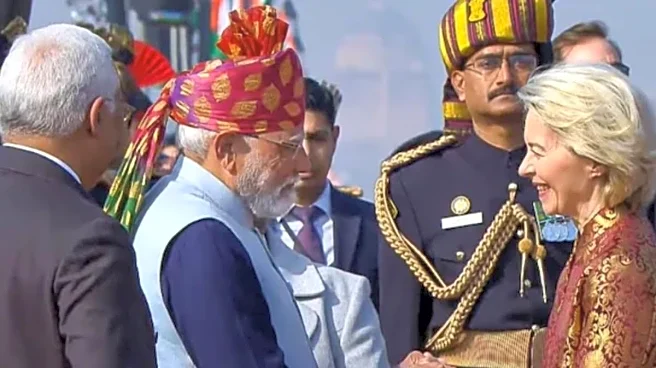
European Commission President Ursula von der Leyen on Monday said that a successful India plays a vital role in making the world more “stable, prosperous and secure,” as she attended the Republic Day parade as a chief guest amid expectations of a landmark India–EU trade agreement.
Calling her presence at the celebrations an “honour of a lifetime,” von der Leyen joined European Council President António Costa as India marked its 77th Republic Day at Kartavya Path.
She shared her remarks in a post on social media, underscoring India’s growing global importance. “A successful India makes the world more stable, prosperous and secure. And we all benefit,” she wrote.
It is the honor of a lifetime to be Chief Guests at the Republic Day celebrations.
A
successful India makes the world more stable, prosperous and secure.
And we all benefit ↓ https://t.co/boeqFGv15Q
— Ursula von der Leyen (@vonderleyen) January 26, 2026
Von der Leyen is on a three-day visit to India and is scheduled to hold summit-level talks with Prime Minister Narendra Modi on Tuesday, where the two sides are expected to announce the conclusion of negotiations for the long-pending free trade agreement.
India–EU Trade Deal Nears
Ahead of her visit, von der Leyen described the proposed pact as a “historic” agreement that could reshape economic ties between India and the 27-nation European Union.
Speaking at the World Economic Forum in Davos last week, she said the deal would create a combined market of nearly two billion people, accounting for close to a quarter of global GDP.
She added that the agreement would give Europe an early advantage in one of the world’s fastest-growing and most dynamic economies, aligning with the EU’s strategy to deepen engagement with emerging growth centres.
The European Union is currently India’s largest trading partner, with bilateral trade in goods valued at $135 billion in the 2023–24 financial year.
Negotiations for the free trade agreement were first launched in 2007, stalled in 2013, and revived in 2022.
As part of the discussions, India is reportedly considering steep cuts in import duties on cars from the EU, potentially reducing tariffs to 40 per cent from as high as 110 per cent.
Under the proposal, duties on a limited number of high-value imported vehicles would be lowered immediately and phased down further over time, easing market access for European automakers such as Volkswagen, Mercedes-Benz and BMW.
/images/ppid_59c68470-image-177094778070247070.webp)

/images/ppid_59c68470-image-177094774796122738.webp)
/images/ppid_59c68470-image-177094760561149068.webp)
/images/ppid_59c68470-image-177094753760312086.webp)
/images/ppid_59c68470-image-17709476750941928.webp)
/images/ppid_59c68470-image-177094757431594714.webp)
/images/ppid_59c68470-image-177094764650175790.webp)
/images/ppid_59c68470-image-177094770953263948.webp)
/images/ppid_59c68470-image-177094761449961991.webp)
/images/ppid_59c68470-image-177094753833787776.webp)