


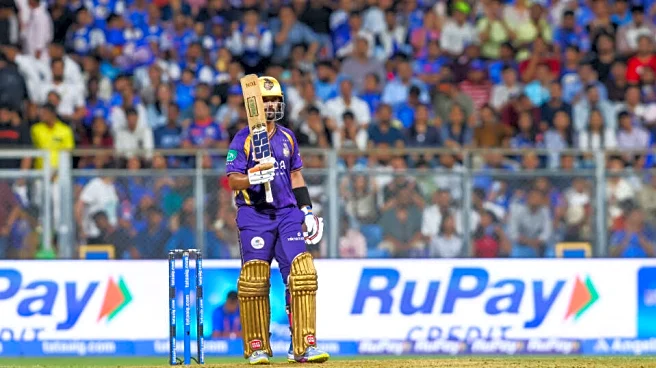
Defending champions Kolkata Knight Riders, still searching for early-season momentum in their IPL campaign, returned to Eden Gardens hoping home comforts would spark a turnaround, but the initial look at their own square has raised as many questions as answers about how well the conditions actually suit them.
There was no overt criticism from within the camp, yet the expressions in the KKR dugout and the cautious tone adopted by head coach Abhishek Nayar hinted at a lingering discomfort, even as he repeatedly refused to lean on the pitch as a shield for any potential shortcomings.
Pressed several times about the surface on the eve of their clash with Sunrisers Hyderabad, Nayar kept a tight rein on his responses, even lightening the mood by quipping
that he might get “siphoned off for something else” by the anti-corruption unit, but the core of his stance remained unchanged — KKR would accept the conditions and move on without any “excuses”.
“I think the beauty of our sport is the fact that it is unpredictable. When you’re explaining cricket to someone who doesn’t know the game, you tell them that if the sun is out, the pitch is good; if the clouds are in, the bowlers are in. That’s the beauty of the game — you want the unexpected,” Nayar said.
In their previous title defence, KKR had slumped to eighth place, their poorest finish since 2009, dropping four of seven matches and managing only two wins at Eden Gardens, a run that intensified scrutiny on a home track perceived to be at odds with their traditional spin-heavy template.
Those doubts seem to have carried into the new season, despite sweeping changes in both the coaching group and the playing personnel.
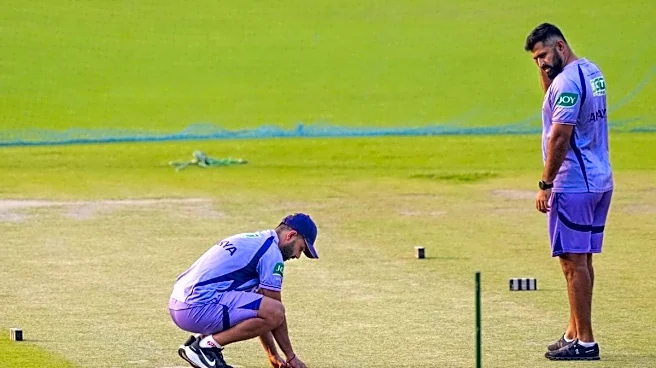
On the day before their opening home fixture, captain Ajinkya Rahane and Nayar conducted a lengthy inspection of the strip with curator Sujan Mukherjee, with Rahane even stretching out on the turf to get a close feel of the surface.
The pitch, which was later watered and given a light roll, displayed a noticeable green shade, adding another layer of uncertainty to how it might play.
“Just because there’s grass on the pitch, it doesn’t change how we look at the game. We, as players and support staff, have to be professional enough to take what’s put in front of us and run with it. Those are circumstances — sometimes they work, sometimes they don’t.”
Shortly before Nayar faced the media, SRH head coach Dainel Vettori admitted he was taken aback by the amount of grass and predicted that spinners were unlikely to find much assistance.
Nayar, though, maintained that he was not taken by surprise, pointing instead to the recent spell of unseasonal showers as the primary reason behind the greener look.
“Am I surprised? I’m not, because there has been rain around over the last couple of days. It’s not easy for the groundsmen as well. So whatever is prepared for us, we’ll try to make the most of it. We’ll try to play the kind of cricket we can without any excuses. At the end of it, our honest judgment is that whatever we get, we try to put our best foot forward. No excuses.”
Beneath that diplomatic exterior, however, lay an echo of a long-running theme.
Last season, KKR’s struggles to secure pitches that complemented their spinners became a major talking point, and the underlying debate still appears unresolved.
“I honestly feel, having coached at different levels and been part of setups where pitches are developed, it’s not always easy. Every pitch, every franchise, every state has its own soil, and it’s not simple to curate surfaces, especially with back-to-back matches,” he said.
“There is a science to it, but when the weather doesn’t support you, it’s not always possible to prepare the pitch you want.”
Even as he tried to steer clear of dwelling on earlier criticism, Nayar conceded, in measured fashion, that teams have limited control over how far they can shape conditions to their liking.
“I don’t know what the narrative was before. For me, the narrative is that when you enter the ground, you focus on what’s in front of you and play accordingly. I don’t like to overcomplicate things because our players are used to different conditions, they play red-ball cricket, they play Ranji Trophy.
“As a team, you don’t really know what your advantage is. You can prepare a turning pitch, and it can work against you.”
He underlined that, in T20 cricket, surfaces can often be overshadowed by individual performances, further playing down the pursuit of customised pitches.
“Yes, you want preferences, but in T20 cricket one player can change the game — that’s the nature of the format. For me, a true pitch that supports both batting and bowling is a good cricketing surface because viewers enjoy it and players enjoy it.
“As long as it’s neutral and not one-sided, I’m happy. A pitch that is purely for batters or purely for bowlers — that’s just my opinion — but a good, fair pitch is what matters.”
The strip under discussion is the very one that staged the New Zealand-South Africa semifinal at the T20 World Cup, a contest in which a target of 170 was overhauled inside 13 overs on March 4.
With three consecutive home games compressed into a single week, followed by another outing on April 19 before a month-long pause owing to the Assembly elections, this four-match stretch at Eden Gardens is poised to shape the trajectory of KKR’s season.
(With PTI Inputs)