
/images/ppid_a911dc6a-image-17710654257455666.webp)
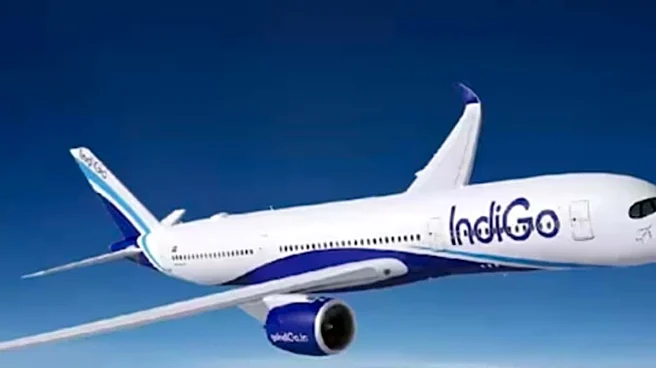
IndiGo’s early-December meltdown — its worst operational breakdown in years — is now showing up in sell-side downgrades, wider target-price divergence and growing governance concerns, signalling that markets no longer view the episode as a temporary scheduling glitch.
Bloomberg data shows that between December 5 and 8, at least five institutional analysts revised their stance. While global brokerages such as Goldman Sachs and Jefferies reiterated their ‘buy’ calls, others like Investec downgraded the stock to ‘sell’, citing execution risks around crew planning and regulatory compliance. Target prices in the latest set of notes now range from Rs 4,050 to Rs 7,025 — a sharp dispersion reflecting the uncertainty surrounding IndiGo’s operational
turbulence.
These reassessments follow a warning from Moody’s, which said IndiGo’s mishandling of Phase 2 Flight Duty Time Limitation (FDTL) norms — known for over a year — represented a “significant lapse in planning, oversight and resource management”, calling it credit negative. The agency flagged potential financial damage from refunds, penalties and reputational hit, and noted that show-cause notices to CEO Pieter Elbers and COO Isidro Porqueras could affect leadership continuity.
Adding to the scrutiny, proxy advisory firm SES (Stakeholders Empowerment Services) issued a sharply worded governance red flag on December 8, asking whether IndiGo’s board “consciously ignored FDTL compliance for commercial considerations” and whether its Risk Management Committee adequately assessed disruption risks.
Veteran aviation professional Capt. Shakti Lumba wrote on X that IndiGo may struggle to meet its own fleet-expansion timelines unless it urgently rebuilds trust with its pilots. “If IndiGo has still not realised that pilot salaries are a cost of doing business, they can forget their ambitious A321XLR induction — they may have to defer them,” he said. He added that relying on expat captains by February 2026 is unrealistic because the FATA approval cycle alone takes 4–6 months. According to him, IndiGo risks losing “pilots hand over fist” unless it restores its 70-hour minimum guarantee pay and repairs what he termed “rock-bottom pilot–management relations”. He also noted that DGCA and MoCA will not allow future aircraft induction unless IndiGo can demonstrate adequate captain availability — making crew strength, not aircraft deliveries, the binding growth constraint.
JM Financial, in its latest note, said IndiGo’s crew-planning challenges and regulatory friction may compress near-term operating leverage, even though long-term demand remains intact. The brokerage said the episode highlights how lean-cost models become vulnerable when regulatory buffers shrink, and warned of short-term profitability volatility as IndiGo rebuilds compliance systems.
Market sentiment, too, has been hit by the scale of the disruption. “Other airlines haven’t seen disruptions on this scale, but IndiGo’s larger fleet may have amplified the impact,” said market veteran Deepak Jasani. He added that in a sector already struggling to make consistent money, widespread operational issues can quickly influence sentiment — especially when social media magnifies passenger complaints.
DGCA’s temporary exemption: Breathing room with tougher scrutiny
The DGCA’s temporary relaxation of FDTL norms (valid till February 10, 2026) gives IndiGo space to restore its 1,650+ daily flights. But the regulator has mandated fortnightly operational reports, updates on captain-availability measures, revised rostering processes and a 30-day roadmap for full compliance — a structure analysts describe as a “probation period”, not a reprieve.
Market dominance under policy spotlight
IndiGo controls 60–65% of India’s domestic market — a level of concentration far higher than the US or China, where no airline exceeds ~21%. Analysts believe the meltdown could trigger policy-level debate over the risks of over-dependence on a single carrier. IndiGo’s week-long cancellations pushed up fares, added volatility and exposed the fragility of India’s duopoly-like structure. While rivals gain in the short term, industry-wide costs will rise under stricter FDTL rules, making this a structural reset rather than a cyclical blip.
Stock outlook now depends on trust rebuilding
Even though IndiGo’s balance sheet and profitability remain strong, the added compliance requirements, possible penalties, the cost of pilot realignment and potential fleet-induction delays have created a valuation overhang. Sell-side models now factor in higher operating costs under tighter duty-time rules, slower fleet expansion if captain availability lags, temporary yield gains, and offsets from refund outgo and network instability.
Most market watchers expect IndiGo to return to full schedules by mid-December, but warn that rebuilding credibility — internally, with pilots, and with regulators — will take much longer.
Disclaimer: The views and investment tips by experts in this News18.com report are their own and not those of the website or its management. Users are advised to check with certified experts before taking any investment decisions.






/images/ppid_59c68470-image-177106753408288480.webp)

/images/ppid_a911dc6a-image-17710672654155818.webp)