

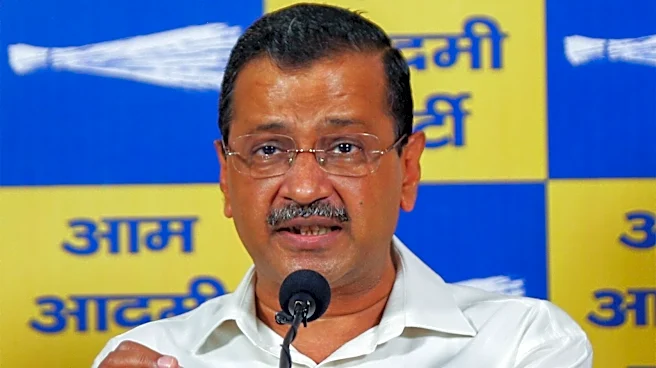
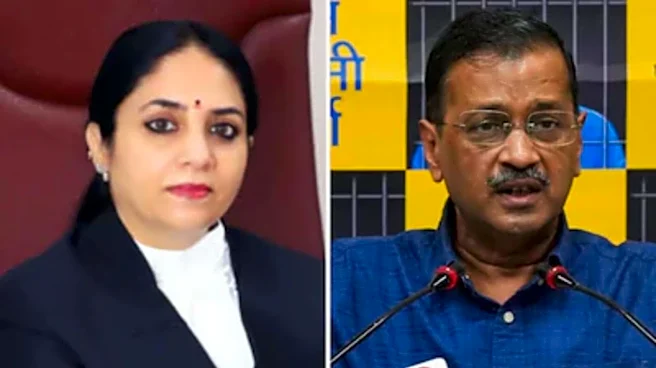
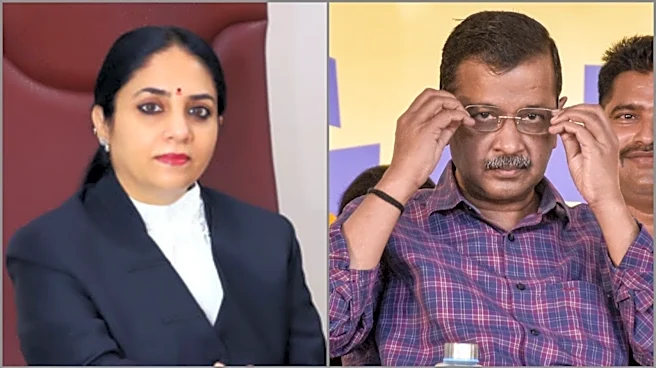
Delhi High Court Justice Swarana Kanta Sharma on Monday rejected Aam Aadmi Party (AAP) national convenor Arvind Kejriwal’s plea to recuse from a hearing on the liquor excise policy case, saying that his arguments had no evidence but only insinuations and aspersions on her credibility.
In a detailed judgment, Justice Sharma refuted Kejriwal’s allegations of conflict of interest, saying they were based on conjectures and mere apprehension of the court. She said Kejriwal failed to provide any evidence to support his claims, and that he cannot be permitted to lower the judicial process based on allegations and insinuations.
The judge also commented that recusal would have been an easy path, but it would have amounted to abdication of duty and would have given
an impression that any judge could be pressurised by unsubstantiated allegations.
“I reject these applications because my oath is to the Constitution. My oath has taught me that justice is not achieved by bending under pressure—true justice is that which does not yield to pressure. This has been my resolve and will remain so; I will act without fear or discrimination,” she said in her concluding remarks.
The case has been listed for further hearing on April 29.
‘No Evidence, Only Allegations, Insinuations’: Justice Sharma’s Point-By-Point Rebuttal To Kejriwal
‘My Dignity Challenged’
“When I began to pen this judgment, the courtroom had fallen silent. What remained was the weight of being a judge who had taken the oath of the Constitution of India, that is Bharat. I realised my silence as a judge was itself put to test, and the question now was about the fairness of the judge and the institution itself,” she said while announcing the judgement.
Justice Sharma said she faced a situation where her dignity was challenged, and that recusing herself without hearing would have been an easier option, but she chose to deal with the allegations that had challenged the judge’s reputation. She also said that personal attacks on a judge are an attack on the institution itself, and a recusal will lower the credibility of the legal profession.
“What has made the task difficult is that contrary stands have been taken during the arguments. They have said that they do not doubt the integrity of the judge, but they want the case transferred not because I have a bias, but they have apprehension of bias,” she added.
ALSO READ: Delhi HC Allows Kejriwal’s Reply To Judge’s Recusal Plea: ‘He Doesn’t Feel He Hasn’t Been Heard’
‘Kejriwal Selectively Placed Events’
Responding to Kejriwal’s arguments on the judge’s links to the Adhivakta Parishad, which is connected to the BJP and RSS, Justice Sharma said the events were not political and speakers were invited to speak on legal issues. She argued that an invitation to deliver a lecture does not necessarily insinuate political bias.
She said the applicant had “selectively placed on record events of Adhivakta Parishad”, adding that the court has routinely attended functions of NLU, colleges, hospitals and lawyer forums.
“Judges are invited as judges of the court. In this interaction, there is no space for any political ideology. The relationship between the bar and bench is not confined only to courtrooms. It is not uncommon for bar associations to organise functions. No litigant can be allowed to weaken the relationship between the bar and the bench,” she said.
She also remarked that some members of the Bar may represent a political ideology, but when they appear before the court, their cases are adjudicated based on merits and not political affiliations. “The floodgates of the court cannot be opened by allowing a litigant to plant seeds of distrust solely on this basis,” she added.
On Kejriwal’s Claim On Judge’s Children
Justice Sharma said Kejriwal failed to point out any political statement made by her. Responding to Kejriwal’s “conflict of interest” owing to her two children being empanelled on the government’s panel of its advocates, the judge said neither of the relatives was connected with the excise policy case in any capacity.
She said the litigant has to show relevance and impact on the case even if relatives are part of government panels, but no such connection had been shown by Kejriwal.
She also said Kejriwal could not dictate how the children or family members of a judge can lead their lives, as the family does not take an oath not to enter the legal profession. “If the children of a politician can become a politician, why can’t the children of a judge enter the profession of law?”
She further said a lie will remain a lie even after being repeated thousands of times in court, and the litigant cannot be permitted to create a situation to lower the judicial process. She also stated that she had ethically served as an officer of the law for over 30 years.
“Even a politician, however powerful, cannot be permitted to damage the institution without any material to prove allegations against a judge. The courtroom cannot be a theatre of perception,” she said.



/images/ppid_a911dc6a-image-177678283214138050.webp)