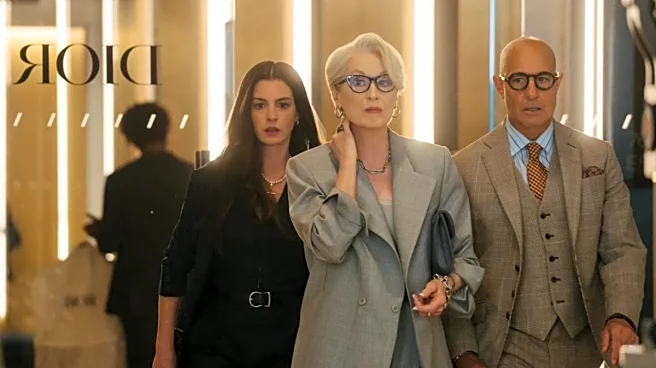

When The Devil Wears Prada 2 trailer dropped, fans immediately zeroed in on one chilling detail: Miranda Priestly appears not to remember Andy Sachs. For a franchise built on razor-sharp power dynamics and emotional undercurrents, that brief exchange has sparked intense debate. Is Miranda genuinely blanking on her former assistant or is something more calculated at play?
The original film, released in 2006, followed Andy (Anne Hathaway), a driven journalism graduate who endured a trial by fire while working at Runway under Miranda’s icy rule. Over time, Andy not only survived but evolved, gaining confidence and clarity about who she wanted to be. By the film’s end, Miranda seemed to grant Andy a flicker of hard-earned respect—subtle, but unmistakable.
So why does Miranda now act like Andy never mattered?
Is Andy Really “One of the Emilys”? In the sequel’s trailer, it’s Nigel (Stanley Tucci) who explains Andy’s identity to Miranda, dismissively referring to her as “One of the Emilys,” suggesting she was merely another disposable assistant in a long line of overworked underlings. The comment lands like a slap—especially for viewers who remember Andy’s growth and the emotional weight of her departure.
On the surface, this could be taken literally. Miranda’s job has always been ruthless, relentless, and all-consuming. Assistants come and go, often without ceremony. From that perspective, Andy may truly blur into the mass of young hopefuls who passed through Miranda’s orbit.
Yet this explanation feels too simple.
Andy wasn’t just another assistant. She stood her ground, challenged Miranda’s worldview, and walked away on her own terms. For a woman like Miranda who prides herself on control that kind of exit is not easily forgotten.
A Calculated Power Move, Not Amnesia
A far more compelling explanation is that Miranda remembers Andy all too well—and chooses not to acknowledge her. In The Devil Wears Prada 2, Andy returns to Runway as the Features Editor, a role that carries genuine influence. The power imbalance that once defined their relationship has narrowed, if not vanished altogether.
Miranda’s refusal to recognize Andy could be strategic. A deliberate denial of validation. By pretending Andy is insignificant, Miranda reasserts dominance in the only way she knows how—through emotional distance and psychological control.
It’s also worth noting the broader context. Print media is no longer the untouchable force it once was. Miranda is now navigating decline, relevance anxiety, and shifting authority, while Andy represents adaptation and survival in a changing industry. Acknowledging Andy would mean acknowledging that evolution—and possibly her own vulnerability.
Does This Undermine the Original Film’s Arc?
The emotional heart of the first movie lay in mutual transformation. Andy learned confidence and self-respect; Miranda, however minimally, learned restraint and respect. If Miranda truly forgot Andy, it risks flattening that arc, suggesting Andy made little to no impact.
But The Devil Wears Prada has always thrived on subtext. Miranda’s strength has never been warmth—it’s control. Her “forgetfulness” may actually be her most honest response to a former protégé who now stands almost beside her rather than beneath her.
Ultimately, Miranda not remembering Andy may say less about memory and more about fear—fear of being challenged, surpassed, or seen as anything less than untouchable. In that sense, the snub isn’t a flaw in the sequel’s logic. It’s a reminder that Miranda Priestly’s sharpest weapon has always been her indifference.
/images/ppid_a911dc6a-image-177005853147911870.webp)


/images/ppid_59c68470-image-177005752808323538.webp)

/images/ppid_59c68470-image-177005753275452040.webp)
![[In pictures] Harshit Rana flaunts swanky Lamborghini ahead of T20 World Cup 2026](https://glance-mob.glance-cdn.com/public/cardpress/binge-magazine-card-generation/spaces/IN/en/crictracker-spaces/images/ppid_49c02804-image-177005752880329954.webp)

/images/ppid_59c68470-image-177005757532136821.webp)