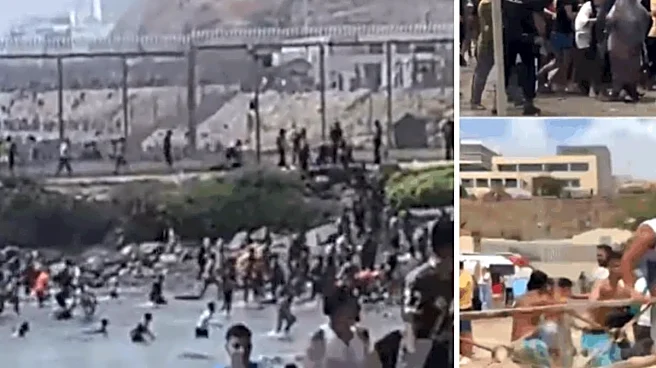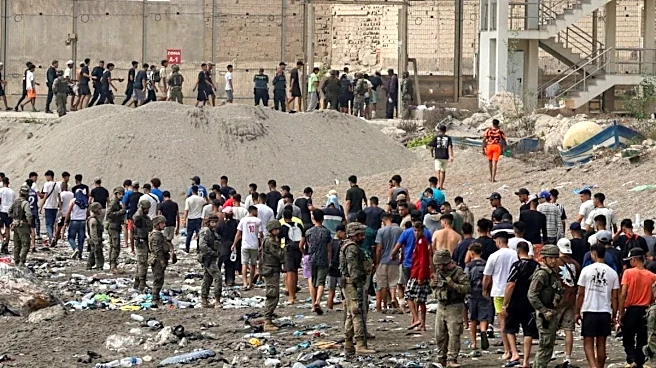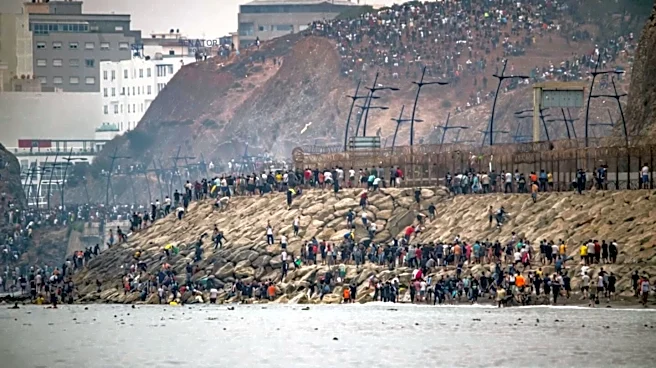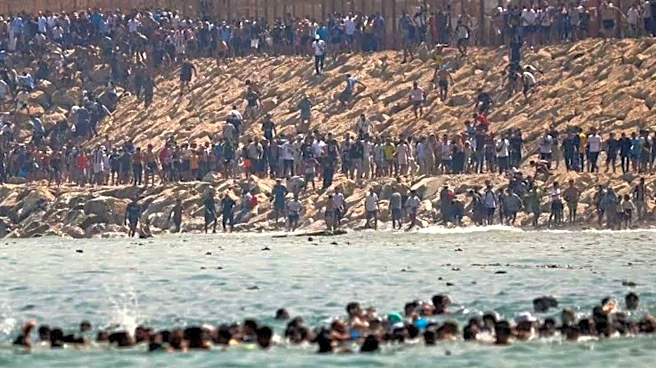




Many videos that show Moroccan migrants crossing the sea and entering the small town of Ceuta, Spain, have been flooding social media. It has been noted that around 60,000 people crossed into the Spanish territory of Ceuta in North Africa, and this has caused alarm bells to ring across the Spanish border into Europe and also among right-wing nationalist parties across the world. Italy has closed its borders to Spain, and France is also considering reinforcing land border controls, which were already in place.
On Friday, Italy’s Foreign Minister Antonio Tajani took to X (formerly Twitter) to announce the “unavoidable” decision to suspend the Schengen Agreement with Spain temporarily. He wrote, “HISTORIC — It is official. Italy has just suspended
the Schengen agreement with Spain. Spaniards will no longer be able to enter Italian territory freely; they will be subject to checks, just like citizens of non-European countries. The world is beginning to isolate Spain.”
🇪🇸🇮🇹 | HISTORICO — Es oficial.
Italia acaba de suspender el acuerdo Schengen con España. Los españoles ya no podrán ingresar libremente al territorio italiano, necesitaran controles como el resto de los países no europeos.
El mundo comienza a aislar a España. pic.twitter.com/2cTSioTZXl
— Agustín Antonetti (@agusantonetti) July 31, 2026
He also posted on X and wrote, “The temporary suspension of Schengen with Spain is a necessary choice to safeguard the security of our citizens and defend the European borders.” He noted that the influx of migrants in Ceuta, Spain, “reminds us that the management of the Union’s borders is a shared responsibility among our countries, one toward the other”. The pause will remain in effect for a period of one month starting Saturday.
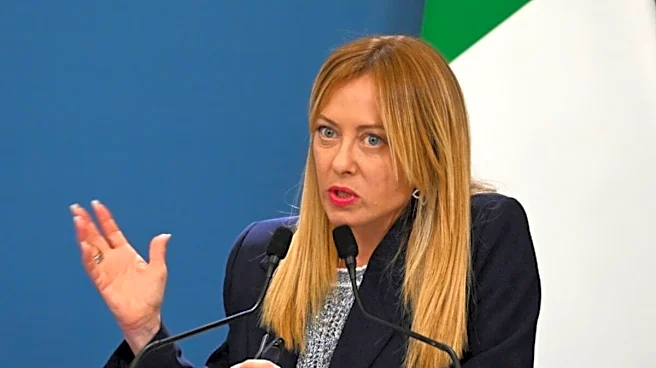
The directive came after Italian Prime Minister Giorgia Meloni urged Spain to take concrete action and described the footage of ass attempts to enter Spanish territory as “shocking”.
What is the Schengen Agreement?
Having completed 40 years in May last year, the Schengen Agreement allows for the free movement of more than 450 million citizens of the European Union (EU). This agreement also extends to non-EU nationals living in the EU or visiting the area as tourists, exchange students or for business purposes i.e. anyone legally present in the EU. A tourist has to apply for a Schengen visa, which entitles the holder to visits of up to 90 days every 6 months in the entire Schengen area.
The EU, aka the European Union, is a group of 27 European countries that work together on things like trade, laws, travel, and security. The EU and the Schengen Agreement are linked. In fact, they started as two separate entities, but in 1997, via the Amsterdam Treaty, the Schengen rules were incorporated into EU law, which makes the latter a core part of the EU’s “free movement” policy.
The Schengen Agreement is a treaty that led to the creation of Europe’s Schengen Area. It is a zone where internal border checks are largely abolished to allow free movement of people. It was first signed by 5 countries – Belgium, France, West Germany, Luxembourg, and the Netherlands – on June 14, 1985.
Now, the Schengen Area is composed of 29 countries, which include 25 EU Member States and 4 non-EU countries (Iceland, Norway, Switzerland and Liechtenstein). The Schengen Area was expanded multiple times, with Bulgaria and Romania being the last countries to join on 1 January 2025.
The 25 EU member nations include the following:
- Austria
- Belgium
- Bulgaria
- Croatia
- Czech Republic
- Denmark
- Estonia
- Finland
- France
- Germany
- Greece
- Hungary
- Italy
- Latvia
- Lithuania
- Luxembourg
- Malta
- Netherlands
- Poland
- Portugal
- Romania
- Slovakia
- Slovenia
- Spain
- Sweden
What does the European Commission say about border closure?
The European Commission is like the “government” or executive branch of the Union. The EU sets the broader rules for free movement, security, and border management. There is a lot of overlap between the EU and the Schengen Area.
So, the European Commission has some say in the goings-on of the Schengen Area. It has a wide range of tools to guarantee security without limiting freedom of movement and so, countries may temporarily reintroduce internal border controls as a measure of last resort in cases of a serious threat to public policy or internal security. This is what Italy has done to protect themselves from the entry of legal or illegal migrants that might be living in Spain.
If such controls are reintroduced, the country concerned has to inform the Council (and thus, other Schengen countries), the European Parliament and the European Commission as well as the public.
/images/ppid_59c68470-image-178547752510017987.webp)