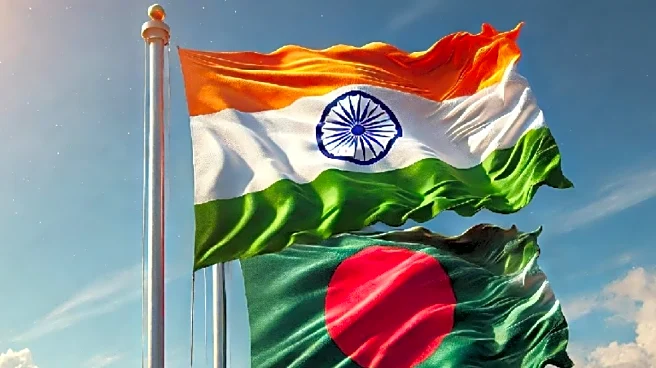

India and Bangladesh have one of South Asia’s most consequential neighbourhood relationships. It is built on geography, shared history, trade, culture, and the simple fact that both nations do better when
the other is stable. Yet in recent months, social media has begun to look like a battlefield—crowded with accounts that claim to speak for Bangladeshi youth while repeatedly pushing one central message: India is the enemy.
This is not ordinary criticism or political debate. It is a relentless, crisis-driven propaganda style that turns every tragedy, every flood, and every political development into the same conclusion: “India did it”.
The objective is clear—manufacture distrust and create a permanent emotional distance between two societies that have lived as close neighbours for centuries.
One relationship. Two narratives.
In the real world, India–Bangladesh ties are complex but practical: border management, river sharing, connectivity, trade, power, and people-to-people links. Problems exist, and discussions are normal.
But online, a parallel narrative is being pushed—simplified, aggressive, and deliberately humiliating:
• Bangladesh must “prove” nationalism by opposing India
• any cooperation with India is “betrayal”
• every crisis in Bangladesh is evidence of an Indian “plot”
• India’s internal diversity—especially the Northeast—is used as a target for divisive messaging
This is the language of political sabotage, not national interest.
The crisis template: flood, politics, assassination—blame India
A striking pattern emerges when you look at recent episodes:
During floods, instead of prioritising rescue, relief, and technical coordination, social media pushes instant certainty: “India caused it”, “India released water to punish us”, “India wants Bangladesh to suffer”. These claims spread fastest when emotions are highest and facts are hardest to verify.
During political controversies, the same accounts push the idea that Bangladesh’s domestic politics is controlled by New Delhi—reducing real, internal political debates to a cartoonish “foreign hand” storyline designed to trigger rage.
Now, after the assassination of Sharif Osman Hadi, the same playbook has reappeared: emotionally loaded claims circulate rapidly, attempting to frame the killing as an Indian conspiracy—often without evidence, and often aimed at provoking street anger rather than demanding a credible investigation.
When every event ends in the same accusation, it is not analysis. It is a script.
From ‘Bangladeshi voice’ to cross-platform agitation
The most revealing aspect is that many of these “Bangladeshi nationalist” accounts operate like media brands rather than individuals—active across multiple platforms with a single political purpose.
One example (visible across Facebook, YouTube, Instagram, Threads, and X under the same branding) shows how this ecosystem works in practice:
• Posts urging Bangladeshis not to support “pro-India” politics, framing India-friendly engagement as shameful.
• Content designed to turn Bangladesh’s electoral choices into an “anti-India referendum.”
• Messaging that targets India’s internal cohesion—especially the Northeast—by promoting divisive themes such as the idea that India’s “Seven Sisters” should separate, presented absurdly as a “solution” for Bangladesh’s flood problem.
• Inflammatory statements romanticising hostility toward India as a marker of “true patriotism.”
• Attempts to exploit Osman Hadi’s death as a trigger for public hatred—pushing emotion first, facts later.
Whether such accounts are run from abroad, supported by outside networks, or simply chasing influence and attention, the outcome is the same: they inject poison into a relationship that requires maturity and restraint.
Why this is dangerous for Bangladesh as well
This kind of online agitation is often framed as “standing up to India.” But the truth is harsher: it pushes Bangladesh into a permanent posture of resentment, where national identity is defined not by development, education, jobs, and governance, but by who to hate.
That is not patriotism. That is paralysis.
When youth are taught that hatred is politics, they stop demanding real answers from real leaders. Every failure becomes “India’s fault.” Every tragedy becomes a tool. And every chance for cooperation—on floods, rivers, trade, border safety—becomes politically risky.
In the long run, this benefits only those who want a weaker, angrier neighbourhood.
Why it matters for India too
India cannot afford a future where Bangladesh’s public discourse is constantly pushed towards hostility by online provocation. Even when governments manage diplomacy, public sentiment shapes the space for cooperation. Toxic narratives create suspicion, raise tensions, and make every bilateral issue harder to solve.
This is particularly sensitive in border regions, where stability depends on calm, confidence, and coordination—not viral misinformation.
The real choice: Bridges or wedges
India and Bangladesh do not need to agree on everything. They do need to resist the weaponisation of grief, disaster, and politics.
The answer is not counter-hate. It is strategic calm:
• Faster, clearer public communication during crises (floods, border incidents, political unrest) so misinformation has less room to grow.
• Joint emphasis on people-to-people ties—students, cultural exchanges, medical cooperation, and shared heritage—so the relationship is not reduced to online shouting.
• Responsible media and community voices in Bangladesh calling out incitement that harms Bangladesh’s own social stability.
• Firm action by platforms on content that promotes violence, separatism, and targeted hostility—without confusing that with legitimate political speech.
Conclusion
India–Bangladesh ties are too important to be held hostage by social media agitators and opportunists. The flood victim, the student, the farmer, the small trader—ordinary people on both sides—gain nothing from manufactured hatred. They gain from stability, dignity, and cooperation.
If a social media ecosystem’s only product is anger and its only solution is hatred, then it is not defending Bangladesh’s interests or India’s interests.
It is building a wedge—one post at a time.




/images/ppid_a911dc6a-image-177092774715746114.webp)

/images/ppid_a911dc6a-image-177092767520012684.webp)
/images/ppid_a911dc6a-image-177092763347449403.webp)
/images/ppid_a911dc6a-image-177092652580356823.webp)