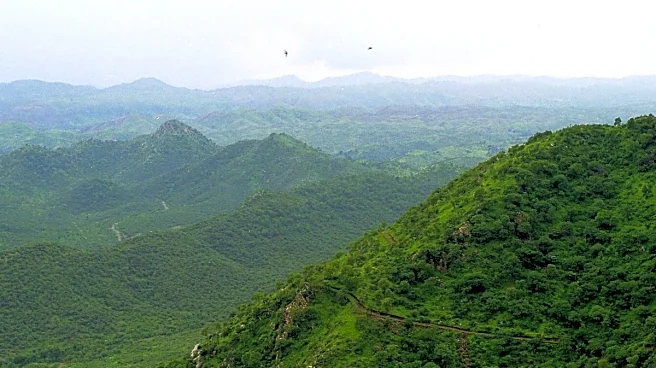

In the echo chambers of social media and opposition rhetoric, the Aravalli Hills have become the latest casualty of a manufactured outrage. A Supreme Court ruling on November 20, 2025, adopting a uniform
definition for the range, has been deliberately twisted into a narrative of “eco-destruction” and a “death warrant” for 90% of these ancient hills. But strip away the hyperbole, and the facts reveal a different story: this isn’t plunder but protection.
Let’s start with the truth behind the ruling. The Aravallis span across Rajasthan, Haryana, Gujarat, and Delhi and have long suffered from inconsistent definitions across states, fuelling illegal mining. A petition on this dates back to 1985, highlighting unchecked exploitation. In May 2024, the Supreme Court formed a committee under the Union Environment Ministry to standardise the definition, ensuring uniform norms in all four states and 39 districts. The panel, including state forest secretaries and experts from the Forest Survey of India (FSI) and Geological Survey of India (GSI), recommended that only elevations rising 100 metres above local terrain—or clusters within 500 metres—qualify as Aravalli hills or ranges.
This isn’t a new “loophole” concocted by the Modi government. It’s rooted in a definition established under Ashok Gehlot’s Congress regime, based on a 2002 committee report and Richard Muff’s 1968 landform classification. The SC order extends this uniformly, adding safeguards like mandatory mapping on Survey of India toposheets before any mining consideration, and prohibiting activities in “inviolate zones” such as protected areas, eco-sensitive zones (ESZs), tiger corridors, and Ramsar wetlands.
Fact-checking the core lie: Propagandists claim the 100-metre threshold excludes 90% of the range, exposing it to mining. False. This misinterprets the rule as applying only to the “top 100 metres.” In reality, it protects the entire hill structure—from base to peak and subsurface—plus connecting lowlands in ranges. Union Minister Bhupender Yadav has repeatedly clarified: “There are no relaxations. Over 90% of the Aravalli region remains protected.” Analysis of Aravalli districts shows the total area at 1.44 lakh sq km, with only 277.89 sq km (0.19%) under legal mining leases—90% in Rajasthan, 9% in Gujarat, 1% in Haryana, and zero in Delhi. No new leases can be granted until the ministry, via the Indian Council of Forestry Research and Education (ICFRE), prepares a Management Plan for Sustainable Mining (MPSM) for each district, incorporating cumulative impact assessments and restoration priorities. Existing mines must comply with stringent sustainable practices, including phased reclamation, wildlife plans, and six-monthly audits. The SC order is no automatic okay for mining to start in Aravalli!
Now, the track record of those spreading fakery. Congress’ “#SaveAravalli” crusade is rich with irony. During Ashok Gehlot’s tenures (1998-2003, 2008-2013, 2018-2023), illegal mining flourished despite SC bans. A 2018 report flagged unabated activities in Rajasthan, with mafias denuding hills. Under Congress-led central and state governments in 2009, the SC imposed a blanket mining ban due to rampant exploitation. Guess who opposed it? Gehlot government! Also, enforcement was abysmal—31 hills vanished in Rajasthan over decades, per court records. Gehlot govt definition was a start, but without teeth: no uniform mapping, no inviolate zones, and lax monitoring allowed over-exploitation. What Congress is doing isn’t activism—it’s opportunism, using the hills as a political ground.
Contrast this with the Modi government’s record. The Aravalli Green Wall Project, launched under PM Modi, restores forests along the range, including seed-ball campaigns in Gujarat. Under this initiative, the government has committed to establishing more than 20 new forest reserve areas across the Aravalli range, designating additional reserved and protected zones to bolster biodiversity hotspots. Crackdowns on illegal mining in ESZs, funds for afforestation via the National Mission for a Green India, and the MPSM mandate ensure science-driven sustainability. The Modi administration has also intensified enforcement through the ‘Green Aravalli’ movement, which includes large-scale planting drives and community involvement to prevent desertification, while rejecting baseless charges of favouring mining by emphasising that the new definition actually limits activities and enhances overall conservation efforts. Moreover—drone surveillance, district task forces, AI for illegal mining prevention, and reclamation of abandoned sites are adding teeth to enforcement. No mining in Delhi’s districts, and over 20 reserves/protected areas are totally shielded. As Environment Minister Bhupendra Yadav notes, protections have increased since Modi government has taken office, not weakened.
The Aravallis’ woes—illegal mining, urbanisation, groundwater overdraw—predate this ruling and Modi government.
Ashok Gehlot’s era botched enforcement; but PM Modi’s government unifies and fortifies it. The Aravallis aren’t doomed—they’re more secure with 90% protected and mining capped at 0.19%. *In fact, recent government reports highlight successful seizures of illegal mining equipment and arrests of over 500 violators in Rajasthan alone this year, underscoring the Centre’s proactive stance against unregulated exploitation.*
Ultimately, the Aravallis stand as a testament to India’s enduring natural heritage, and safeguarding them requires unity beyond political divides. By prioritising science, enforcement, and restoration, the Modi government is not just protecting these hills but ensuring a greener, more resilient future for generations to come. Let facts prevail over fakery—it’s time to celebrate real progress and commit to collective stewardship, turning outrage into action for a truly sustainable India.
The author is National Spokesperson of the BJP. Views expressed in the above piece are personal and solely those of the author. They do not necessarily reflect News18’s views.