


/images/ppid_a911dc6a-image-17710654257455666.webp)
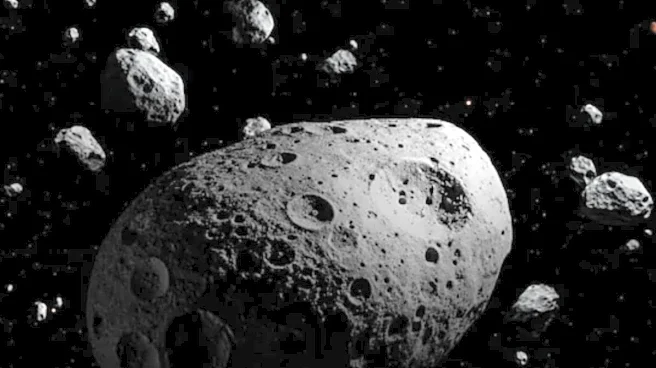
The world’s largest digital camera has identified an asteroid, 2025 MN45, whose immense size and extraordinary speed are enough to unsettle even seasoned scientists. Measuring roughly half a mile wide, the asteroid is nearly eight times the size of a football field. What makes it truly remarkable is its rotation speed: it is now recorded as the fastest-spinning giant asteroid ever discovered.
This rare find was made using the Vera C Rubin Observatory, situated atop a mountain in Chile. The observatory is equipped with an ultra-powerful 3,200-megapixel camera, capable of piercing through the hazy depths of space to capture what scientists have described as a cosmic ‘super rotator’.
Where Is The World’s Largest Digital Camera Installed?
The discovery was made possible by the LSST camera, currently the largest
and most powerful digital camera ever built. With a staggering 3,200-megapixel sensor, it can take high-resolution images of the sky every 40 seconds.
Installed on a high mountain in Chile, the camera will continuously scan the skies for the next 10 years, creating an unprecedented time-lapse record of the universe. The mission is jointly supported by scientists from the National Science Foundation (NSF) and the Department of Energy (DOE).
Astronomer Luca Rizzi has said the camera will uncover phenomena that scientists never even thought to look for. Although the observatory is not yet fully operational, its early trial runs have already delivered astonishing results. In June 2025 alone, it detected 1,900 previously unknown asteroids.
Why Is Asteroid 2025 MN45 Called A ‘Super Rotator’?
Asteroid 2025 MN45 is far from ordinary. It has officially joined the elite category of solar system objects known as ‘super rotators’.
Most asteroids rotate slowly around their axis. In contrast, 2025 MN45 completes one full rotation every 1.88 minutes. This is the fastest recorded spin rate for any asteroid larger than 500 metres, a fact that has surprised scientists worldwide.
Such an extreme spin rate suggests a violent past. Researchers believe the asteroid may have been struck in a powerful collision long ago, setting it spinning at this incredible speed. It could also be a fragment of a much larger planetary body. Due to its rapid rotation, scientists now regard it as the fastest ‘spinner’ ever observed in space.
Where Is 2025 MN45 Located In Space?
Images show asteroid 2025 MN45 surrounded by other space rocks within the main asteroid belt, which lies between Mars and Jupiter. In the background, both the Sun and Jupiter appear far away, offering perspective on its position in the solar system.
Can This Asteroid Break Apart In Space?
Many asteroids are not solid objects but loose collections of rocks held together by gravity, often described as ‘rubble piles’. If such bodies spin too fast, centrifugal force can cause them to break apart. Asteroids located between Mars and Jupiter generally follow a rotation limit: they must take at least 2.2 hours to complete one full spin. If an asteroid rotates faster than this, it must be structurally solid.
According to scientist Sara Greenstreet, the fact that 2025 MN45 spins every 1.88 minutes proves it must be incredibly strong. If it were a loose rubble pile, it would have already shattered. Its internal structure has now become a major topic of scientific investigation.
What Other Threats Could Be Detected In The Future?
The discovery of 2025 MN45 is only the beginning. During just seven nights between April and May 2025, the Rubin Observatory detected 76 new asteroids. Among them, 16 were fast rotators, and three completed a full rotation in under five minutes.
Apart from 2025 MN45, asteroids such as 2025 MJ71 and 2025 MK41 have also attracted scientific attention due to their unusual behaviour. Over the next decade, the observatory is expected to identify millions of new objects, greatly improving our ability to detect potential threats to Earth early. At the same time, it will help scientists better understand the birth, evolution, and destruction of the solar system.
Often described as a ‘third eye’ on the universe, this powerful camera is set to reveal corners of space that humanity has never explored before.









/images/ppid_59c68470-image-177106753408288480.webp)

/images/ppid_a911dc6a-image-17710672654155818.webp)