
/images/ppid_59c68470-image-177591008378511282.webp)
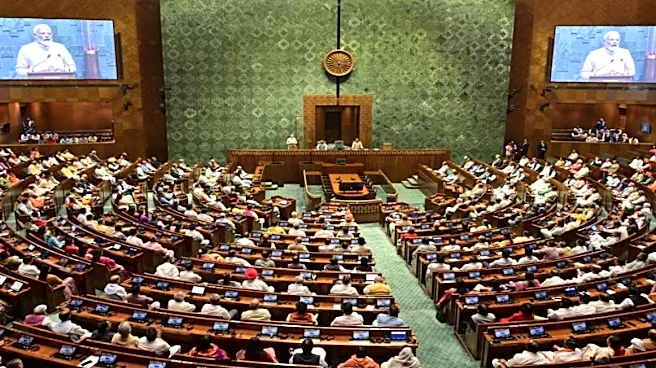
The Nari Shakti Vandan Adhiniyam, passed with historic fanfare in September 2023, is currently at the centre of an intense legislative push as the April 2026 Budget Session extends into a high-stakes three-day sitting. While the law is already on the books as the Constitution (106th Amendment) Act, its implementation was originally tethered to a fresh Census and subsequent delimitation.
To bring the 33% quota into effect for the 2029 general elections, the government is now proposing a dual-bill strategy: a constitutional amendment to delink the quota from the new Census and a plan to expand the Lok Sabha’s total seats by 50%. As of mid-April 2026, the question is no longer just about support for women’s representation, but whether the National
Democratic Alliance (NDA) has the mathematical muscle to reconfigure India’s electoral map.
Does the NDA have the required majority in the Lok Sabha?
In the Lower House, the current arithmetic presents a strong but not entirely self-sufficient picture for the government. The BJP-led NDA currently commands approximately 293 to 294 seats in the 543-member Lok Sabha. While this is well above the simple majority mark of 272 required for ordinary legislation, a constitutional amendment is a different beast entirely.
Under Article 368, such an amendment requires a “special majority”—defined as a majority of the total membership of the House and a two-thirds majority of those present and voting. To pass the new amendments comfortably, the NDA would ideally need around 362 votes if all members are present. This means the government must secure roughly 68 to 70 additional votes from outside its formal alliance to avoid any procedural hurdles.
What is the situation in the Rajya Sabha?
The Upper House has historically been the more challenging theatre for the ruling alliance, though recent biennial elections have bolstered its position. Following the March 2026 Rajya Sabha polls, the NDA’s strength has risen to approximately 141 seats in the 245-member House.
While this is a solid working majority, it still falls short of the 164-vote mark required for a two-thirds majority (assuming full attendance). To bridge this 23-seat gap, the government is actively courting “non-aligned” parties such as the YSRCP, BRS, and BJD. Early signals from these quarters suggest they remain supportive of the women’s quota in principle, though they remain wary of the proposed seat expansion and its impact on regional representation.
Why is the proposal to increase seats to 816 so controversial?
To bypass the political minefield of redrawing existing boundaries—which would inevitably lead to some male incumbents losing their seats—the government is floating a “pro-rata expansion” plan. This would increase the Lok Sabha’s strength from 543 to 816 seats, with the additional 273 seats reserved exclusively for women.
This “expansion-first” model is designed to soothe the anxieties of southern states. By increasing every state’s representation by exactly 50%, the government argues that no state loses its relative weightage. However, the Opposition, led by the INDIA bloc, has flagged two major concerns:
The OBC Sub-quota: Parties like the SP and RJD continue to demand a “quota within the quota” for women from Other Backward Classes.
The North-South Divide: Southern leaders argue that even with pro-rata increases, the absolute gap in seat numbers between the high-population north and the south will widen significantly, potentially marginalising their influence in national policy.
Can the government secure the numbers by April 18?
The three-day special window (April 16-18) is designed to be a marathon of floor management. Given the high “moral cost” of voting against women’s empowerment, the government is banking on a repeat of the 2023 scenario where most parties feel compelled to support the bill despite their reservations.
If the NDA successfully secures the backing of parties like the YSRCP and potentially some sections of the INDIA bloc that fear being labelled “anti-women”, the bills will likely sail through. However, if the Opposition holds firm on the demand for an immediate Census or an OBC sub-quota, the government may find itself just short of the elusive two-thirds mark, forcing a delay that could push the dream of 2029 reservation back into the realm of uncertainty.
/images/ppid_a911dc6a-image-177600542971385695.webp)

/images/ppid_a911dc6a-image-177614066528894231.webp)
/images/ppid_a911dc6a-image-177605222883099514.webp)


/images/ppid_a911dc6a-image-177597163112971246.webp)