
/images/ppid_a911dc6a-image-177789823060044379.webp)
/images/ppid_a911dc6a-image-177787746106773203.webp)
/images/ppid_a911dc6a-image-177779164633598462.webp)
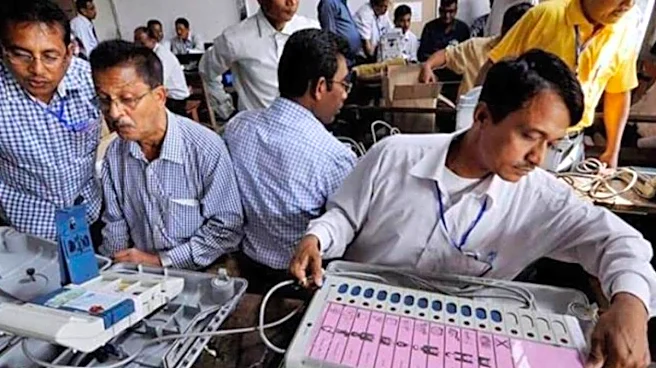
The assembly election results have produced a striking set of “giant-killer” moments across five politically diverse regions, with relatively lesser-known or insurgent candidates toppling entrenched leaders. These upsets, cutting across West Bengal, Tamil Nadu, Assam, Kerala, and Puducherry, underscore a deeper churn in India’s electoral landscape—where no stronghold appears immune to disruption.
Tamil Nadu: Stalin’s fortress falls
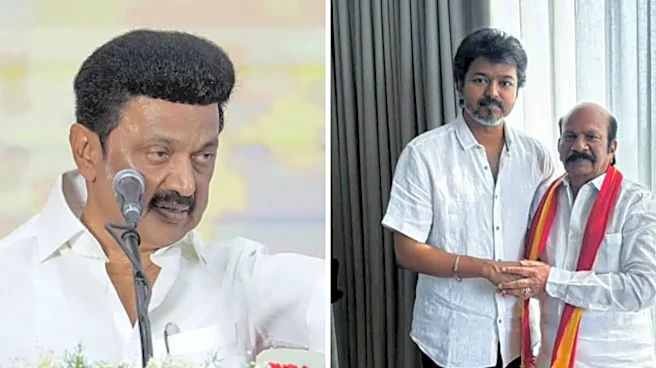
The most dramatic upset of the 2026 cycle has come from Tamil Nadu, where Tamilaga Vettri Kazhagam (TVK) candidate VS Babu defeated Chief Minister MK Stalin in the Kolathur constituency. Stalin, who had held the seat for over a decade and won it comfortably in 2021, was unseated by nearly 9,000 votes in what is widely being described as a political earthquake.
Babu’s victory is significant not merely for the scale of the upset but for what it represents—a breach in the Dravidian political fortress. Backed by actor Vijay’s emerging political force, his win signals a generational and structural shift in Tamil Nadu politics.
Another notable result came from Gobichettipalayam, where TVK’s KA Sengottaiyan defeated DMK’s Nallasivam by over 16,000 votes, reinforcing the party’s ability to challenge established regional players.
Assam: Targeted blows to Congress heavyweights
In Assam, the BJP’s broader dominance was accompanied by key constituency-level upsets. In Jorhat, veteran BJP leader Hitendra Nath Goswami defeated Congress MP Gaurav Gogoi by more than 23,000 votes, marking one of the most high-profile individual defeats in the state.
Similarly, in Biswanath, BJP’s Pallab Lochan Das overcame senior Congress leader Jayanta Borah by a wide margin exceeding 25,000 votes.
These victories highlight the BJP’s strategy of directly targeting influential opposition figures rather than merely seeking aggregate seat gains.
Kerala: Opposition breakthroughs in LDF bastions
Kerala’s results, while following a broader anti-incumbency trend, also produced constituency-specific giant killers. In Kuttiadi, Indian Union Muslim League (IUML) leader Parakkal Abdulla defeated CPI(M)’s KP Kunhammedkutty Master by over 10,000 votes—a significant upset in a closely watched contest.
In Payyanur, independent-backed UDF candidate V. Kunhikrishnan defeated CPI(M)’s TI Madhusoodanan, signalling cracks in Left strongholds.
These outcomes reflect the opposition’s ability to convert local dissatisfaction into decisive constituency wins.
West Bengal: Emerging challengers in a shifting battlefield
While West Bengal’s broader narrative has been shaped by a sweeping political shift, several constituency-level contests have produced notable disruptors. In Kalimpong, BJP’s Bharat Chettri defeated BGPM’s Ruden Sada Lepcha by over 21,000 votes, marking a significant breakthrough in the sensitive hill region.
Elsewhere, closely fought contests such as Ranaghat Dakshin saw BJP’s Ashim Kumar Biswas challenge TMC’s Sougata Kumar Burman, reflecting the erosion of long-standing local dominance structures.
These results illustrate how the BJP has moved beyond being a challenger to actively dislodging entrenched regional actors.
Puducherry: Quiet but significant disruptions
In Puducherry, the electoral churn has been subtler but still meaningful. While Chief Minister N Rangasamy retained his seat in Thattanchavady, several NDA-backed candidates have edged out Congress-DMK-aligned figures in key constituencies, indicating a gradual weakening of traditional power centres.
The Union Territory’s fragmented political landscape has made these constituency-level victories particularly significant, as even small swings can reshape the balance of power.
A new political order
Taken together, the “giant killers” of 2026 represent more than isolated upsets. From VS Babu’s toppling of a sitting Chief Minister in Tamil Nadu to the defeats of prominent Congress leaders in Assam, these results point to a broader trend: electoral loyalty is increasingly fluid, and localised, high-intensity campaigns can overturn even the most secure bastions.
As India moves towards the next electoral cycle, these victories will be studied as templates—proof that in contemporary politics, no leader is too big to fall, and no seat too safe to lose

/images/ppid_a911dc6a-image-177788789283032353.webp)

/images/ppid_a911dc6a-image-17778541472192216.webp)
/images/ppid_a911dc6a-image-177787490344256113.webp)
/images/ppid_a911dc6a-image-177785407415525309.webp)
/images/ppid_a911dc6a-image-17778697818388283.webp)


/images/ppid_a911dc6a-image-177788014293372290.webp)
/images/ppid_a911dc6a-image-177787756605324063.webp)