



Kriti Sanon’s rakshabandha Ad To Kangana-Taapsee Row: A jewellery ad became a culture war. An old feud got a new lease of life. That’s Bollywood now: a blouse can become a cultural argument, a sentence can resurrect a seven-year-old rivalry, and one interview question can keep the whole thing going.
Last week, Kriti Sanon’s Raksha Bandhan campaign and the latest Taapsee Pannu-Kangana Ranaut exchange offered two versions of the same spectacle: everyone has an opinion, everyone has a phone, and nothing stays over for long.
The blouse Becomes The Story
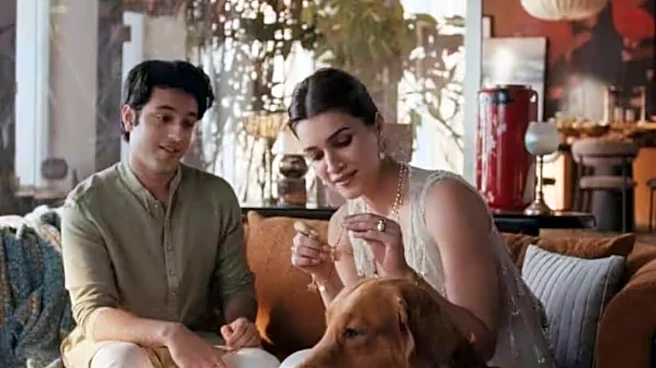
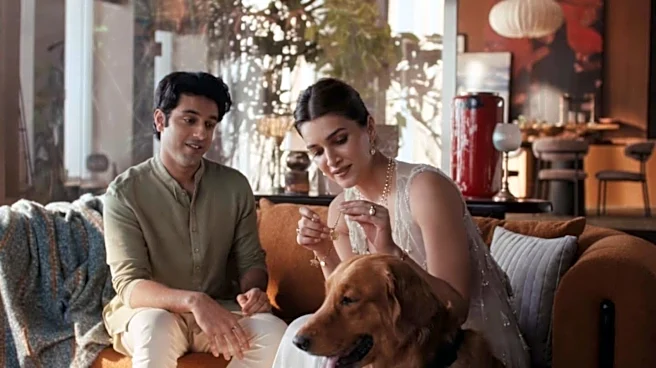
Kriti Sanon’s Raksha Bandhan campaign was criticised for its styling, with some arguing that the look was too contemporary for a festival associated with family and tradition. Kangana Ranaut was among
those who questioned the choice.
The criticism isn’t difficult to understand. If a brand builds a campaign around a festival, it must understand what that festival means to people. You cannot borrow the sentiment of tradition and then be surprised when people have an opinion about how you represent it.
But neither is Kriti’s defence difficult to understand.
A woman’s clothes do not determine her relationship with her family, her culture or her traditions. Raksha Bandhan is about a bond; it does not suddenly become less meaningful because the woman tying the rakhi is wearing a modern outfit.
The problem begins when criticism of an advertisement becomes criticism of the woman in it. The campaign was eventually withdrawn, and an apology followed. Perhaps that was the sensible thing for a brand to do. But it leaves behind a slightly uncomfortable question: are advertisers becoming more thoughtful about culture, or simply more frightened of offending people?
There is a difference.
One produces better advertising. The other produces safer advertising. And safer is not always better.
And Then There Is Taapsee and Kangana
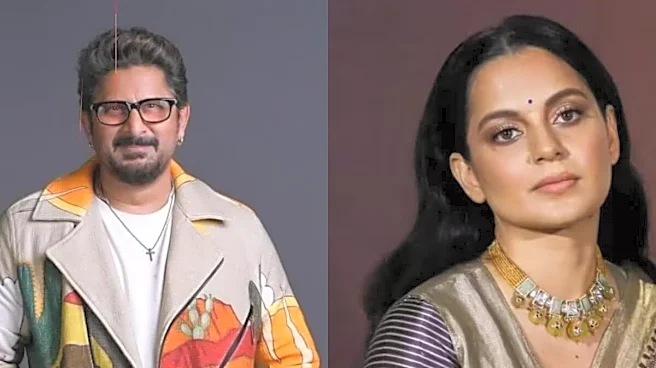
Taapsee Pannu and Kangana Ranaut seem to have discovered the one thing more durable than a Bollywood friendship: a Bollywood disagreement. Their history goes back years, to the particularly noisy period when Bollywood was arguing about nepotism, outsiders and who had earned the right to complain about the industry.
This time, Taapsee spoke about Kangana and suggested that their differences could perhaps be understood through their different upbringings and worldviews. Kangana took issue with that and responded in her familiar, forthright fashion. Taapsee’s next question was the most sensible one of the week: why are people still asking about this?
She has a point.
The media has a habit of keeping celebrity feuds on life support. Ask an actor about an old disagreement, get a headline, wait for the other actor to respond, and then ask the first actor about that response. It is a story that writes itself. Except that celebrities are not entirely innocent victims of the process either. They know how interviews work. They know that a sentence about an old rival can travel much further than the interview itself. And when there is history between two people, even an apparently casual observation can land differently.
So perhaps neither woman needs to be declared the winner here. Taapsee is right that the media keeps reopening the subject. Kangana is entitled to feel that a remark about her upbringing is personal. The rest of us might simply ask whether this particular argument still deserves the attention we keep giving it.
What These Two Stories Tell Us
That is what connects these two stories. We are increasingly inclined to read more into a moment than may actually be there.
A blouse becomes a statement about culture. A remark becomes a judgement on character. A disagreement becomes a battle between two camps. But real life is rarely that tidy. Kriti can be criticised for appearing in an ad that some viewers found culturally misplaced without being told that she has disrespected tradition.
The brand can be asked to do better without being treated as though it has committed some great cultural offence.
Taapsee can be questioned about her choice of words without turning her into Kangana’s lifelong antagonist. And Kangana can disagree strongly without every disagreement becoming a judgement on who she is.
There is room for all of this. Perhaps that is what gets lost in the rush to take sides: the ability to say, “I don’t agree with you, but I understand why you think that.”
It is not nearly as exciting as outrage. It does not make as good a headline. But it makes for a much more interesting conversation. Because there is something rather exhausting about a culture in which every disagreement has to become a position, every position a fight, and every fight a spectacle. Maybe some things are better left unresolved. Maybe an advertisement can simply miss the mark. Maybe two actors can simply dislike each other.
And maybe the smartest thing the rest of us can do is stop asking for another round.
Really, not every controversy needs a sequel.