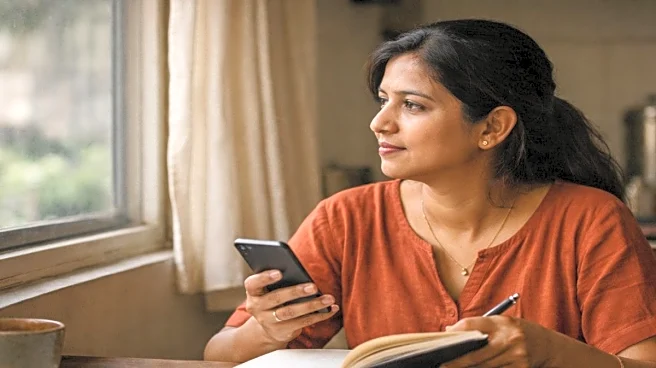



While organising a financial literacy session at the Ladies’ Wing of the Indian Merchants Chamber recently, I was reminded of just how deeply intertwined money, sustainability, and autonomy really are. As the speaker asked questions, many of the women in the room spoke with surprising honesty about how dependent they were on their fathers, husbands, or sons to manage their finances. Some said they had never logged into their own bank accounts. Others admitted to signing documents without fully understanding them, trusting that someone else “knew better”.
What stayed with me wasn’t the admission itself, but the matter-of-fact way it was said. There was no embarrassment in their voices, just quiet acceptance, and that acceptance is something we
don’t talk about enough.
Until a few years ago, I was one of these women. While I was comfortable making big decisions in my business and could speak confidently about strategy, growth, and cash flow, when it came to building my own personal wealth, I stepped back. I let the men in my life handle it because it felt overwhelming alongside everything else I was managing. Even though my father often encouraged me to take the lead, I had no motivation to do so. Between him and my brother, I knew my finances were being handled carefully and thoughtfully, and that felt like enough.
In India, financial dependence among women is rooted in cultural norms. For generations, money management has been framed as a masculine responsibility. Men earn. Men invest. Men decide. Whereas women, even those who contribute financially to their households, are expected to manage the home, stretch budgets, and make things work, without necessarily being included in financial decision-making. This dependence is often disguised as care or convenience, but over time, it quietly strips women of agency. When we talk about sustainability, we rarely account for this reality.
The numbers reflect this gap. Multiple studies show that a large percentage of Indian women do not have independent control over financial assets, even when they earn an income. Many lack access to formal financial products such as insurance, credit, or long-term savings instruments. Financial literacy surveys in India consistently show that women score lower than men on basic financial concepts. This isn’t because they are incapable, but because they have historically been excluded from these conversations.
Sustainability discourse often assumes choice, without recognising that not everyone has access to the time, resources, and freedom to think long term. When survival is the priority, sustainability becomes secondary.
For women from low-income backgrounds, especially, financial insecurity forces short-term decisions. They choose cheaper products instead of durable ones, immediate solutions rather than long-term planning, and convenience over intention. These choices are not driven by ignorance or lack of awareness. They are driven by necessity. And yet, these are the very women who are often already living the most sustainable lives. They reuse, repair, inherit, share, and stretch resources in ways that sustainability campaigns rarely acknowledge. Their sustainability isn’t aesthetic or glamorous. It’s practical, resourceful, and mostly invisible because it’s a way of life. So while we talk about behaviour being the problem, the real issue here is the underlying insecurity that influences these behaviours.
This is where financial literacy becomes a sustainability issue. When women understand money, even at a basic level, something shifts. Budgeting reduces waste because spending becomes intentional. Savings reduce panic purchases because emergencies feel manageable instead of catastrophic. Insurance provides protection against shocks that would otherwise push families into debt. Access to financial knowledge creates options, which in turn fosters greater choice.
As conversations continued during the financial literacy session, I noticed another pattern emerge. Many women were not afraid of money itself; they were afraid of making mistakes, asking questions, and being judged for not knowing enough. Financial illiteracy thrives in silence and is often reinforced by cultural messages that tell women they do not need to know these things.
We cannot expect women to make environmentally conscious choices if they are excluded from financial conversations that shape their lives. We cannot take the moral high ground on sustainability while ignoring the fact that economic vulnerability limits decision-making power. Asking women to “buy better” without addressing whether they feel financially secure enough to plan ahead isn’t just unrealistic; it’s unfair.
Sustainability requires participation, and participation requires confidence.
True sustainability is about resilience. It’s about having enough stability to think beyond the next bill. Enough confidence to ask questions. Enough security to say no to exploitative systems. Enough knowledge to protect oneself and one’s family. This is why financial literacy programmes for women matter. They restore agency, empowering women to participate in decisions that affect their households, their work, and their futures.
The first step to financial sustainability is acknowledging the gap. As that gap begins to close, sustainability stops being aspirational and starts feeling achievable. It moves from being a moral obligation to a natural outcome of security.
When women feel financially safe, they can plan.
When they can plan, they can choose better.
When they can choose better, sustainability follows, not as a burden, but as a by-product of stability.
If we truly want a sustainable future, we need to widen the lens and look beyond products and practices and start examining systems. We need to stop shaming individuals for choices made under pressure and start addressing the structures that limit those choices in the first place.
Sustainability starts with security.
Security starts with knowledge.
And knowledge, when placed in the hands of women, has the power to change not just households, but entire communities.
Juveca Panda Chheda is an entrepreneur, writer and unapologetic slow-living advocate who believes mindfulness should come with a sense of humour. Views expressed in the above piece are personal and solely those of the writer. They do not necessarily reflect News18’s views.