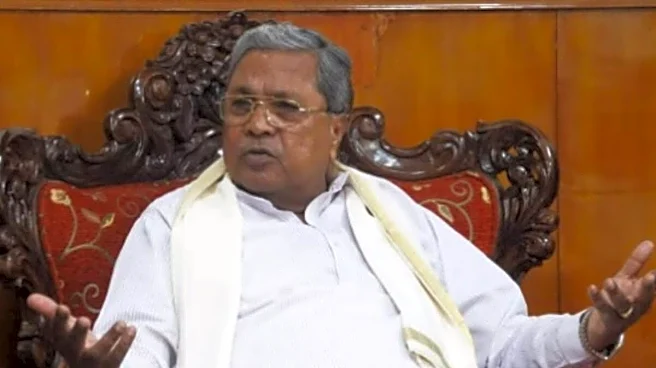


Former Karnataka Chief Minister Siddaramaiah has once again underlined his AHINDA politics, calling for reservation to be increased to at least 75 per cent based on the findings of the caste census. Addressing an OBC convention, Siddaramaiah said he was confident that Chief Minister DK Shivakumar, the Congress government and party leaders would listen to his views.
“I have faith that the ministers here, our party and the Chief Minister will listen to me. You all must get justice. You should get at least 75 per cent reservation,” Siddaramaiah said.
He argued that reservation must be linked to the population of different communities and said this was essential for creating an egalitarian society. “Only when reservation is given according to the numbers
of each caste can we build an egalitarian society,” he said.
Siddaramaiah also said adequate political representation was necessary for communities to gain political power, pointing to the need for reservation in the Lok Sabha and state Assemblies.
The former Chief Minister also sought to put an end to speculation that his decision to retire from electoral politics meant he was stepping away from public life. “I will remain in active politics. I am only retiring from electoral politics,” Siddaramaiah said.
Explaining his decision, he said elections had become increasingly expensive and that the electoral system needed reforms.
“I am not saying I will stop contesting elections because I have grown old. But the electoral system has deteriorated. Elections have become very expensive. That is why I have spoken about retirement,” he said.
Siddaramaiah assured his supporters that he would continue to remain politically active and fight for social equality. “Until the caste system is removed from society, I will remain with you and continue the struggle. None of you need to worry,” he said.
His remarks came as supporters at the convention raised slogans and displayed posters urging him to contest the next election.
Deputy Chief Minister G Parameshwara, meanwhile, strongly backed Siddaramaiah’s political legacy, crediting him with giving a new direction to AHINDA politics.
“Siddaramaiah created a new thought. He gave a new identity to AHINDA,” Parameshwara said, adding that the movement was aimed at giving social and economic strength to communities whose voices had remained unheard.
“AHINDA has not worked only for his politics; it has successfully worked for the politics of all of us,” he said.
Parameshwara described Siddaramaiah’s politics as one of struggle and social justice, saying he had followed the principles of Basavanna and imbibed the ideals of BR Ambedkar.
He also defended the Congress government’s guarantee schemes, arguing that they had benefited poorer sections and were aimed at addressing economic inequality.
“There are effectively two Indias – one for the landlords and moneylenders and another for the poor and farmers. Ambedkar did not agree with creating two Indias. He fought for one India,” Parameshwara said.
He claimed that guarantee schemes were now being replicated across the country despite earlier criticism, saying the model had gained wider acceptance.
With Siddaramaiah’s renewed push for 75 per cent reservation and his assertion that he will remain active in politics, the OBC convention has sent a strong political message on the continued relevance of his AHINDA agenda within the Congress.