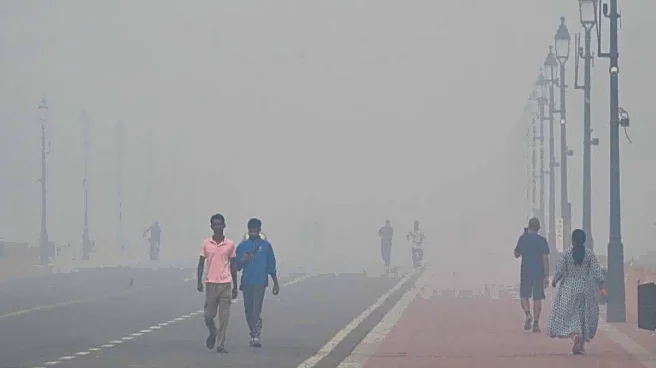



Delhi residents faced another difficult day as dense smog and fog covered large parts of the national capital, reducing visibility and raising health concerns. Visuals on Wednesday morning from areas such as Anand Vihar and ITO showed a thick layer of toxic smog hanging over roads, buildings and traffic corridors. Even prominent landmarks like the Akshardham Temple were only faintly visible through the haze.
AQI remains in ‘very poor’ category
According to data from the Central Pollution Control Board (CPCB), the Air Quality Index (AQI) in Anand Vihar stood at 341, while readings around the ITO area touched 360. Both figures fall in the ‘very poor’ category. Although pollution levels improved slightly on Tuesday due to stronger winds and thinning fog, the air quality remained unsafe,
especially for children, the elderly and people with breathing problems.
GRAP stage-IV measures enforced
In response to the continuing pollution, the Commission for Air Quality Management (CAQM) has invoked all actions under Stage-IV of the Graded Response Action Plan (GRAP) across Delhi-NCR. These emergency measures are enforced when air quality reaches critical levels and include strict restrictions on construction activities, industrial operations and the movement of certain vehicles.
Flights and traffic affected by fog
The worsening weather conditions also affected travel. IndiGo issued a travel advisory on Tuesday night, warning passengers of reduced visibility and slower flight movements on Wednesday morning.
The airline said fog across North and East India could lead to delays or changes in flight schedules. It also cautioned that road traffic may move slowly, advising passengers to plan with extra time and check flight updates before leaving home.
#WATCH | Delhi | Visuals around Anand Vihar area as a thick layer of toxic smog engulfs the national capital.
AQI (Air Quality Index) around the area is 341, categorised as 'Very poor', as claimed by CPCB (Central Pollution Control Board).
CAQM (Commission for Air Quality… pic.twitter.com/WCp82nL8mJ
#WATCH | Delhi | Visuals around Anand Vihar area as a thick layer of toxic smog engulfs the national capital.
— ANI (@ANI) December 17, 2025
AQI (Air Quality Index) around the area is 341, categorised as 'Very poor', as claimed by CPCB (Central Pollution Control Board).
CAQM (Commission for Air Quality… pic.twitter.com/WCp82nL8mJ
Delhi government announces fresh curbs
The Rekha Gupta-led Delhi government announced stricter steps to tackle rising pollution. Vehicles without a valid Pollution Under Control (PUC) certificate will no longer be allowed to buy petrol or diesel. Only BS VI-compliant vehicles will be permitted to operate within the city, while older vehicles will face restrictions. On Tuesday, Delhi’s AQI stood at 377, an improvement from 498 recorded a day earlier, but still well within the danger zone.
Punjab CM reacts to Delhi pollution
Punjab Chief Minister Bhagwant Mann weighed in on the issue, rejecting claims that pollution from Punjab was responsible for Delhi’s air crisis. In a video message, he said no smoke was coming from Punjab and urged authorities to acknowledge that Delhi’s pollution has local causes.
Despite minor improvement, Delhi continues to battle hazardous air, with authorities urging caution and compliance with pollution control measures.



/images/ppid_a911dc6a-image-177107062796921011.webp)




/images/ppid_a911dc6a-image-17710700586131340.webp)


/images/ppid_a911dc6a-image-177107002875928030.webp)
/images/ppid_a911dc6a-image-177107008754197673.webp)