
/images/ppid_a911dc6a-image-177881869827450930.webp)
There are award shows, and then there is the absolute glitter-fuelled chaos called the Eurovision Song Contest… a place where pop music, drama, politics, sequins and giant wind machines somehow exist together in perfect harmony. And this year, one song managed to completely take over the night.
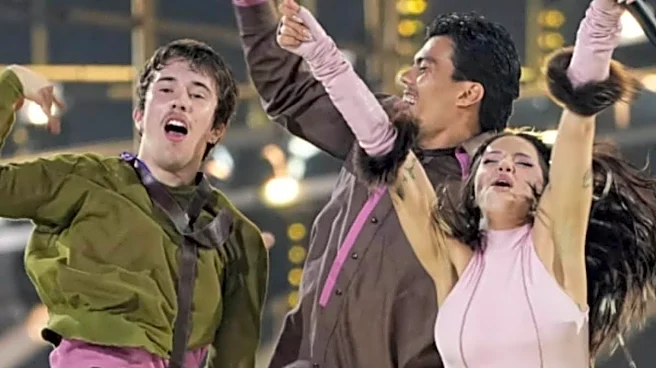
Dara from Bulgaria emerged as the winner of the 70th Eurovision Song Contest on Saturday with her high-energy party anthem Bangaranga, giving the country its first-ever Eurovision victory.
Held in Vienna, the grand finale saw Dara beat 24 other contestants in one of the world’s most colourful and unpredictable music competitions. Her performance, packed with infectious beats and sharp choreography, connected strongly with both international juries and public
voters.
And honestly, “Bangaranga” sounds exactly like the kind of song Eurovision audiences love — loud, dramatic and impossible to forget.
The track includes the catchy line: “Surrender to the blinding lights. No one’s gonna sleep tonight. Welcome to the riot.”
Speaking at a post-show press conference early Sunday, Dara reacted emotionally to the win and said, “This is unbelievable. I don’t even know what’s going on.”
She also thanked “everyone who felt the bangaranga and felt connected to the force.”
The 27-year-old artist was already known in Bulgaria before Eurovision, though she was not considered among the top favourites heading into the competition. Over the past few months, Dara has spoken openly about her struggles with anxiety and explained that “Bangaranga” represents an inner force that helps people stop “chasing perfection.”
The singer has also said the performance was inspired by Bulgaria’s kukeri tradition, where elaborately dressed performers dance in ritual celebrations believed to drive away evil spirits.
Coming in second place this year was Noam Bettan from Israel. Romania’s Alexandra Căpitănescu secured third place with the rock track “Choke Me,” while Australian artist Delta Goodrem finished fourth with the ballad “Eclipse.”
Italian singer Sal Da Vinci claimed fifth place with “Per Sempre Si,” while Finnish duo Pete Parkkonen and Linda Lampenius, who had been major betting favourites, eventually landed in sixth place.
Eurovision historian Dean Vuletic noted that unexpected winners are part of the contest’s magic.
“Eurovision has never really been a contest for big stars,” Vuletic said. “People like to see the underdog on stage. They like to the artist-in-the-making on stage or an artist from a smaller, poorer country on stage.”
As always, Eurovision delivered a wildly eclectic mix of performances. Acts ranged from Serbian metal band Kravina to Moldovan folk rap and techno-pop performances from across Europe. Female soloists dominated much of the night, with artists from Germany, Poland, Ukraine, Sweden and France all bringing dramatically different musical styles to the stage.
Meanwhile, British act Look Mum No Computer finished last with novelty track “Eins, Zwei, Drei,” receiving only one point.
Under Eurovision’s voting system, Bulgaria finished with 516 points while Israel received 343.
But alongside the music and spectacle, politics once again became impossible to separate from Eurovision this year.
The contest faced controversy over Israel’s participation amid ongoing conflicts in Gaza and elsewhere. Several longtime Eurovision participants — including Spain, the Netherlands, Ireland, Iceland and Slovenia — boycotted the event in protest.
Protests were also held outside the venue before the final. Hundreds of demonstrators marched near the arena carrying signs reading “Block Eurovision,” while pro-Palestinian groups organised a separate concert under the banner “No stage for genocide.”
Congolese-Austrian artist Patrick Bongola, one of the organisers, said, “Inviting Israel on such a beautiful stage as the Eurovision Song Contest stage is an affront to all the people who believe in humanity, who believe in love and togetherness.”
Reports also noted that four people were removed earlier in the week after allegedly attempting to disrupt Bettan’s semifinal performance.
Despite the political tensions and boycott concerns affecting finances and viewership, Eurovision organisers are already looking ahead. A new spinoff event, Eurovision Song Contest Asia, is scheduled to take place in Bangkok later this year.
And if Eurovision has proved anything after 70 years, it’s that the contest will always remain gloriously dramatic, unpredictable and impossible to ignore.





/images/ppid_59c68470-image-17788125652524960.webp)



/images/ppid_a911dc6a-image-177883167063010840.webp)

/images/ppid_a911dc6a-image-177878486877044322.webp)