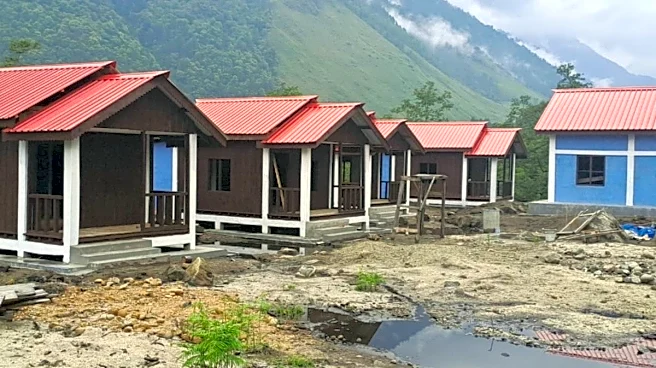




India’s resolve to transform itself into a developed nation by the year 2047, coinciding with the centenary of independence, is articulated through the national vision of Viksit Bharat 2047. This vision represents a comprehensive and forward-looking development framework that seeks to harmonise economic growth with social justice, territorial integrity, environmental sustainability, and good governance. Central to this aspiration is the recognition that development must be inclusive and spatially balanced. In this context, the Vibrant Village Programme assumes critical importance as a flagship initiative of the Government of India aimed at revitalising border villages and integrating them into the mainstream of national development.
Border villages
have historically remained on the margins of India’s development trajectory due to geographical remoteness, difficult terrain, harsh climatic conditions, and limited administrative reach. These structural disadvantages resulted in inadequate infrastructure, restricted access to education and healthcare, and a lack of sustainable livelihood opportunities. Over time, such conditions contributed to migration and demographic decline, weakening both social cohesion and strategic presence in border areas. Recognising these multidimensional challenges, the Government of India conceptualised the Vibrant Village Programme as a targeted and corrective intervention rooted in the principles of inclusive governance and national integration.
The programme reflects an important shift in the state’s development philosophy. Border villages are no longer viewed merely as remote or vulnerable settlements but as strategically vital spaces and symbols of India’s territorial and cultural identity. This reorientation secures a social order based on justice, equality, and opportunity. By prioritising the development of border villages, the government reinforces its commitment to balanced regional growth, a long-standing objective of India’s planning process.
The Vibrant Village Programme is designed to strengthen physical, digital, and social infrastructure in border areas through coordinated administrative action. Investments in roads, housing, electricity, drinking water, and telecommunications reduce isolation and improve access to essential services. Enhanced digital connectivity enables the delivery of e-governance services, telemedicine, and online education, thereby bridging the digital divide between urban and rural India. Such initiatives are consistent with the objectives of Digital India and reflect the state’s evolving approach to citizen-centric governance.
Livelihood generation forms a core pillar of the programme and resonates with the broader goal of self-reliance under the Atmanirbhar Bharat framework. The promotion of agriculture, animal husbandry, horticulture, handicrafts, and border-specific tourism creates locally grounded economic opportunities. Skill development initiatives enhance employability while respecting local ecological and cultural contexts. By enabling residents to sustain themselves economically within their native regions, the programme addresses distress-driven migration and strengthens the social fabric of border communities.
The programme requires effective coordination among multiple ministries, state governments, and district administrations, highlighting the importance of institutional capacity and administrative competence. This reflects the shift toward outcome-based governance and cooperative federalism, wherein the Centre and states work collaboratively to achieve shared developmental objectives.
From the perspective of internal security and border management, the Vibrant Village Programme represents a holistic and human-centric approach. A stable and prosperous civilian population in border areas enhances vigilance and fosters cooperation between local communities and security forces. This approach complements traditional security measures by recognising development as a force multiplier for national security. Such integration of development and security thinking is consistent with India’s broader strategic culture and reflects mature statecraft.
The alignment of the programme with the vision of Viksit Bharat 2047 is evident in its emphasis on inclusivity and sustainability. A developed nation, as envisioned by the Government of India, is one in which growth is equitable and environmentally responsible. Many border villages are located in ecologically sensitive regions, including the Himalayan belt and arid landscapes. The programme promotes climate-resilient infrastructure, renewable energy, and sustainable livelihoods, thereby aligning development goals with India’s commitments under global climate frameworks and national environmental policies.
Cultural preservation and community participation are integral to the Vibrant Village Programme. Border regions often possess distinct languages, traditions, and knowledge systems that contribute to India’s pluralistic heritage. The programme adopts a participatory development model that respects local identities and encourages community involvement in decision-making. By promoting cultural tourism, traditional crafts, and homestays, the government transforms cultural assets into economic opportunities while strengthening social cohesion and national integration.
The empowerment of women and youth occupies a central place in the programme and reflects the government’s emphasis on women-led development and demographic dividend. Women’s participation through self-help groups, entrepreneurship initiatives, and skill training enhances household incomes and social status. Youth, provided with access to education, digital resources, and employment opportunities, are more likely to remain engaged in their local economies. This not only reduces migration but also ensures the intergenerational sustainability of development efforts.
Despite its strong conceptual foundation, the Vibrant Village Programme faces implementation challenges arising from difficult terrain, climatic constraints, and logistical complexities. Ensuring effective coordination among stakeholders and maintaining the pace of execution requires sustained administrative effort. However, the Government of India has demonstrated its capacity to adapt policies, leverage technology, and strengthen bureaucratic capabilities through continuous monitoring and feedback mechanisms. Such adaptive governance is essential for achieving long-term developmental outcomes.
The Vibrant Villages Programme reflects a fundamental rethinking of India’s border development philosophy, rooted in the understanding that secure borders begin with thriving communities. By recognising northern border villages as the nation’s first line of defence, the programme places national security at the heart of development, ensuring that these areas are neither neglected nor vulnerable to external influence. It also serves as a calibrated response to China’s construction of “Xiaokang” villages with dual civilian–military purposes near the Line of Actual Control, reinforcing India’s strategic presence through civilian empowerment.
Equally important is the programme’s focus on preventing outmigration by creating sustainable livelihoods, modern infrastructure, and basic amenities that encourage residents to remain rooted in their homeland. In line with the Prime Minister’s vision of transforming India’s “last villages” into its “first villages,” the initiative reimagines border settlements as dynamic hubs of opportunity rather than distant margins. Through an integrated approach encompassing roads, digital connectivity, housing, energy, healthcare, education, tourism, and welfare delivery, the Vibrant Villages Programme seeks to combine development with defence, turning border regions into resilient, prosperous, and strategically vital spaces for the nation’s future.
The Vibrant Villages Programme, aligned with the broader vision of Viksit Bharat, represents a comprehensive reimagining of India’s borderlands as spaces where development and security reinforce one another. Central to this effort is the active role played by the Indian Army and the Border Guarding Forces, whose long-standing presence, logistical capabilities, and deep familiarity with difficult terrain have been instrumental in enabling development in remote frontier areas. Beyond their primary security responsibilities, these forces assist in infrastructure creation, connectivity projects, medical outreach, disaster response, and the delivery of essential services, often serving as the first link between the state and border communities.
Their engagement helps build trust, ensures uninterrupted governance, and strengthens civilian resilience along sensitive borders. By combining the efforts of civil administration with the support of the armed forces, the programme addresses national security concerns, counters external strategic challenges, discourages outmigration, and advances the Prime Minister’s vision of transforming India’s “last villages” into its “first villages.” Through integrated development spanning roads, digital access, housing, energy, health, education, tourism, and welfare delivery, Vibrant Villages emerges as a model where human security, territorial integrity, and inclusive growth converge to shape a stronger and more self-reliant India.
In conclusion, the Vibrant Village Programme represents a decisive and well-calibrated policy initiative that embodies the Government of India’s commitment to inclusive, strategic, and sustainable development. By focusing on border villages, the programme advances constitutional values, strengthens national security, and promotes socio-economic equity. It demonstrates how visionary policymaking can translate national aspirations into grassroots realities.
As India progresses toward the goal of Viksit Bharat 2047, vibrant and self-reliant villages will form the foundation of a resilient and integrated nation. They will stand as evidence that true development is not confined to urban centres but is realised when governance reaches the most distant citizens. In this sense, the Vibrant Village Programme is not merely a development scheme but a vital instrument in India’s journey toward becoming an inclusive, confident, and fully developed republic.
Martand Jha is a Senior Research Fellow at JNU, a visiting faculty member at the Indian Institute of Mass Communication (IIMC), and often writes on strategic issues concerning India’s foreign policy, space programs (like Gaganyaan), and global geopolitics. Minga Sherpa is an IAS officer and currently serving as Deputy Commissioner, Udhampur. Views expressed in the above piece are personal and solely that of the authors. They do not necessarily reflect News18’s views.




/images/ppid_a911dc6a-image-177696497499729480.webp)

/images/ppid_a911dc6a-image-177695963162498605.webp)
/images/ppid_a911dc6a-image-177694406182151434.webp)