
/images/ppid_a911dc6a-image-177547247010740457.webp)

Saudi Arabia’s critical East-West oil pipeline, which bypasses the Strait of Hormuz, has reportedly been damaged in an Iranian attack.
According to Reuters, the oil pipeline is specifically designed to safeguard global energy supplies from maritime blockades, such as the one in the Hormuz strait amid the West Asia conflict.
The report said this has sparked fears that the global energy crisis may worsen as millions of barrels of crude are potentially removed from the market. An industry source told
Reuters that the pipeline was hit alongside several other facilities within Saudi Arabia.The Islamic Revolutionary Guard Corps (IRGC) issued a statement on Wednesday claiming responsibility for the attack. It used a combination of missiles and drones
to strike various targets across the Persian Gulf. Oil facilities belonging to American companies in Yanbu were also targeted, it added.
This infrastructure serves as Saudi’s only remaining outlet for crude exports following the closure of Hormuz by Iran’s Revolutionary Guards. The East-West pipeline was engineered to divert roughly 7 million barrels per day (bpd) from the kingdom’s eastern oil heartlands to the Red Sea port of Yanbu.
Reuters reported that this strategic bypass was intended to ensure that exports could continue even if the Arabian Gulf were blockaded. But damage to the Yanbu export hub now threatens this vital flow. Recent shipping data shows that Yanbu loadings had been averaging a near-capacity 4.6 million bpd in the week beginning March 23.
Authorities are assessing the damage, but experts said the disruption to these flows will have profound consequences for global market stability. With Saudi Aramco requiring 2 million bpd for domestic use, the remaining 5 million bpd designated for export is now in jeopardy.
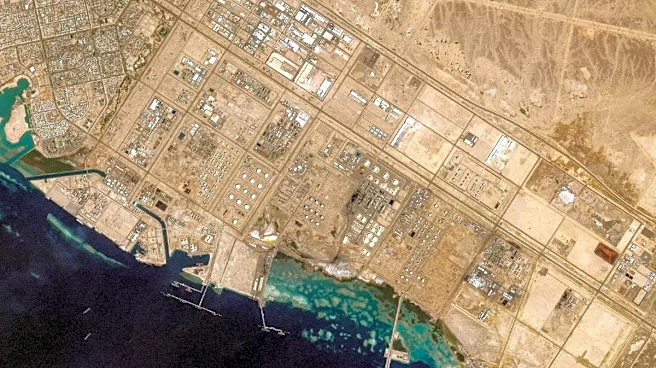
This is not the first time Iran has targeted oil infrastructure near Yanbu during the ongoing conflict. Last month, a drone crashed into the Samref refinery in the industrial zone in the port.
WHAT IS THE EAST-WEST OIL PIPLELINE?
Potentially the “last tap” amid the global energy crisis due to the Iran war and a blocked Strait of Hormuz, Saudi Arabia’s crucial East-West oil pipeline – also called Petroline – is a single, 1,200-km stretch of steel pipes buried beneath the scorching sands of the Arabian Peninsula.
It has transitioned from a strategic backup into the world’s most critical “release valve” for energy. Spanning from the oil-rich eastern province to the Red Sea port of Yanbu, it is presently the primary land-based outlet for Saudi crude.
The Petroline connects the massive oil-producing fields near Abqaiq in the east to Yanbu on the western coast. Originally conceived during the Iran-Iraq War in the 1980s, it was designed specifically as a “bypass strategy” to ensure Saudi Arabia could continue exporting oil even if the Persian Gulf’s main maritime chokepoints were compromised.
The system comprises two primary pipes – 56-inch and 48-inch in diameter – supported by 11 high-capacity pumping stations that drive crude oil across the rugged Hijaz Mountains. Following aggressive expansion efforts and the conversion of parallel natural gas liquids lines to carry crude, its maximum capacity reached 7 million bpd earlier this year.
Last month, Amin Nasser, CEO of Saudi Aramco, said the pipeline will reach this full capacity “in the coming days” to offset the loss of Gulf traffic. As of April, it handles roughly 2 million bpd for domestic use at Red Sea refineries, with the remaining 5 million bpd funnelled directly into the international export market.
WHY IS THE PORT OF YANBU CRITICAL?
If the Petroline is the artery, Yanbu is the heart of Saudi Arabia’s “insurance policy” against regional instability. Situated on the Red Sea, it provides a direct gateway to global markets that avoids the world’s most dangerous maritime chokepoints.
Since the Strait of Hormuz was closed, Yanbu has seen a meteoric rise in activity. Last month, it reached a record export average of 3.3 million bpd – a staggering increase from its pre-crisis average of approximately 8,00,000 bpd.
Here’s all you need to know:
- Known as the “Hormuz-free” exit, Yanbu allows Saudi Arabia to entirely bypass the Persian Gulf, loading tankers in the Red Sea instead.
- The port is home to two of the world’s most advanced refineries, SAMREF (a joint venture with ExxonMobil) and YASREF (with China’s Sinopec). Together, they process nearly 1 million bpd into high-value products like gasoline and diesel.
- With a total capacity of roughly 37 million barrels, its storage tanks have allowed Saudi Arabia to “buffer” exports, tapping into 22 million barrels of stored oil to maintain steady delivery while pipeline flows were ramped up during the initial weeks of the Hormuz blockade.
WHAT HAPPENS IF EAST-WEST PIPELINE IS DAMAGED?
If the East-West oil pipeline, or Petroline, has been damaged in Iranian attacks, the “final door” for global oil will effectively close.
At present, Saudi Arabia has pushed the infrastructure to its absolute technical limit of 7 million bpd. The loss of this pipeline will see approximately 5 million bpd of global export capacity vanish instantly.
There is no alternative pipe, truck fleet, or railway capable of making up that volume. A “double blockade” scenario – where the Petroline is damaged and the southern Red Sea exit at Bab el-Mandeb is targeted – will leave Saudi oil “trapped” in the Red Sea with no way to reach Asian or European markets.
WHAT WILL HAPPEN TO GLOBAL SUPPLIES?
The world normally relies on the Strait of Hormuz for 20 to 21 million bpd. With that route blocked, the Petroline has acted as a “ceiling” for oil prices.
Experts have warned that while the Hormuz blockade pushed Brent Crude toward USD 120 per barrel, damage to the Petroline will remove the last remaining buffer. They said if the Petroline is compromised, Brent Crude will immediately spike toward USD 180 to USD 200 per barrel, likely triggering “stagflation” – a combination of high inflation and zero growth – in major economies including the UK, US, China, and India. The crisis will extend beyond crude oil to a “distillate crunch”, as the refineries in Yanbu will lose their supply, ending the production of millions of gallons of diesel and jet fuel daily.
This will lead to a near-instant doubling of global shipping and fuel costs, transforming the current energy crisis into a full-scale global economic depression.
/images/ppid_a911dc6a-image-177563623418111594.webp)

/images/ppid_59c68470-image-177563002819132492.webp)

/images/ppid_59c68470-image-177565503836489392.webp)

/images/ppid_a911dc6a-image-177565963496494207.webp)